Matter-Antimatter Mystery: CERN Unlocks Secrets of Universe’s Imbalance
Scientists at CERN are producing and studying antimatter to solve the cosmic mystery of why the universe is dominated by matter. This elusive substance, created in a specialized factory, could reveal the fundamental imbalance that allowed matter to prevail over antimatter in the early universe.

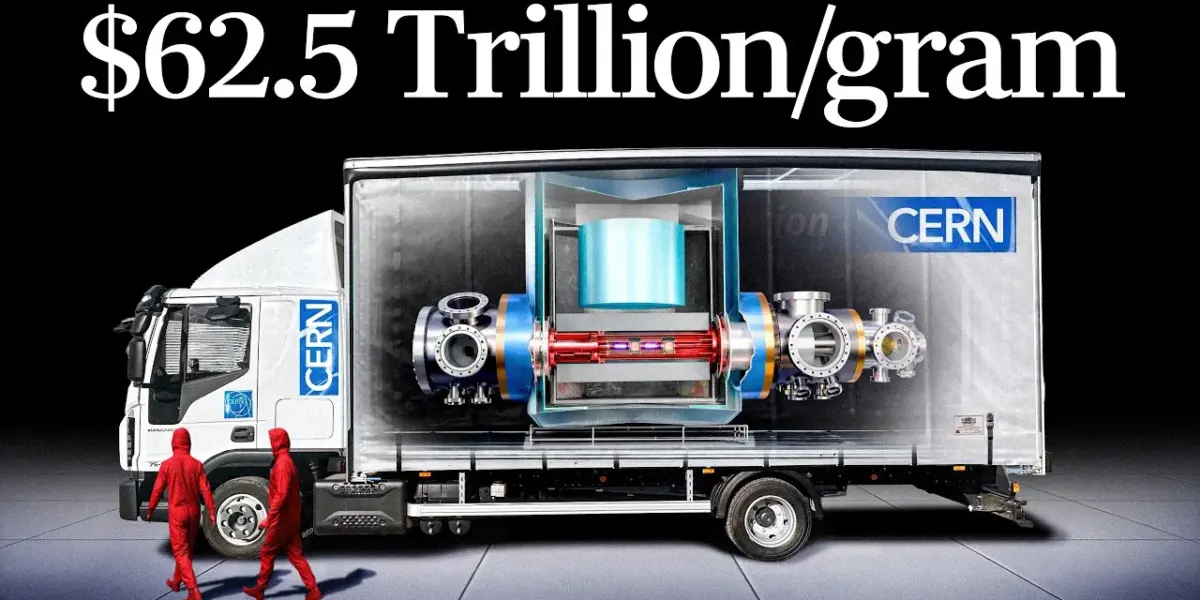
CERN’s Antimatter Factory Probes Universe’s Deepest Puzzle
In a realm where science fiction meets reality, scientists at CERN, the European Organization for Nuclear Research, are actively producing and studying antimatter. This elusive substance, known for its dramatic annihilation upon contact with ordinary matter, holds the key to one of physics’ most profound questions: Why is the universe made almost entirely of matter, with virtually no antimatter? CERN’s dedicated antimatter factory is at the forefront of this quest, pushing the boundaries of our understanding.
The Explosive Power of Antimatter
Antimatter is the mirror image of ordinary matter. For every particle of matter, there exists an antiparticle with the same mass but opposite electric charge. When a particle and its antiparticle meet, they annihilate each other, converting their entire mass into pure energy, as described by Einstein’s famous equation E=mc². This process is the most violent and efficient energy conversion known to physics, making antimatter both fascinating and incredibly dangerous to handle.
From Theory to Tangible Substance: Creating Antimatter
The concept of antimatter was first proposed by physicist Paul Dirac in 1928. His groundbreaking equation, which unified quantum mechanics and special relativity, predicted the existence of antiparticles. He suggested that the equation’s solution, which allowed for negative energy, could represent a new particle with the same mass as an electron but a positive charge—an anti-electron, later named the positron. Astonishingly, the positron was discovered experimentally just a year later.
Today, CERN is a leading producer of antimatter. At its antimatter factory, protons are accelerated to nearly the speed of light—up to 99.93%—and then smashed into a target made of iridium. This high-energy collision generates approximately 20 million antiprotons every minute. These antiprotons are then carefully collected, slowed down, and stored.
The Immense Challenge of Storage
Storing antimatter is an extraordinary feat. Since antimatter annihilates on contact with matter, it must be held in a vacuum using powerful magnetic fields. These fields create a ‘magnetic bottle’ that keeps the antimatter contained without touching the walls of its container. Even a minuscule amount of antimatter is incredibly expensive to produce, with estimates placing its cost at billions of dollars per gram.
CERN’s journey to effectively store antimatter has been a long one. In 1995, scientists successfully created the first anti-hydrogen atoms. However, these early anti-atoms existed for only about 40 billionths of a second before annihilating. This fleeting existence was far too short for meaningful study. Years of dedicated research and technological advancements, particularly with the installation of the ELENA (Extra Low ENergy Antiproton) ring, have allowed scientists to significantly slow down antiprotons, making them stable enough for experiments.
The Cosmic Imbalance: The Matter-Antimatter Mystery
The very existence of the universe as we know it hinges on a fundamental imbalance. According to the Big Bang theory, in the universe’s earliest moments, energy converted into equal amounts of matter and antimatter. As the universe expanded and cooled, these particles should have met and annihilated, leaving behind only radiation. However, observations clearly show that matter vastly predominates over antimatter.
This asymmetry is one of the greatest unsolved mysteries in physics. If matter and antimatter were created in perfectly equal amounts, our universe should be devoid of stars, galaxies, and life itself. The fact that we exist implies that there was a slight excess of matter in the early universe. Current estimates suggest that for every billion pairs of matter-antimatter particles that annihilated, only one matter particle was left over to form the universe we see today.
Searching for Answers in Symmetries
Physicists have explored various symmetries—fundamental properties that describe how physical laws remain unchanged under certain transformations—to understand this imbalance. These include Charge (C) symmetry (swapping matter with antimatter), Parity (P) symmetry (mirror reflection), and Time reversal (T) symmetry (running time backward). The combination of these, CPT symmetry, is believed to be a fundamental law of physics.
A crucial turning point came in the 1950s when experiments revealed that parity (P) symmetry was violated in weak nuclear interactions. This discovery, notably by Chien-Shiung Wu, showed that the universe does indeed distinguish between ‘left’ and ‘right’ in certain processes. Later, it was found that Charge-Parity (CP) symmetry was also violated. These violations are essential for explaining the matter-antimatter asymmetry, but the Standard Model of particle physics, our current best description of fundamental particles and forces, only accounts for a tiny fraction of the observed imbalance.
CERN’s Role in the Future of Physics
The discrepancy between the predicted asymmetry and the observed reality strongly suggests that there is ‘new physics’ beyond the Standard Model waiting to be discovered. By producing and trapping antimatter, CERN provides a unique laboratory to test its properties with unprecedented precision. Scientists are looking for even the slightest differences between matter and antimatter that could explain why matter won out.
Experiments at CERN aim to compare the properties of anti-atoms with their matter counterparts, looking for deviations from expected symmetries. If even a tiny asymmetry in their behavior can be found, it could finally unlock the secret of why our universe is built from matter and not antimatter. This research is not just about understanding the past; it’s about understanding the fundamental nature of reality and our place within it.
Source: Why It's Almost Impossible To Ship Antimatter (YouTube)

Related Articles


Antimatter Meteor Threat: Could Space Rocks Annihilate Earth?
Could rare meteors made of antimatter pose an existential threat to Earth? While theoretically possible, the harsh conditions of space make it highly unlikely for such objects to survive long enough to reach our planet. Antimatter's annihilation with regular matter releases immense energy, but its rarity and the vastness of space offer us protection.


Higgs Boson Unlocks Door to Dark Universe
The Higgs boson, discovered at the LHC in 2012, is now theorized to be a 'portal' to a hidden 'dark sector' of particles. Upgrades to the Large Hadron Collider aim to detect these invisible particles, potentially solving the mystery of dark matter.


Dirac’s Equation: The Accidental Discovery of Antimatter
In 1928, Paul Dirac's relativistic electron equation unexpectedly predicted the existence of antimatter. Initially met with skepticism, the discovery of the positron in 1932 confirmed this groundbreaking concept, revolutionizing our understanding of the universe.