Market Tumbles as Tech Stocks Face AI Disruption Fears
The stock market experienced a significant downturn, with tech stocks leading the decline as fears surrounding AI's disruptive potential intensified. Critical support levels were breached, while the commercial real estate sector faced escalating loan defaults. A late-day rebound offered some recovery, but underlying concerns remain.

Market Tumbles as Tech Stocks Face AI Disruption Fears
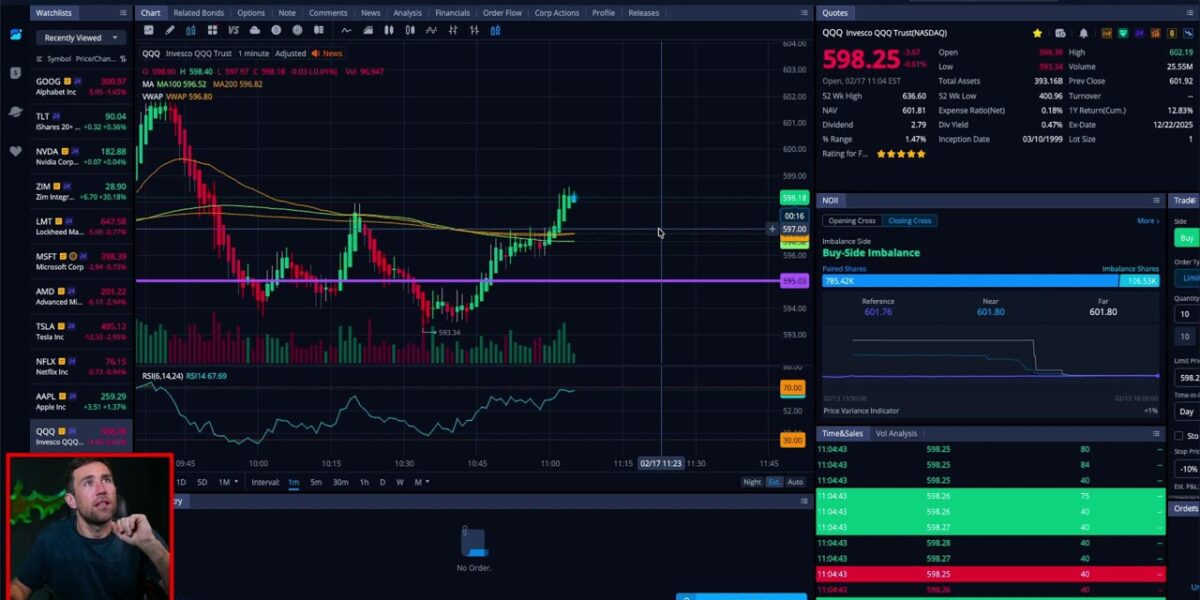
The stock market experienced a significant downturn, particularly impacting technology shares, as investors grappled with escalating concerns over the disruptive potential of artificial intelligence (AI) and broader economic uncertainties. The Nasdaq Composite, represented by the Qs ETF, briefly dipped below a critical 595 level, a threshold that has historically provided support. This decline signals a broader market rotation, affecting even previously dominant sectors like artificial intelligence.
Key Market Movements and Sector Rotations
The trading session saw widespread selling pressure. Major technology companies experienced notable declines: Microsoft was trading below $400, and Netflix was down to $75. Advanced Micro Devices (AMD) saw a significant intraday drop of 5%, falling below $200. Tesla also faced pressure, nearing the $400 mark after losing $414. Open Door was approaching $420. Even tech giants like Google experienced a substantial pullback, down approximately 15% to around $297-$298.
The decline in the Qs ETF below 595 is particularly noteworthy. This level had been a significant support area, last breached for extended periods in November, and generally held since September 2025. Its current struggle to maintain this level is seen as a bearish indicator.
AI’s Double-Edged Sword: Disruption and Investment
A primary driver of market anxiety appears to be the accelerating narrative around AI. Management calls increasingly mention AI disruption, with mentions nearly doubling compared to the previous quarter. While the long-term potential of AI to revolutionize industries is widely acknowledged, the short-term implications for existing business models are causing significant investor apprehension. There is a dual sentiment: one that AI will dramatically disrupt entire economic segments, leading to the dumping of stocks at risk, and another of deep skepticism regarding the massive investments being poured into AI without clear, immediate profitability for many companies.
This has led to a sharp rotation. While semiconductor stocks have soared due to increased computing demand driven by AI, software stocks have faced significant selling pressure. An ETF tracking the software index was down 22%. Some analysts express a grim outlook, suggesting that sophisticated AI tools could replicate and modify existing software, creating greater competition from clients developing internal tools and from AI startups. This perspective posits that many software firms face an existential threat, with only a select few expected to survive the shakeout, drawing parallels to the newspaper industry’s decline in the 2000s.
Commercial Real Estate Woes Deepen
Adding to market concerns is the escalating crisis in the commercial real estate (CRE) sector. Lenders are beginning to call in tens of billions of dollars in troubled loans as refinancing property debt has become increasingly difficult amid higher interest rates. The ‘extend and pretend’ strategy, where lenders initially deferred loan maturities hoping for market improvement, is now giving way to defaults.
The delinquency rate for office loans within Commercial Mortgage-Backed Securities (CMBS) surged to a record 12.34% in January, the highest level since tracking began in 2000. This represents a significant increase from previous years, with hotels and industrial properties showing more stability. More alarmingly, over half of the approximately $100 billion in CRE loans packaged as securities that are maturing this year are unlikely to be repaid at maturity. This compares starkly to payoff rates of around 75% in 2024 and over 80% in 2023. Many lenders are now opting for foreclosure or liquidation rather than extending further, signaling a potential wave of ‘creative destruction’ in the sector.
Inflationary Pressures Re-emerge
Despite previous hopes for a pricing break, companies are reportedly beginning a new round of price increases, some in the high single digits. This follows a period where many firms held prices steady during the holiday season. Increases in January for electronics, appliances, and durable goods appear stronger than normal. While some companies cite tariffs and high wages, others point to hefty health insurance costs. Online prices, according to the Adobe Index, posted their largest increase in a dozen years in January, driven by higher prices for computers, appliances, and furniture.
Corporate and Geopolitical Developments
In other news, SoftBank Group’s reported dissolution of its share stake in Nvidia, while based on prior information from November, could continue to fuel market fear. Bonds are showing signs of becoming a flight-to-safety asset. Warner Bros. Discovery has reportedly reopened talks with Paramount, though a deal with Netflix was previously preferred, despite Netflix’s poor performance post-announcement. Apple’s upcoming event, expected to feature new iPads and MacBooks, saw its stock rise about 1.5%. In China, intense competition among AI chatbot providers is leading to aggressive giveaways of cash and prizes, including humanoid robots and electric cars, signaling a potential commoditization of AI services.
Market Rebound and Investor Outlook
Towards the end of the trading session, a rebound began to take hold. The Qs ETF managed to regain the 595 level, and several previously declining stocks, including Nvidia and AMD, showed signs of turning green or recovering significant intraday losses. Microsoft was also showing signs of regaining the $400 level. This late-day recovery, however, does not erase the day’s significant declines and the underlying concerns that drove them.
Market Impact
The market’s reaction highlights investor sensitivity to technological disruption and macroeconomic headwinds. The sharp sell-off in tech, particularly software, underscores the perceived threat from AI. The ongoing issues in commercial real estate add another layer of systemic risk. The resurgence of inflationary pressures complicates the outlook for interest rates and corporate profitability.
What Investors Should Know
- AI Disruption: The narrative around AI’s impact on business models is shifting from potential to perceived immediate threat, leading to a significant rotation away from software and towards infrastructure and hardware related to AI.
- Commercial Real Estate Risk: The increasing defaults and lack of refinancing in CRE pose a risk to financial institutions and could have broader economic consequences.
- Inflationary Signals: Renewed price increases across various goods suggest that inflationary pressures may persist, influencing central bank policy.
- Market Volatility: The rapid intraday recovery indicates continued volatility and a potential tug-of-war between fears of disruption and the underlying strength of certain market segments.
While the late-day rebound offers some respite, the underlying concerns about AI’s disruptive capabilities, the stability of the commercial real estate market, and persistent inflation require close monitoring. Investors are advised to stay informed about these evolving dynamics.
Source: Stocks Dump (YouTube)

Related Articles


AI’s Economic Shift: Ownership is the New Wage
Artificial intelligence is projected to significantly reduce the economic value of human labor within a decade. Experts suggest that capital ownership, rather than wages, will become the primary means of wealth accumulation. Investors are urged to consider this shift in their long-term strategies.


Nvidia Earnings Signal AI Revolution’s Next Phase
Nvidia's latest earnings report reveals accelerating revenue growth and profitability, signaling a new phase in the AI revolution driven by sophisticated AI agents. The company's strong performance underscores the growing demand for computational power as AI transitions into a core digital infrastructure component.


Russia’s Hidden Debt Crisis: A Silent Drain on Citizens
Russia is reportedly accumulating significant debt through complex financial schemes, which critics argue are subtly draining resources from its citizens. The government's reliance on borrowing, coupled with inflation and rising interest rates, is placing a growing burden on ordinary Russians.