Mandela’s Legacy Under Fire: Terrorist Roots Emerge
A critical examination of Nelson Mandela's past reveals his leadership of the militant group Umkhonto we Sizwe and deep ties to communist ideology. This analysis questions the traditional hero narrative, highlighting the group's violent tactics, including 'necklacing,' and the subsequent challenges faced by post-apartheid South Africa.


Mandela’s Legacy Under Fire: Terrorist Roots Emerge
Nelson Mandela, often hailed as an international hero and the father of modern South Africa, is facing a new wave of scrutiny. A recent analysis of his past actions and affiliations challenges the widely accepted narrative of his role in ending apartheid. The focus is shifting from his statesman image to his involvement with militant groups and communist ideology, raising uncomfortable questions about his legacy and the nation’s subsequent development.
Challenging the Hero Narrative
The prevailing story of Nelson Mandela often portrays him as the sole architect of apartheid’s downfall, leading South Africa to a unified, prosperous future. However, a closer look at his history reveals a more complex and controversial figure. This analysis delves into Mandela’s leadership within Umkhonto we Sizwe (MK), the armed wing of the African National Congress (ANC), and his deep ties to the South African Communist Party (SACP).
The Militant Arm: Umkhonto we Sizwe
Mandela co-founded MK in 1961 with figures like Joe Slovo, a prominent SACP leader. MK, meaning ‘Spear of the Nation,’ operated as a guerrilla group. Its initial strategy involved acts of sabotage, targeting infrastructure like power stations, railway lines, and train stations. The aim was to destabilize the apartheid government.
However, the group’s methods evolved, and it began targeting civilians. Attacks included bombings in public spaces such as shopping centers, bars, and sports stadiums. Anti-tank mines were also laid in rural areas, posing a threat to farm workers and children. Mandela himself admitted to involvement in numerous acts of sabotage before his imprisonment in 1964.
Communist Ideology and International Ties
Mandela’s political beliefs were deeply rooted in communism. He was a member of the SACP’s central committee and received training in communist states like Libya, the Soviet Union, and China. His association with leaders like Fidel Castro and Muammar Gaddafi further highlights these connections. This ideological alignment, according to critics, shaped his approach to dismantling the existing system, prioritizing revolutionary change over gradual reform.
The Horrors of Necklacing
One of the most disturbing aspects brought to light is the practice of ‘necklacing,’ which became a brutal tool of terror within the townships. This involved placing a car tire filled with petrol around a victim’s neck and setting it alight, causing a horrific death by burning and molten rubber. While officially condemned by some ANC leaders, the practice was widely carried out by MK operatives.
Winnie Mandela, Nelson Mandela’s wife and a significant figure during his imprisonment, publicly endorsed this method in 1986, stating, “With our boxes of matches and our necklaces, we shall liberate this country.” Thousands are estimated to have died through necklacing. Victims included not only suspected collaborators with the apartheid regime but also members of rival anti-apartheid groups like the Inkatha Freedom Party (IFP), the Azanian People’s Organisation (AZAPO), and the United Democratic Front (UDF).
The violence was not confined to those perceived as enemies. Mob mentality, fueled by suspicion and xenophobia, led to brutal killings within black communities. People were targeted for perceived collaboration, for having certain accents, or even for being labeled a witch.
The Truth and Reconciliation Commission
Following the end of apartheid, the Truth and Reconciliation Commission (TRC) provided a platform for perpetrators from all sides to confess their crimes in exchange for amnesty. The TRC’s findings revealed the extent of the violence and torture, including necklacing and systematic abuse, carried out by groups like MK. While the commission aimed for a clean slate, it also exposed the dark side of the liberation struggle.
Apartheid’s End: International Pressure vs. Mandela’s Role
The narrative that Mandela single-handedly ended apartheid is also being questioned. Many argue that international pressure, including sanctions and diplomatic isolation, played a more significant role. By the time Mandela was released from prison in 1990, apartheid laws were already being dismantled, and South Africa was moving towards integration.
The speaker notes that by the age of nine or ten, apartheid was effectively no longer a functional system in their daily life, with integrated schools and black neighbors, even before Mandela officially took power. This suggests that the transition was already well underway due to external forces.
Post-Apartheid South Africa: Unfulfilled Promises
Despite the initial hope, the post-apartheid era has seen significant challenges. Critics point to widespread corruption, nepotism, and a failure to address deep-seated economic inequality. While a black middle class emerged, many argue that the promised redistribution of wealth, particularly through nationalization of mines and banks, did not materialize.
The result is a nation where poverty and unemployment have increased significantly for the black majority. White South Africans, meanwhile, face economic and social challenges, including race-based employment laws that make it difficult to secure jobs. The country’s infrastructure has also reportedly declined, contributing to a pervasive sense of insecurity and instability, with many citizens resorting to fortified homes.
A Complex Legacy
The analysis concludes that Nelson Mandela was a communist and a terrorist who led a violent organization responsible for horrific acts. While acknowledging that blaming one man for South Africa’s current struggles might be unfair, the speaker rejects the notion of Mandela as a pure savior. The legacy is seen as deeply flawed, tainted by his communist ideology and his leadership of a group that inflicted immense suffering.
The speaker, a South African, expresses a personal decision never to return to their birth country due to these ongoing issues. The core message is a rejection of communism, attributing the nation’s troubles to its influence and the actions of groups like the ANC and MK.
Source: You Were Lied to About Mandela (YouTube)

Related Articles


Shen Yun Revives Ancient China Amid Communist Suppression
Shen Yun Performing Arts has launched a new tour, aiming to revive 5,000 years of traditional Chinese culture suppressed by the Communist Party. The group's mission has garnered significant support from 70 New York state officials, highlighting a global interest in pre-communist Chinese heritage.

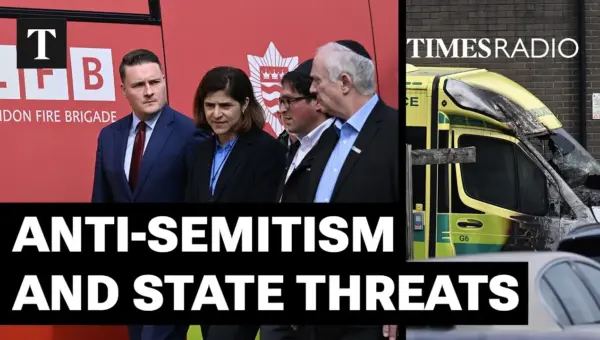
Iran Suspected of Using Petty Criminals for UK “State Threats”
The UK faces a growing threat from foreign states using petty criminals for sabotage, according to intelligence warnings. Iran is suspected of employing this tactic, potentially exploiting anti-Semitism to motivate attacks like the recent burning of Jewish ambulances. Authorities are grappling with distinguishing these state-backed acts from ordinary crime and terrorism.


Iran Linked To London Ambulance Arson Via Criminal Ties
A group with alleged ties to Iran has claimed responsibility for setting fire to Jewish charity ambulances in North London. Experts suggest Iran may be using unwitting criminals as "useful idiots" to carry out attacks and sow disruption. The incident highlights concerns over Iran's use of proxies and the targeting of Jewish communities.