Maddow Slams SCOTUS Birthright Citizenship Case
Rachel Maddow has strongly criticized the Trump administration's challenge to birthright citizenship, labeling it a "radical move against immigrants and the Constitution." The case, now before the Supreme Court, questions whether children born in the U.S. to non-citizen parents automatically receive citizenship under the 14th Amendment. This legal battle could redefine American citizenship.

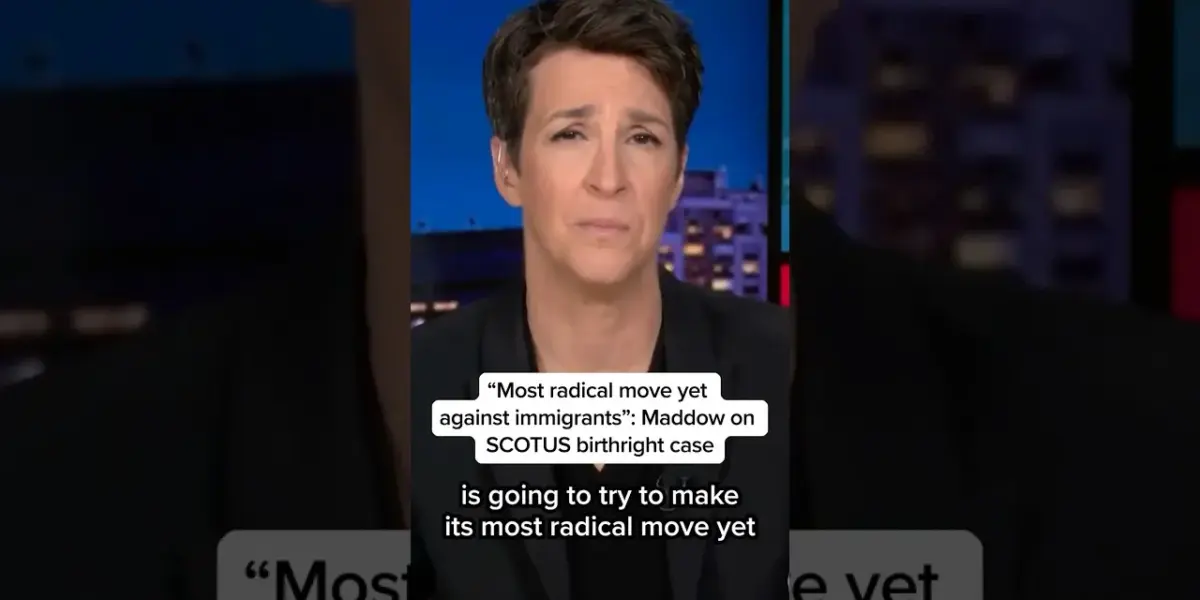
Maddow Criticizes Trump’s Birthright Citizenship Challenge
Rachel Maddow, a prominent MSNBC host, has strongly criticized the Trump administration’s efforts to challenge birthright citizenship, calling it the “most radical move yet against immigrants.” This challenge comes as the Supreme Court considers President Trump’s executive order that aimed to limit the constitutional right to citizenship for children born in the United States to non-citizen parents. Maddow’s commentary highlights the significant legal and social implications of this case.
Understanding Birthright Citizenship
Birthright citizenship, often referred to as jus soli (Latin for “right of the soil”), grants citizenship to nearly everyone born within a country’s borders. In the United States, this principle is rooted in the 14th Amendment of the Constitution, which states that “All persons born or naturalized in the United States, and subject to the jurisdiction thereof, are citizens of the United States and of the State wherein they reside.” This amendment was ratified after the Civil War to ensure citizenship for newly freed slaves.
The Trump administration’s executive order sought to reinterpret this amendment. It proposed that children born in the U.S. to parents who are not U.S. citizens, and who are not legally present in the country, would not automatically be granted citizenship. This move aimed to deter undocumented immigrants from coming to the U.S., as they would not be able to secure citizenship for their children born on American soil.
Maddow’s Concerns and Legal Arguments
Maddow expressed deep concern over the administration’s attempt to circumvent established constitutional law through an executive order. She argued that such a move is not only legally questionable but also a radical departure from American tradition. The core of her criticism lies in the belief that the 14th Amendment provides clear and broad protection for birthright citizenship.
The legal basis for challenging birthright citizenship often centers on the phrase “subject to the jurisdiction thereof” within the 14th Amendment. Opponents of birthright citizenship argue that it was not intended to apply to children of parents who are in the country unlawfully or without full legal status. However, legal scholars and civil rights advocates widely interpret this phrase to mean anyone physically present within U.S. territory, regardless of their immigration status.
“The Trump administration is going to try to make its most radical move yet against immigrants and against the Constitution in order to get at immigrants.”
Maddow echoed this sentiment, suggesting that the administration’s actions are an attempt to use executive power to rewrite constitutional interpretation. She emphasized that the Supreme Court’s involvement signifies the gravity of the issue, as it could set a precedent for how constitutional rights are applied in the future. The administration’s strategy, according to Maddow, is to bypass Congress and directly challenge established legal norms.
Broader Implications and Historical Context
The debate over birthright citizenship has significant implications for the United States. If birthright citizenship were to be curtailed, it could create a large population of stateless individuals or long-term residents without citizenship, potentially leading to social and economic instability. It could also impact the country’s identity as a nation built on immigration and the promise of opportunity.
Historically, the U.S. has largely upheld birthright citizenship, with legal challenges failing to overturn the 14th Amendment’s broad interpretation. The current case represents a renewed effort to challenge this long-standing principle. Maddow’s commentary frames this as a critical moment where the nation’s foundational legal principles are being tested.
What’s Next?
The Supreme Court’s decision on this matter will have far-reaching consequences. It will either reaffirm the broad interpretation of the 14th Amendment regarding birthright citizenship or open the door to significant changes in immigration and citizenship law. Observers will be watching closely to see how the court balances constitutional text, historical precedent, and the administration’s policy goals. The outcome could reshape the definition of American citizenship for generations to come.
Source: "Most radical move yet against immigrants": Maddow on SCOTUS birthright case (YouTube)

Related Articles

GOP Lawmaker Demands ‘Aggressive’ AG Replacement
GOP lawmakers are divided over border security funding as one representative calls for a more "aggressive" Attorney General. The debate over funding and the upcoming replacement for AG Pam Bondi highlight internal party struggles. Meanwhile, concerns about birthright citizenship and FEMA's low disaster fund add to the political landscape.


Iran’s Regime Faces Pressure as US Focuses Inward
The U.S. faces a dual challenge: navigating complex foreign policy in Iran while grappling with deep domestic political divisions. The administration's strategy towards Iran is under scrutiny, with questions about its clarity and effectiveness. Simultaneously, the Supreme Court is hearing a pivotal case on birthright citizenship, potentially reshaping constitutional law.


House Delays DHS Funding Vote, Faces Recess
The House of Representatives has delayed a critical vote to fund the Department of Homeland Security, pushing the decision past a two-week congressional recess. The Senate previously passed a funding bill that excludes some immigration enforcement measures, but the House has yet to take it up. This stalemate leaves DHS partially unfunded and highlights deep divisions within the Republican party.