Land Cruiser vs. GX: Toyota’s Off-Road Siblings Face Off
The Toyota Land Cruiser and Lexus GX share a platform but offer distinct experiences. The Land Cruiser prioritizes honest off-road capability with a hybrid powertrain, starting under $60,000. The more luxurious Lexus GX boasts a potent V6, advanced suspension, and a higher starting price of $67,000. Your choice depends on budget and desired refinement.

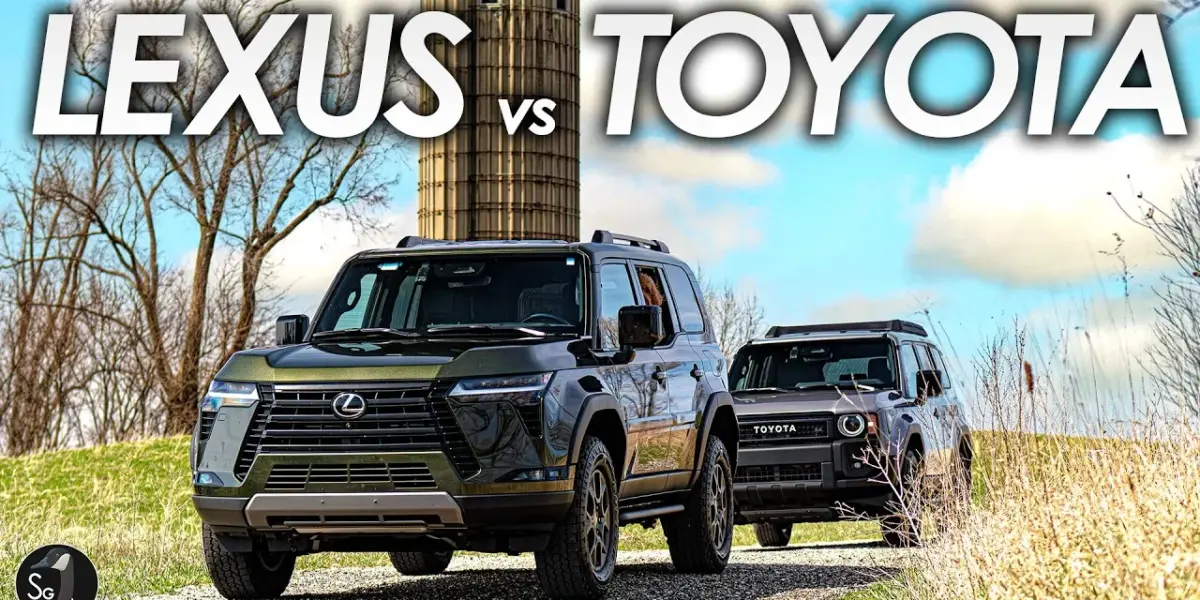
Land Cruiser vs. GX: Toyota’s Off-Road Siblings Face Off
Choosing between the Toyota Land Cruiser and the Lexus GX boils down to one major factor: your budget. While these two SUVs share a platform and many mechanical parts, their price tags and features create distinct personalities. We’ve spent significant time with both, covering over 25,000 miles in the Lexus GX alone. Let’s break down which one might be the right fit for you.
Pricing and Trims: Where the Gap Widens
The most significant difference is cost. The Toyota Land Cruiser starts under $60,000, with the base 1958 trim priced at $58,575. Higher trims, which add features like Multi-Terrain Select and a disconnecting sway bar, push the price into the mid-$60,000s, and can easily exceed $70,000 with added packages. The Lexus GX, on the other hand, begins at $67,000 for its base model. Moving up to the Overtrail or Luxury trims places you in the mid-$70,000s, with the top-tier Overtrail Plus and Luxury Plus models reaching into the mid-$80,000s.
A key decision point arises early: the GX forces you to choose. Opt for the off-road focused Overtrail trims, and you sacrifice the third-row seating. If you need that extra row for passengers, you’ll stick with the more city-oriented GX trims. This is a crucial factor that can immediately steer you toward either the Land Cruiser or the GX.
Interior and Practicality: Space and Materials Matter
Visually, the Land Cruiser and GX share many body panels, including the rear hatch, fenders, and doors. However, their front and rear fascias, along with lighting, are distinct. While interior dimensions for the first and second rows are similar, the GX offers slightly more second-row headroom due to its higher roofline.
The biggest interior difference lies in cargo capacity. The Land Cruiser’s battery pack for its hybrid system is located under the cargo floor, raising it significantly. This reduces its cargo space by about 15 cubic feet compared to the GX, making it harder to load and unload bulky items. This is a noticeable compromise for the Land Cruiser.
Materials also differ. The Land Cruiser uses more cloth and less premium materials to keep costs down. In terms of noise, the GX, even with all-terrain tires and an optional performance exhaust, is about 3 to 4 decibels quieter on the road than the Land Cruiser. This translates to a more refined experience in the Lexus.
When it comes to technology, most GX trims come with a large touchscreen that relies heavily on the display for controls, though essential knobs for climate and volume remain. The Land Cruiser, especially in lower trims, offers more physical controls and a less dominant screen. Ultimately, whether you prefer a screen-heavy interface or physical buttons is a personal choice.
Both vehicles suffer from a common Toyota truck issue: limited storage space in the center console, a drawback on this shared platform.
Mechanicals and Performance: Different Philosophies
Underneath the skin, these siblings are built on the same robust TNGA-F platform, featuring multi-link front and solid rear axles, and an identical four-wheel-drive system with a transfer case and locking differentials. They are both highly capable off-road machines.
However, their suspension tuning and drivetrain choices set them apart. The Land Cruiser uses passive dampers on all trims, though a disconnecting sway bar can be optioned. This system is manually activated by the driver for increased suspension articulation off-road. The GX, particularly on Overtrail models, features the advanced Electronic-Kinetic Dynamic Suspension System (EKDSS). EKDSS automatically disconnects the sway bar for better articulation and allows for a thicker bar, improving body control and reducing lean on paved roads. The GX also offers Adaptive Variable Suspension (AVS), which allows the dampers to adjust for a softer or firmer ride, something the Land Cruiser lacks. This makes the GX feel more dynamic and comfortable during spirited driving.
Ground clearance is also a differentiator. The Land Cruiser offers 8.7 inches. Most GX models also have 8.7 inches, but the Overtrail variants boast nearly 9.8 inches of clearance, giving them an advantage on challenging terrain.
Off-road angles are largely comparable, with the Land Cruiser having a slight edge in approach angle due to its front fascia design. However, the GX pulls ahead significantly in towing capacity, rated at around 9,000 lbs compared to the Land Cruiser’s 6,000 lbs. This is thanks to its more powerful engine.
Drivetrain: V6 Power vs. Hybrid Efficiency
The GX is powered by a 3.4-liter twin-turbo V6 engine producing 349 horsepower and 479 lb-ft of torque. This engine is paired with a 10-speed automatic transmission. The Land Cruiser uses a 2.4-liter turbocharged four-cylinder engine working in tandem with an electric motor and a hybrid battery pack. This setup delivers 20 fewer horsepower and 20 fewer lb-ft of torque than the GX, totaling 302 horsepower and 465 lb-ft of torque. It’s mated to an 8-speed automatic transmission.
While both transmissions can feel a bit slow to downshift and somewhat clunky, the GX’s 10-speed offers better gear spacing, keeping the engine in its sweet spot more often. The V6 in the GX provides a linear power delivery that builds smoothly. The Land Cruiser’s hybrid system offers immediate torque from the electric motor at low RPMs, which is beneficial for crawling over obstacles or in stop-and-go traffic. However, the four-cylinder engine feels strained at higher RPMs, lacking the punch of the V6.
Fuel economy is where the Land Cruiser shines. It achieves around 20 MPG combined, while the GX manages about 16.5 MPG combined and requires premium fuel. However, the Land Cruiser’s smaller hybrid battery pack results in a smaller fuel tank capacity (around 18-19 gallons), limiting its overall range to roughly 300 miles, similar to the GX’s range despite its larger tank (21-22 gallons).
On-Road Manners: Luxury vs. Basic Capability
On the road, the Land Cruiser’s four-cylinder hybrid powertrain feels less refined than the GX’s V6. While the electric motor provides a quick initial response, the engine quickly runs out of breath at higher RPMs. The ride quality, while competent for an off-road focused vehicle, is less sophisticated than the GX. The GX, with its adaptive dampers and more powerful V6, offers a more engaging and comfortable driving experience. Its suspension provides better body control on pavement, and the overall cabin is noticeably quieter, enhancing the feeling of luxury.
Both vehicles, being body-on-frame SUVs with solid rear axles, exhibit some traditional truck-like characteristics, like a noticeable rear axle movement over bumps. However, Toyota has done a commendable job making both feel relatively nimble for their size. The GX, with its EKDSS and adaptive suspension, offers a wider range of driving dynamics, from comfortable cruising to sporty handling.
Verdict: Premium Comfort or Honest Capability?
The Lexus GX is, by most metrics, the superior vehicle. Its V6 engine, more advanced suspension, quieter cabin, and better towing capacity justify its higher price. It offers a more luxurious and refined experience, both on and off the road, thanks to features like EKDSS and AVS.
The Toyota Land Cruiser, however, remains a very capable and honest off-roader. Its hybrid powertrain offers better fuel economy and immediate low-end torque. For those who prioritize pure off-road function over luxury and are looking for a more budget-friendly option, the Land Cruiser is a compelling choice. The base 1958 trim, starting under $60,000, offers significant capability for the money.
Ultimately, the decision hinges on your priorities and your wallet. If you can afford the premium, the Lexus GX delivers a more polished and capable package. If your budget is tighter and your focus is squarely on robust off-road performance without the frills, the Toyota Land Cruiser is an excellent, albeit less refined, alternative.
Source: Toyota Land Cruiser vs Lexus GX | It's a Question of Money (YouTube)

Related Articles


Land Cruiser Conquers Ike Gauntlet, Out-Tows Palisade
The Toyota Land Cruiser has proven its towing superiority over the Hyundai Palisade in the grueling Ike Gauntlet test. While the Palisade struggled with control and engine strain, the Land Cruiser demonstrated impressive stability and power, solidifying its position as the top family tow rig.


Used Land Cruiser: The Affordable Off-Roader?
You can buy a used Land Cruiser with over 200,000 miles for around $12,000 to $15,000. Astonishingly, these SUVs hold their value so well that you can drive them for thousands of miles and likely sell them for the same price you paid. This makes them a unique and smart investment for long-term ownership.


Hyundai Boulder Concept: A Rugged SUV That Looks Ready for Adventure
Hyundai's new Boulder concept SUV makes a powerful statement with its rugged design and emphasis on capability. Showcasing a tough aesthetic and functional details, the Boulder hints at Hyundai's future direction for adventure-ready vehicles. While purely a concept, it signifies the brand's interest in expanding into more extreme off-road segments.