JWST Unveils Early Universe Mysteries
The James Webb Space Telescope is revealing an early universe that defies expectations, presenting puzzles about galaxy and black hole formation, and the abundance of elements like lithium. These findings challenge current cosmological models, prompting a re-evaluation of our understanding of cosmic origins.

JWST Unveils Early Universe Mysteries
The James Webb Space Telescope (JWST), humanity’s most powerful orbital observatory, continues to push the boundaries of our cosmic understanding. Launched in December 2021, this marvel of engineering, with its massive 6.5-meter mirror and tennis-court-sized sunshield, is designed to peer deeper into space and further back in time than ever before. Its primary mission is to capture light from the universe’s earliest stars and galaxies, offering unprecedented insights into the cosmos’ nascent stages. However, the initial data streaming back from JWST is not only confirming our theories but also presenting profound challenges, suggesting our models of the early universe may be incomplete.
Peering into the Cosmic Dawn
The principle behind observing distant objects is elegantly simple: light travels at a finite speed. By detecting light that has journeyed for billions of years, astronomers are, in effect, looking back in time. JWST’s instruments, particularly its sensitivity to infrared light, are crucial for this endeavor. As the universe expands, the light from distant objects is stretched, shifting towards longer, redder wavelengths. This phenomenon, known as redshift, allows JWST to detect light that was emitted when the universe was just a fraction of its current age.
One of JWST’s early triumphs was the capture of Webb’s First Deep Field image. This image, focused on an incredibly small patch of sky—equivalent to a single grain of sand held at arm’s length—revealed thousands of galaxies. Among them were some of the most distant galaxies ever observed, with light that has traveled for over 13 billion years to reach us. By analyzing the redshift of these ancient galaxies, scientists can estimate their distance and, consequently, the epoch of the universe in which they existed.
The Big Bang Model: A Framework Under Scrutiny
Our current understanding of the universe’s origin is largely based on the Big Bang model, theorized by Georges Lemaître in the 1920s. This model posits that the universe began as an infinitely hot, dense singularity that rapidly expanded and cooled, eventually giving rise to all matter and energy we observe today. The universe’s age is estimated to be approximately 13.8 billion years, derived from observations of its ongoing expansion and cooling, quantified by the Hubble Constant.
This model relies on several key assumptions: the universe is homogeneous (uniform on large scales), isotropic (laws of physics are the same in all directions), and the Big Bang occurred everywhere simultaneously. These assumptions allow cosmologists to extrapolate backward from current observations, such as the brightness of supernovae and fluctuations in the Cosmic Microwave Background Radiation (CMBR). The CMBR, a faint afterglow of the Big Bang, dates back to about 380,000 years after the initial event, when the universe had cooled enough for atoms to form and light to travel freely. It currently appears as microwave radiation due to the universe’s expansion stretching its wavelengths.
Emerging Anomalies: Galaxies Too Soon, Black Holes Too Big
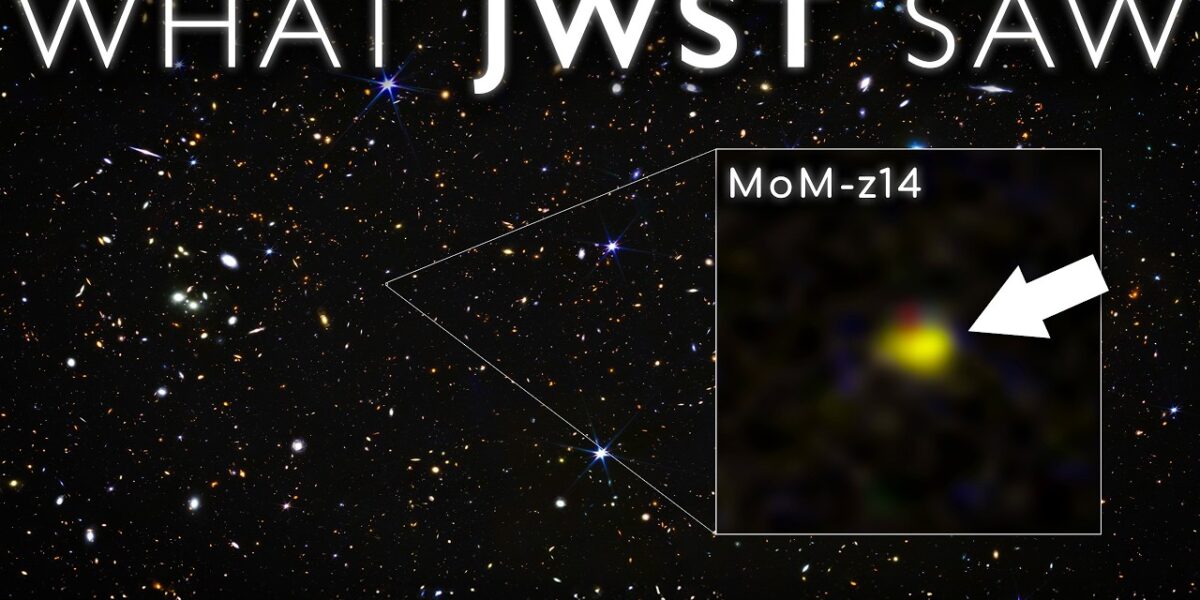
Despite the success of the Big Bang model, JWST’s observations have introduced perplexing anomalies. The telescope has detected galaxies that appear remarkably bright and massive at epochs when, according to our models, they should not have had enough time to form. For instance, a galaxy named MoM-z14, observed as it existed just 280 million years after the Big Bang, presented a significant puzzle. Its observed brightness and size suggested a level of stellar formation and galactic development that was thought to require much more time.
Initially, the excess brightness of these early galaxies was attributed to an unusually high number of stars. However, a re-evaluation by researchers at the University of Texas suggested an alternative explanation: the intense light might be originating from the accretion disks of supermassive black holes within these galaxies. These black holes, rapidly consuming surrounding gas, could generate enough radiation to make the entire galaxy appear brighter, thus reconciling the observations with the models without requiring an improbable number of stars.
This explanation, however, shifted the mystery to the black holes themselves. How could supermassive black holes, with masses millions or billions of times that of our Sun, form so quickly in the early universe? Stellar black holes, formed from the collapse of massive stars, are understood to form over time. The existence of such large black holes so early on challenged the established understanding of black hole growth, particularly the Eddington Limit—a theoretical maximum rate at which matter can fall into an object due to radiation pressure.
The case of black hole LID-568 further complicated matters. Initially, it appeared to be accreting matter at a rate far exceeding the Eddington Limit, suggesting novel mechanisms for black hole growth. However, subsequent analysis indicated that dust obscuration might have skewed the initial calculations, bringing its accretion rate back within the theoretical bounds. This leaves the question of how supermassive black holes achieved their immense sizes so early in cosmic history unresolved.
The Lithium Enigma
Adding to the cosmic quandaries is the peculiar absence of lithium. The Big Bang nucleosynthesis theory predicts specific abundances of light elements, including a tiny but measurable amount of lithium (about 0.00000007% by mass), formed in the first few minutes after the Big Bang. Observations of the early universe, particularly through spectroscopy of ancient stars, consistently show about three times less lithium than predicted.
This discrepancy, known as the lithium problem, has persisted for decades and remains a significant challenge to the standard cosmological model. While JWST is not directly observing lithium in the early universe, its continued exploration of the most distant objects provides crucial data for refining our understanding of cosmic evolution, which may eventually shed light on this elemental mystery.
What Comes Next?
The James Webb Space Telescope is still in the early stages of its mission, with decades of observation ahead. Its powerful instruments are poised to deliver a torrent of data, promising to refine our understanding of galaxy formation, black hole evolution, and the very composition of the early universe. The anomalies observed so far are not necessarily signs that the Big Bang model is fundamentally wrong, but rather that it may be incomplete. They highlight areas where our theoretical frameworks need expansion or revision.
These unexpected findings underscore the dynamic nature of scientific discovery. Each new observation from JWST is an opportunity to test our assumptions, refine our models, and deepen our appreciation for the complexity and wonder of the cosmos. The universe, it seems, is still full of surprises, and JWST is our most advanced tool for unraveling them.
Source: JWST Found an Impossible Galaxy at the Edge of the Universe (YouTube)

Related Articles


JWST Unveils Distant Galaxy’s Surprising Maturity
The James Webb Space Telescope has detected an ancient galaxy, JADES-GS-z13-0, existing just 320 million years after the Big Bang. Its surprising maturity challenges current theories about the rapid formation of early galaxies.


Earth’s Planetary Status Questioned, Figure-8 Orbits Debunked
Exploring Earth's planetary status, the impossibility of figure-8 orbits, the ongoing debate about dark matter's composition, and the future of human spaceflight.


Milky Way’s Center: Black Hole or Dark Matter Mystery?
New research proposes that Sagittarius A*, the supermassive object at the Milky Way's center, might not be a black hole but a dense concentration of dark matter. Future observations of its photon ring could reveal the truth.