JWST Captures Star Moments Before Supernova
The James Webb Space Telescope has captured a star just before its supernova explosion, offering unprecedented data on stellar death. Meanwhile, new cosmological measurements attempt to resolve the Hubble tension.

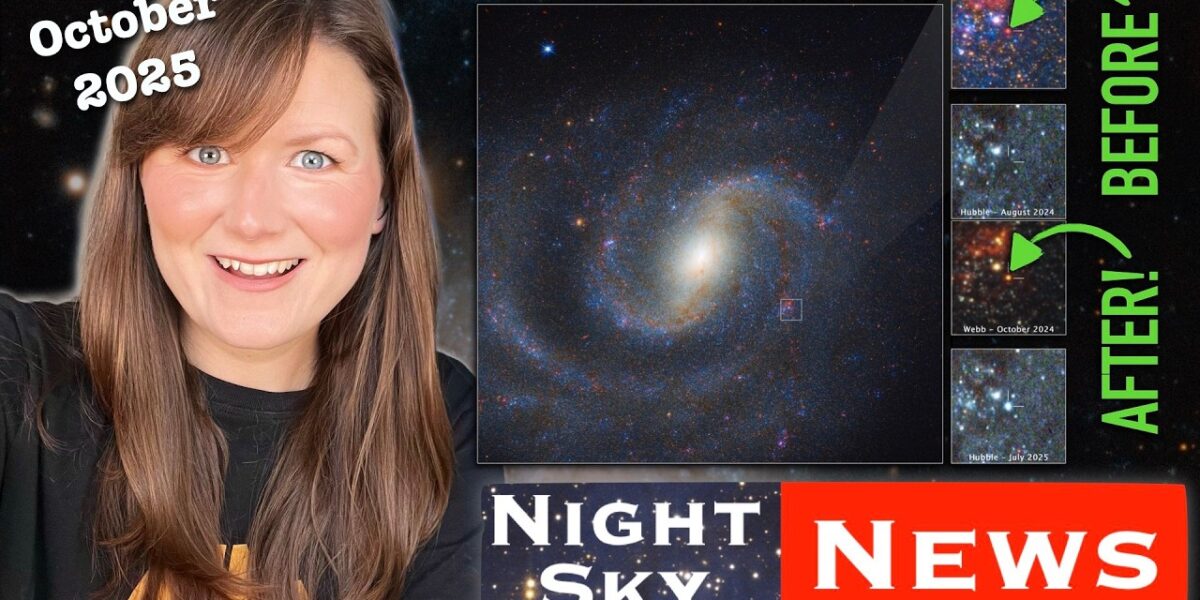
JWST Offers Unprecedented Glimpse of Pre-Supernova Star
In a groundbreaking achievement for astrophysics, the James Webb Space Telescope (JWST) has successfully observed a star in the moments before its spectacular supernova explosion. This marks the first time astronomers have been able to witness and analyze a star’s state immediately prior to its demise, offering invaluable insights into stellar evolution and the processes leading to one of the universe’s most energetic events.
A Star’s Final Moments Revealed
Supernovae, the cataclysmic explosions of stars, have long fascinated and puzzled scientists. While their immense power and role in creating heavier elements are well-understood, the precise conditions and timing of these events have remained elusive. A key challenge has been the inability to predict exactly when a star will explode. Stars nearing the end of their fuel supply are subject to gravitational collapse, leading to a rebound and subsequent explosion. However, the exact amount of remaining fuel is difficult to measure, making precise predictions impossible. Traditionally, by the time astronomers detect a supernova, the star has already exploded, forcing them to work backward, examining old data to find evidence of the star that once was.
A significant hurdle in this retrospective analysis has been the shrouding of stars in dust as they approach their final stages. This dust obscures visible light, rendering them invisible to telescopes like the Hubble Space Telescope, which primarily observe in optical wavelengths. The hope has always been that JWST, with its unparalleled ability to see in infrared light, could pierce through this dusty veil and reveal what was hidden.
SN 2025PHT: A Case Study
That hope was realized with the observation of supernova SN 2025PHT, which erupted in July 2025 in the galaxy NGC 1637. This event was first detected by the All-Sky Automated Survey for Supernovae (ASAS-SN), a global network of robotic telescopes designed to spot such transient events. Crucially, NGC 1637 had been previously observed by both Hubble and JWST in the years leading up to the supernova. Following the explosion, Hubble also captured post-supernova images of the galaxy.
The analysis, led by Kilpatrick and collaborators, revealed a striking difference between observations. While Hubble images from August 2024 showed no discernible star at the location of the future supernova (marked by a red dot), JWST images taken in October 2024, just months before the explosion, clearly showed a star present. Even earlier Hubble images from August and October 2001 confirmed the presence of a star at that location, which subsequently vanished from optical view, presumably behind its dusty shroud, before the 2025 explosion.
JWST’s Infrared Vision Proves Crucial
JWST’s infrared capabilities were instrumental in this discovery. By observing in infrared wavelengths, the telescope could penetrate the dust that obscured the star from optical telescopes. This allowed scientists to study the star’s properties, its environment, and its evolutionary stage immediately before its catastrophic end. The data suggests that the star responsible for SN 2025PHT was approximately 15 times the mass of our Sun and resided in an environment rich in carbon, rather than the silicon-rich environment that had been anticipated for red giant stars nearing supernova.
Implications for Supernova Research
This milestone opens up new avenues for supernova research. Scientists can now begin to build a more comprehensive understanding of the types of stars that go supernova, the conditions they inhabit, and the specific phases of their red giant evolution that precede explosion. This ability to observe pre-supernova stars directly, rather than inferring their existence from post-explosion data, promises to resolve long-standing questions about stellar death and the cosmic recycling of matter.
The Crisis in Cosmology and Time-Delay Cosmography
Beyond the supernova discovery, the article touches upon the ongoing ‘crisis in cosmology,’ also known as the Hubble tension. This refers to the persistent discrepancy between two primary methods of measuring the universe’s expansion rate, the Hubble constant (H₀). Measurements based on nearby galaxies and standard candles yield a value around 74 km/s/Mpc, while those derived from the early universe’s cosmic microwave background (CMB) and cosmological models suggest a value closer to 67 km/s/Mpc.
The TDCOSMO collaboration is employing a novel technique called time-delay cosmography to address this tension. This method utilizes gravitational lensing, where the gravity of a foreground galaxy bends the light from a background object, creating multiple images. By measuring the time delay between the light arriving from these different paths, and knowing the properties of the lensing galaxy, scientists can calculate the distance to the background object and, consequently, the expansion rate of the universe, independent of the traditional ‘cosmological distance ladder’.
The TDCOSMO collaboration’s latest measurements, based on eight lensed quasars, yielded an expansion rate of 71.6 ± 3.6 km/s/Mpc. While this value falls between the two conflicting measurements, its significant uncertainty prevents definitive conclusions. However, the collaboration believes that with further JWST observations of these quasars, they could achieve the precision needed to rival existing methods and potentially resolve the Hubble tension.
What Comes Next?
The successful pre-supernova observation by JWST is just the beginning. Astronomers will now actively seek out more such events, hoping to build a statistically significant sample of pre-supernova stars. This will allow for more robust studies into the diversity of stellar death throes and the conditions that lead to them. The ongoing efforts in time-delay cosmography, particularly with JWST’s enhanced capabilities, hold the promise of finally resolving the Hubble tension, which could lead to a fundamental revision of our cosmological models, potentially revealing new physics or unknown components of the universe. These advancements underscore the revolutionary impact of JWST and the persistent quest to unravel the universe’s deepest mysteries.
Source: JWST spots a star BEFORE it goes supernova | Night Sky News October 2025 (YouTube)

Related Articles


Vera C. Rubin Observatory Begins Sky Survey
The Vera C. Rubin Observatory has officially begun its 10-year sky survey, promising to generate millions of astronomical alerts nightly. Meanwhile, new Webb images reveal Uranus in unprecedented detail, and the Artemis program faces timeline adjustments.


JWST Unveils Distant Galaxy’s Surprising Maturity
The James Webb Space Telescope has detected an ancient galaxy, JADES-GS-z13-0, existing just 320 million years after the Big Bang. Its surprising maturity challenges current theories about the rapid formation of early galaxies.


Earth’s Planetary Status Questioned, Figure-8 Orbits Debunked
Exploring Earth's planetary status, the impossibility of figure-8 orbits, the ongoing debate about dark matter's composition, and the future of human spaceflight.