Juno Probe Uncovers Jupiter’s Fuzzy Core and Hidden Secrets
NASA's Juno mission has revealed that Jupiter's core is "fuzzy," challenging theories of planetary formation. The probe also captured stunning images of polar cyclones, analyzed atmospheric composition, and provided new insights into Jupiter's powerful magnetic field and auroras.

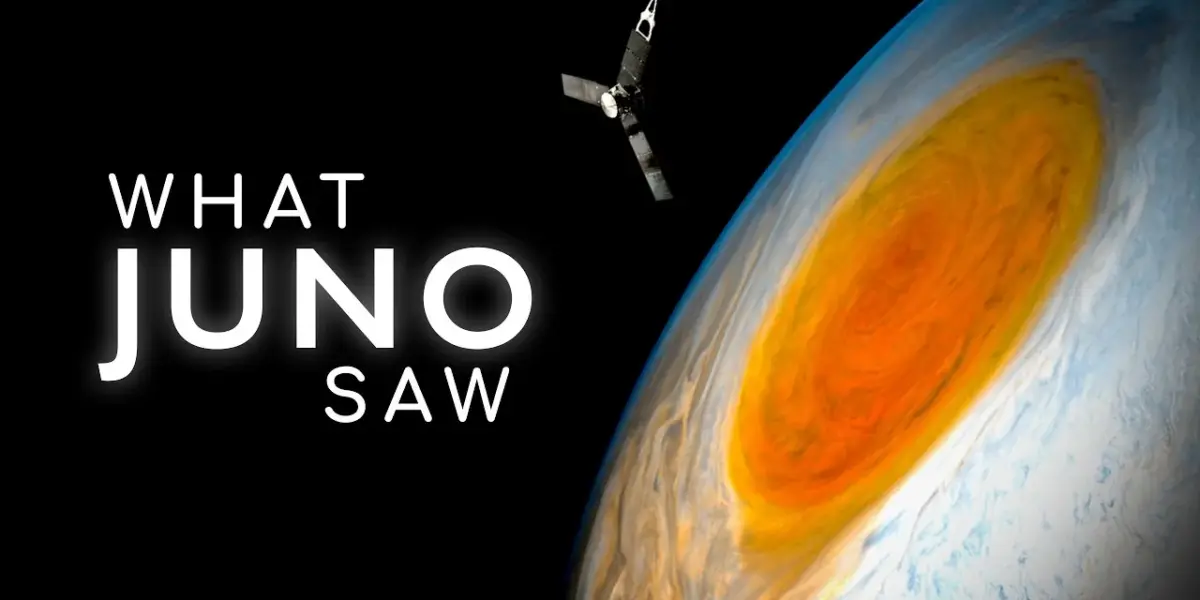
Juno Probe Uncovers Jupiter’s Fuzzy Core and Hidden Secrets
NASA’s Juno mission has dramatically reshaped our understanding of Jupiter, revealing a “fuzzy” core and uncovering secrets about the gas giant’s formation, composition, and powerful magnetic field. This ambitious probe, designed to withstand Jupiter’s harsh environment, has exceeded expectations, operating for years beyond its initial mission end date.
A Journey Against the Odds
Launched on August 5, 2011, Juno embarked on a challenging five-year journey spanning 2.8 billion kilometers to reach Jupiter. Its mission cost an estimated $1.1 billion, a moderate budget for such a complex undertaking. To conserve fuel, Juno used a clever gravitational assist, looping back to Earth two years after launch to gain speed. Earth’s gravity accelerated Juno by over 14,000 km per hour, slingshotting it towards its destination.
Upon arrival in 2016, Juno entered a polar orbit, swooping as close as 4,200 km above Jupiter’s clouds. This proximity is crucial for detailed observation but also exposes the spacecraft to Jupiter’s intense radiation belts. Unlike previous missions like Galileo, which suffered damage from this radiation, Juno was equipped with a one-centimeter-thick titanium shield, akin to a “tank going into space.” Scientists initially worried about its longevity, with some instruments not expected to last beyond a few months.
Surprising Radiation Levels and Stunning Views
Remarkably, Juno’s radiation exposure was ten times lower than anticipated. This unexpected finding, possibly due to a gap between Jupiter’s atmosphere and its radiation belt, greatly extended the probe’s operational life. This fortunate circumstance allowed Juno to capture breathtaking images and gather unprecedented data.
Juno’s polar orbits provided stunning new views of Jupiter’s poles. Instead of the familiar banded clouds, scientists were astonished to see vast cyclones swirling at the South Pole. These images, enhanced for detail, revealed a dynamic and complex weather system unlike anything seen before.
Peering Deep into Jupiter’s Atmosphere
Equipped with a microwave radiometer, Juno can probe deep into Jupiter’s atmosphere, measuring the distribution of ammonia. One striking discovery was a band of ammonia extending over 350 km below the cloud tops near the equator. This unexpected depth and concentration puzzled scientists, suggesting that Jupiter’s atmospheric gases do not mix as uniformly as previously believed.
The Mystery of Jupiter’s Core
Perhaps Juno’s most profound discovery concerns Jupiter’s core. For decades, scientists debated whether it was solid or nonexistent. In 2017, Juno’s data revealed a surprising third option: Jupiter’s core is “fuzzy.” Instead of a dense, solid ball, it appears to be diffuse, gradually blending with the surrounding hydrogen-rich layers without a clear boundary. This fuzzy core spans about half of Jupiter’s radius.
This finding challenged two main theories of planetary formation. The “gravitational collapse” theory suggested Jupiter formed directly from a gas cloud, leaving no core. The “core accretion” model proposed a solid nucleus of heavy elements that captured gas. Juno’s fuzzy core suggests neither theory fully explains Jupiter’s origin. One hypothesis is that Jupiter once had a solid core, but a colossal collision in its early history shattered and mixed it with surrounding gases. However, supercomputer simulations of such impacts failed to replicate the fuzzy core observed by Juno, suggesting our understanding of gas giant formation may need a significant revision.
Saturn’s Fuzzy Core and New Formation Theories
Intriguingly, data from the Cassini mission to Saturn also suggests that planet may possess a fuzzy core. Observations of Saturn’s rings and gravitational field indicate regions within the planet that do not convect heat, similar to Jupiter. This shared characteristic points towards a common formation process for these gas giants, where fuzzy cores are a natural outcome, rather than the result of random collisions.
This emerging theory posits that gas giants form with fuzzy cores composed of a gradient of heavier elements concentrated at the center. This complexity challenges existing models of planetary evolution, which predicted more uniform cooling and internal structures. The findings from Juno and Cassini suggest that all gas giant exoplanets might share these characteristics.
Unraveling Jupiter’s Powerful Magnetic Field
Jupiter’s magnetic field, the strongest in the solar system, is generated by a dynamo process within its metallic hydrogen layer, located deep within the planet. Here, extreme pressures and temperatures (over 30,000 K) turn hydrogen into an electrically conductive liquid metal.
Juno’s highly detailed mapping of Jupiter’s magnetic field has revealed quirky characteristics, including a stronger field in the northern hemisphere, localized magnetic “spots,” and two magnetic south poles. While scientists hoped Jupiter’s fuzzy core would explain these anomalies, it has instead added complexity. Data suggests large regions of Jupiter may not be convective, which complicates the dynamo process. While an upper stable layer might help explain some magnetic field behavior, the dilute fuzzy core itself does not fully account for the observed field.
Researchers are exploring new theories, such as the role of a helium layer or uneven density and conductivity, to explain the magnetic field’s unusual properties and the planet’s lop-sided magnetosphere. The exact mechanisms remain a mystery.
Spectacular Auroras and Io’s Influence
Jupiter’s powerful magnetic field is responsible for the solar system’s most spectacular auroras, displays of light hundreds of times more energetic than Earth’s. These auroras, visible mainly in ultraviolet light, are driven by alternating currents, likely generated by turbulence within the magnetic field. The structure of the auroras differs between the poles, reflecting the complexity of Jupiter’s magnetic field lines.
Juno’s infrared aurora mapper has provided unprecedented views, showing ions striking Jupiter’s ionosphere. Notably, a bright spot and tail in the aurora are linked to the electromagnetic influence of Jupiter’s volcanic moon, Io. Other large moons, Europa and Ganymede, also leave their subtle fingerprints on Jupiter’s auroral displays.
Further Discoveries and the Extended Mission
Juno’s mission has also revealed high-altitude clouds of water or ammonia ice, over 50 km wide, appearing as small white specs in images. The spacecraft also discovered a smaller, less powerful radiation belt hugging Jupiter’s equator. This belt’s origin remains unknown.
The mission’s extended phase has allowed Juno to delve deeper into Jupiter’s magnetosphere, including passing directly through a powerful flux tube connecting Jupiter to Io. This electric current, carrying up to 400,000 volts and millions of amps, did not harm Juno due to its large diameter and the spacecraft’s brief passage.
Juno’s detailed magnetic field mapping confirmed Jupiter’s dipole-like field, though misaligned with its rotation. It also revealed a “Great Blue Spot,” a region of concentrated magnetic field, and evidence of gradual change over time, known as secular variation, particularly around this spot. These findings continue to refine our understanding of Jupiter, revealing a planet far more complex and dynamic than ever imagined.
Source: What Juno Found Below Jupiter's Clouds (YouTube)

Related Articles


NASA Pivots: Mars Nuclear Probe, Moon Base Ahead
NASA is pivoting its exploration strategy, prioritizing a nuclear-powered Mars probe and accelerating plans for a moon base. The International Space Station's future is uncertain, with a shift towards commercial platforms. Meanwhile, new telescope data reveals overmassive black holes in dwarf galaxies and captures stunning images of Saturn and the Crab Nebula.


US Military Pursues Secret Tech, Lunar Base Plans Emerge
Reports indicate the US military and defense contractors are exploring advanced technologies, possibly reverse-engineering unknown craft. Concurrently, NASA plans a lunar base, while millions of UAP-related files are allegedly deleted, raising transparency concerns. These developments could reshape global power dynamics.


Dark Matter Defies Gravity, Forming Fuzzy Clouds Instead of Stars
Dark matter, which outweighs all visible matter, surprisingly does not collapse under gravity to form stars or black holes. Instead, it forms vast, diffuse clouds around galaxies, baffling scientists with its unique behavior. Understanding this cosmic enigma is key to comprehending the universe's structure and evolution.