Iran War: Decapitation Fails, Strait of Hormuz Closure Pressures Trump
The United States' military campaign against Iran in early 2026 has failed to achieve its primary objective of regime change, as the Iranian leadership has appointed a successor amidst escalating conflict. The closure of the Strait of Hormuz by Iran has significantly impacted global oil prices, placing considerable political pressure on the US.

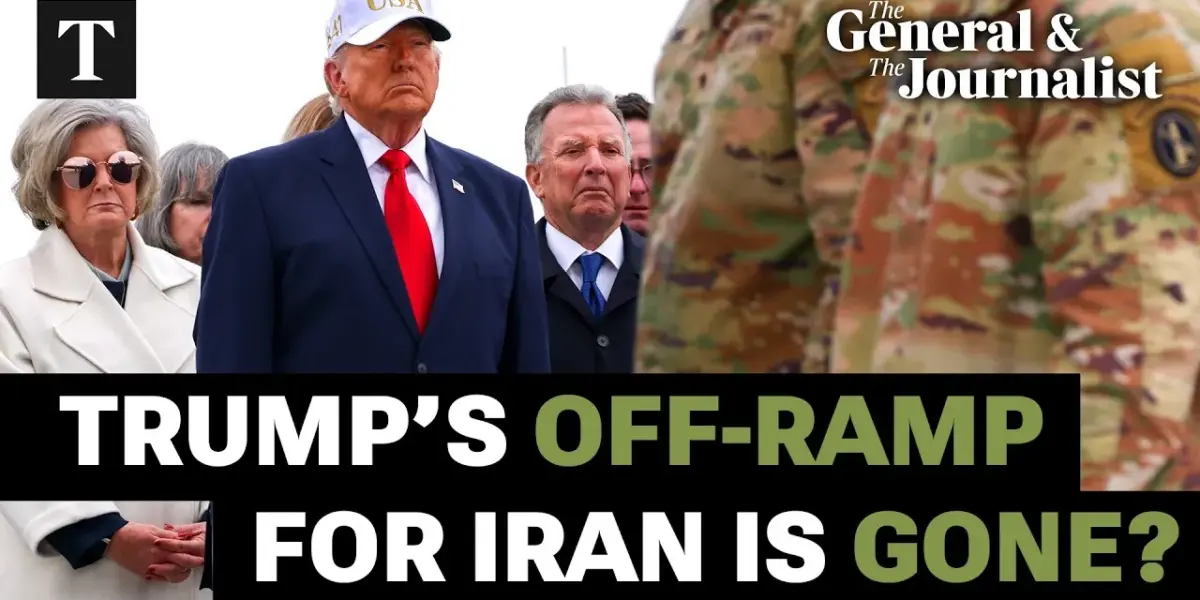
US Strategy Falters as Iran’s Regime Endures Post-Assassination
In the initial months of 2026, the United States has engaged in a high-stakes military operation against Iran, marked by the targeting and elimination of key leadership figures. However, the anticipated collapse of the Iranian regime has not materialized. Instead, Iran has appointed the son of the assassinated Supreme Leader as his successor, signaling a defiant stance against the United States. This development, coupled with a surge in oil prices to recession-inducing levels, has led Tehran to assert that it, not America, will dictate the war’s conclusion.
The Unforeseen Resilience of the Iranian Regime
Sir Simon Gass, former ambassador to Tehran and chairman of the Joint Intelligence Committee, explained that the Iranian regime’s deep and complex web of personal and institutional relationships, buttressed by a strong ideological ethos, makes it resistant to decapitation strategies. “Removing one leader or even as we’ve seen in Iran over the last year a series of leaders will not collapse the regime on its own,” Gass stated. He further elaborated that Iranian leaders had anticipated conflict and implemented robust succession plans and hardened infrastructure, ensuring continuity even after significant leadership losses.
Succession Amidst Crisis: Haman Mushtaba’s Appointment
The appointment of Haman Mushtaba as Supreme Leader has sent complex signals. While representing a continuity candidate, he is also a departure from his father’s legacy. Sir Simon noted a division within the regime between pragmatic conservatives and hardline military elements, with the latter favoring Mushtaba’s ascension. “He is a very different character so far as we know. He is deeply conservative… but he’s also very much involved in business and finance,” Gass observed. While Mushtaba is expected to maintain hostility towards the West, there remains a possibility, albeit slim, that he might adopt a more pragmatic approach to governance and economic reform, especially in light of the nation’s current predicament.
“In order to stay the same we have to change.” – Lampadusa, The Leopard
The dynastic nature of this succession is also a point of contention. “Ali Khamenei, the father, had considerable reservations about Majaba succeeding him precisely because that dynastic succession, particularly in a role which is religiously inspired… is quite strongly against that sort of dynastic succession in a religious context,” Sir Simon explained. This move could alienate ordinary Iranians who may perceive the regime as devolving into a more conventional Middle Eastern dictatorship, reminiscent of the Assad clan in Syria.
Limited Prospects for Internal Change and Opposition
When discussing internally driven regime change, Sir Simon expressed skepticism regarding the viability of external opposition figures like Reza Pahlavi. “I simply don’t see him as a credible leader of Iran nor do people in Iran or most people in Iran,” he stated. The National Council of Resistance of Iran (NCRI) is also identified as having low credibility among ordinary Iranians due to its historical alliance with Iraq during the Iran-Iraq War.
Internally, while the regime has suppressed alternative voices, there are elements within the establishment who recognize the severity of Iran’s situation. “There are some people who have been members of the regime and might even still be on the outer fringes of it, who recognize the total mess that Iran has got itself into and therefore the need for substantial reform,” Sir Simon noted, citing former President Rouhani’s warnings to the clergy.
The Strait of Hormuz: Iran’s Strategic Leverage
The conflict has seen a significant escalation with Iran’s effective closure of the Strait of Hormuz, a critical chokepoint through which approximately 20% of the world’s crude oil passes. Patrick, a military analyst, highlighted the ease with which Iran can disrupt maritime traffic due to the strait’s narrow width and the fact that Iran has long planned for this eventuality. “This is the critical ace that they hold. It’s holding the world’s energy markets at risk, and we’re seeing the consequences now,” Patrick explained.
The threat posed by Iran’s naval capabilities is multifaceted, including anti-ship cruise missiles, mines, submarines, and particularly, fast attack craft. “These are fast attack craft, very very low profile, very fast, very maneuverable, often with missiles mounted on them. There are hundreds if not thousands of them and they are hidden in people’s garages, in industrial infrastructure,” Patrick detailed. Swarming tactics employed by these craft make escort and maritime protection operations exceptionally challenging.
Military Success vs. Strategic Failure
Sir Simon reflected on the operation’s mixed results: “I think in military terms, Patrick would be a better judge, but it seems to me that in military terms, the United States has done what the United States military does. It’s used a vast quantity of precision munitions… and has achieved a great deal in terms of degradation of Iran’s ballistic missile, naval, and political establishment.” However, he concluded that the strategic objectives, such as regime change or compelling Iran into a humiliating settlement, have not been met. “On the contrary, as Patrick said, they’ve discomforted the United States quite considerably by their action in the Persian Gulf against oil supplies.”
Patrick added that Iran’s “chaos strategy” is beginning to pay dividends by inflating oil and financial markets, exerting significant political pressure on the White House. The US military, while executing a systematic campaign against over 4,000 targets, may be encountering the limitations of its power against a determined and ideologically driven adversary.
The ‘Punch in the Mouth’ Strategy and Unintended Consequences
Drawing parallels to boxing, Patrick invoked Mike Tyson’s famous quote: “Everyone has a plan until they get punched in the mouth.” He argued that while the US may not have been militarily defeated, it has been strategically outmaneuvered. The risk, he warned, is that Iran could emerge from the conflict claiming victory by having withstood the might of the US, thereby emboldening its disruptive tactics and reinforcing the belief that it can hold global energy markets hostage.
The war’s outcome, particularly the continued disruption of oil supplies and the potential for Iran to emerge with its nuclear program undiminished, presents a strategic quandary. The military campaign, estimated to require several more weeks, is running against a tightening political timeline in the US, driven by economic pressures and public sentiment.
Regional Repercussions and the UK’s Diminished Role
Looking ahead, Sir Simon anticipates significant lessons for regional players. Gulf states may reassess their reliance on the US security umbrella, given its limitations in preventing Iranian attacks. They will also need to navigate a future relationship with a potentially wounded but aggressive Iran.
The conflict also raises questions about the efficacy of US military power under President Trump, who has previously claimed swift victories through force. “Are we seeing a moment when President Trump has to come face to face with the fact that there are some problems which military force just doesn’t crack?” Sir Simon mused.
Regarding the United Kingdom’s role, Sir Simon acknowledged a weakening influence in the Gulf, stemming from years of underfunding defense capabilities. While supporting Prime Minister Stalmer’s decision not to join the US attack, he criticized the UK’s lack of preparedness and insufficient defense assets in the region, describing the response as “a day late and a dollar short.”
Source: What Is Trump's Off-Ramp For Iran? (YouTube)

Related Articles

G7 Allies Clash Over Iran War Strategy, Urge Focus on Russia
G7 foreign ministers met in Paris, revealing deep divisions over the U.S. war with Iran. European allies urged the U.S. to pressure Russia, linking its actions to the conflict and fearing support for Ukraine will wane.

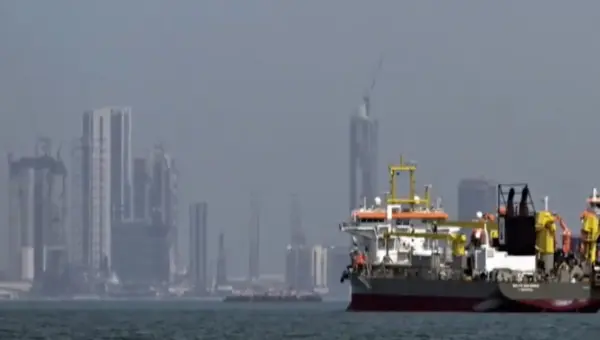
Iran Blocks China Ships, Exposing Beijing’s Weak Grip
Iran's recent decision to block Chinese ships at the Strait of Hormuz is exposing the limits of Beijing's influence in the Middle East. This action is causing delays and cancellations for Chinese manufacturers, turning a perceived geopolitical win into an economic strain.
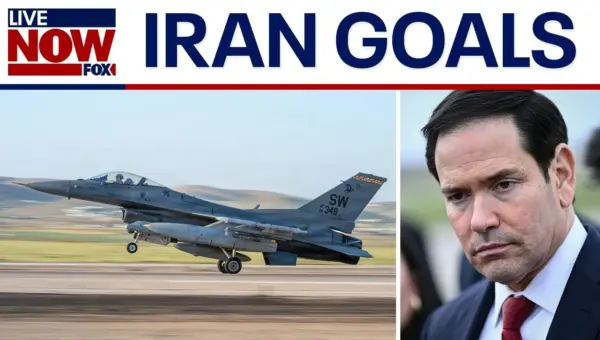
Rubio: US Can Achieve Iran War Goals Without Troops
Senator Marco Rubio outlined a strategy to counter Iran without deploying U.S. ground troops, focusing on weakening the regime and enhancing maritime security. He also criticized Cuba's economic system and expressed concerns about West Bank violence.