Iran Taps New Leader Amid Escalating Conflict with Israel
Iran is reportedly set to name a successor to Ayatollah Ali Khamenei amidst escalating tensions with Israel. The announcement comes as Israel bombs oil facilities near Tehran, drawing accusations of chemical warfare from Iran. Regional powers and analysts express deep concern over the ongoing conflict and the diminishing prospects for de-escalation.

Iran Poised to Appoint Successor to Supreme Leader Amidst Intensifying Regional Conflict
Tehran, Iran – Iran’s top clerical assembly has reportedly reached an agreement on a new Supreme Leader, poised to succeed the late Ayatollah Ali Khamenei. While a formal announcement has yet to be made, sources suggest that Khamenei’s son, Mojtaba, has been chosen for the pivotal role. This internal development unfolds against a backdrop of escalating hostilities, with Israel launching significant strikes on oil storage facilities near the capital, Tehran, and the United States vowing a tough stance against any new Iranian leadership.
Israel Strikes Iranian Oil Infrastructure, Tehran Cries Chemical Warfare
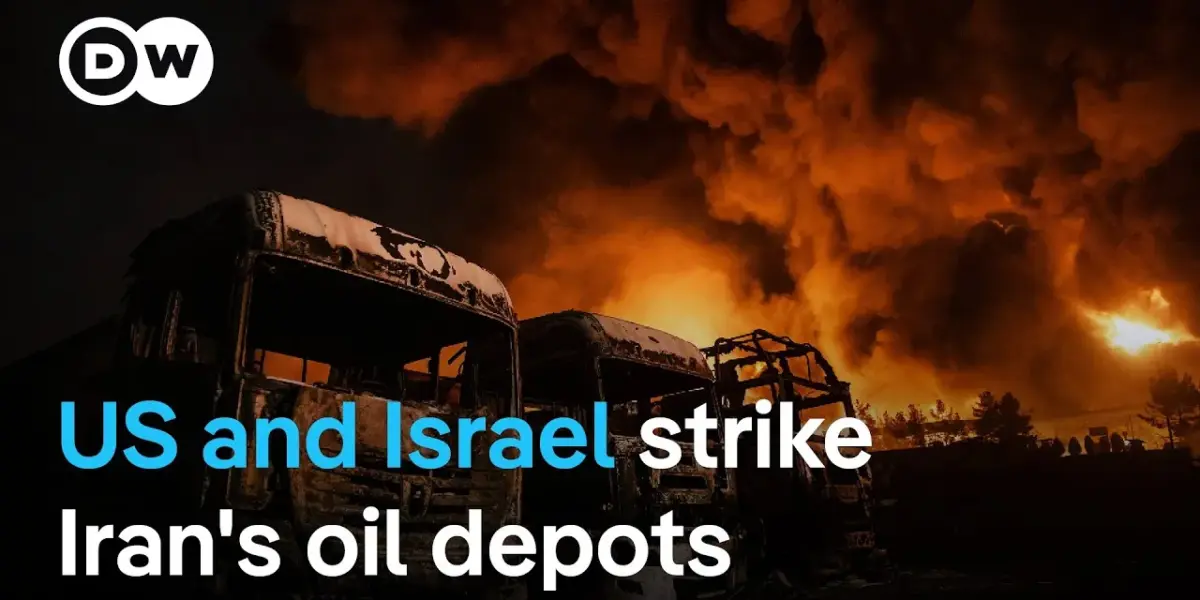
In a dramatic escalation, Israel’s military has targeted fuel depots in the vicinity of Tehran, marking the first time Iran’s vital oil infrastructure has been hit since the conflict began. The strikes have enveloped the capital in toxic smoke, prompting authorities to advise residents to remain indoors due to potential harm to eyes and lungs. Iran’s foreign ministry has condemned the attacks, labeling them as an act of ‘chemical warfare’.
Eyewitness accounts describe the terrifying moments of the strikes. One truck driver recounted, “The first missile hit right over there and then the gasoline started flowing towards the residential areas. All the vehicles the guys had parked here, non-military, were caught in the fire and they ended up burning.” Social media footage purportedly shows flames engulfing a boulevard in Tehran.
Iran Vows Retaliation, Warns of Sustained Regional Conflict
Iran’s Revolutionary Guards have issued a stern warning, vowing to respond with similar actions in the region if attacks on their energy infrastructure persist. They also claim the capability to sustain an intense war against Israel and the United States for up to six months. Iran’s foreign minister has pledged to continue targeting U.S. sites in neighboring countries, stating, “It is Americans who started this war against us, attacking us and we are defending ourselves. So our it is obvious that our missiles cannot reach the the US soil. What we can do is to attack American bases and American installations around us which are unfortunately in the soils of our you know neighborly countries.”
GCC Nations Caught in the Crossfire, Balancing De-escalation and Defense
The escalating conflict presents a “nightmarish scenario” for the six Gulf Cooperation Council (GCC) states, according to Giorgio Cafiero, CEO and founder of Gulf State Analytics. These nations, having invested heavily in efforts to avert a US-Iran conflict, now find their national security and economic interests under severe threat. “Everything they warned about is playing out right now,” Cafiero observed. “I think at this point the GCC states are very much focused on trying to deescalate.”
However, GCC countries are angered by the US’s entry into the conflict, viewing it as a “war of choice.” They are now grappling with Iran’s retaliation, which Tehran frames as a response to the GCC states hosting U.S. military bases. A “war of narratives” is underway, with disinformation from both Israeli and Iranian networks complicating the situation. Cafiero noted, “The GCC states are caught in an incredibly awful situation right now. What’s going on poses nothing short of an existential threat to their economies, especially at a fragile period in which they’re trying to diversify away from oil and gas.”
The Dilemma of Retaliation and Shifting Alliances
While some GCC states have hinted at the possibility of direct military action against Iran if attacks continue, they face a delicate balancing act. Rulers must consider public perception within their own populations and the wider Arab and Islamic world, where striking Iran could be perceived as de facto alignment with Israel. Furthermore, such actions could inadvertently unite the Iranian populace. “The more Iran targets these GCC countries, that risk increases,” Cafiero warned, “But I also think the Gulf Arab states would be careful before taking such action.”
Iran’s Strategic Calculus: Pressure and Survival
Professor Sina Azodi, Director of Middle East Studies at George Washington University, suggests that Iran’s attacks are not impulsive but part of a calculated strategy. “The objective… is to create and uh chaos and increase pressure on uh the GCC countries to rush and to urge their use their influence to urge President Trump to stop the fighting.” The Iranian leadership’s mentality, Azodi explains, is that by preventing a decisive U.S. victory, they can survive the conflict, albeit with significant damage. “Their thinking… is that by not giving the United States a decisive victory they can come out of the conflict with bruises but they can survive.”
Despite rising civilian casualties across the region, including in Iran, the GCC, and Israel, the U.S. has not altered its behavior. Public opinion within GCC countries is reportedly growing, pressuring their governments to act. This pressure was evident when Iranian President Hassan Rouhani apologized to GCC countries, despite facing domestic criticism, in an effort to preserve years of reconciliation efforts.
Diplomatic Channels Narrowed, Uncertainty Prevails
The potential for diplomatic breakthroughs appears dim, with both the U.S. and Iran currently lacking the desire to negotiate. “Right now, neither the Trump administration nor the Iranian leadership wants to talk,” stated Cafiero. “And I think within this context, we don’t really have any reason to be optimistic about some sort of a diplomatic breakthrough anytime soon.” The GCC states remain a crucial potential bridge for diplomacy, but their efforts are hindered by the current unwillingness of both belligerents to engage in dialogue. The targeting of civilian infrastructure, such as desalination plants, is seen as a dangerous trend, with both sides escalating rather than seeking de-escalation.
Looking Ahead: A Volatile Future
As Iran moves to formalize its new leadership, the region braces for continued volatility. The effectiveness of Iran’s pressure tactics on GCC states and, by extension, on the United States remains to be seen. The delicate balance between defense and de-escalation for the Gulf monarchies will be critical in navigating this increasingly perilous geopolitical landscape. The world watches to see if diplomatic channels can be reopened before the conflict spirals further out of control.
Source: Iran picks a new Supreme Leader as Israel bombs oil storage facilities near Tehran | DW News (YouTube)

Related Articles
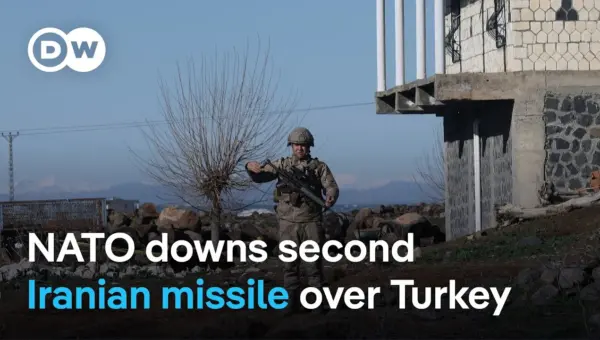
NATO Confirms Downing Second Iranian Missile Over Turkey
NATO confirmed it intercepted a second Iranian ballistic missile over Turkey, raising regional tensions. Turkey vows decisive action but seeks to avoid direct conflict with Iran, prioritizing diplomatic solutions amidst economic pressures.


Trump Eyes Iran Conflict for Global Oil Control
Political analyst Stanislav Bilovski suggests a potential U.S. military operation against Iran could be a strategic move by Donald Trump to control global oil markets and achieve domestic political goals. While Iran possesses regional resilience, its isolation and Russia's limited capacity to intervene paint a complex geopolitical picture. The outcome hinges on various factors, including the conflict's duration and potential U.S. domestic political maneuvers.


Iran: The Geopolitical Lever in the US-China Tech Race
Geopolitical insights reveal Iran's pivotal role in the US-China tech race, acting as a lever that challenges China's influence. A historical memo outlining targeted countries underscores the strategic depth of this competition.