Iran Retaliates After US Strikes; FM Blames UAE for Attacks
Iran's Foreign Minister has vowed retaliation following U.S. strikes on Khark and Abu Musa islands, alleging the attacks originated from the UAE. He clarified that the Strait of Hormuz remains open except for ships belonging to Iran's adversaries. The minister also addressed strategic partnerships and pre-war negotiations.


Iran Vows Retaliation After US Strikes on Khark and Abu Musa Islands
In a significant escalation of regional tensions, Iran’s Foreign Minister, speaking exclusively to MS, has vowed a clear and decisive response following overnight U.S. military strikes on Khark and Abu Musa islands. The U.S. President had initially stated a decision not to target all oil infrastructure on Khark Island, but warned of reconsidering if Iran interfered with the free passage of ships through the Strait of Hormuz. Iran’s armed forces, however, have already declared their intent to retaliate against any attacks on their oil and energy infrastructure, extending the threat to any energy infrastructure belonging to American companies or those with American shareholders.
Allegations of UAE Involvement in Attacks
A critical point raised by the Foreign Minister is the alleged origin of the recent strikes. Iran claims that the rockets used in the attacks, identified as HIMARS, were fired from the territory of neighboring countries. Specifically, the Iranian forces have tracked the launches to two locations within the United Arab Emirates (UAE) – one in Ras al-Khaimah and another near the city of Dubai. The Foreign Minister described this as “absolutely unacceptable” and “very dangerous,” noting the use of highly populated areas for launching attacks against Iran.
“They have attacked Khark Island and Abu Musa Island with, you know, the artillery rocket system, you know, HIMARS as they call it, which is a low range rockets, and they have done it from the soil of our neighbors. And this is crystal clear that now they are using the territory of our neighbors to attack us by this kind of, you know, rockets. And this is absolutely unacceptable.”
– Iranian Foreign Minister
Strait of Hormuz Remains Open, With Caveats
Addressing concerns about the Strait of Hormuz, the Foreign Minister clarified Iran’s stance on maritime passage. He stated that the Strait is not closed but remains open only to ships and tankers belonging to Iran’s “enemies” – those actively attacking the country and their allies. While acknowledging that many vessels prefer not to transit due to security concerns, he asserted that the Strait is not closed to others. The passage is explicitly restricted for American, Israeli ships, and tankers, while others are free to pass.
Supreme Leader’s Status and Systemic Stability
The interview also touched upon the recent election of a new Supreme Leader, Mushtabah Khamenei, who has yet to be seen publicly. The Foreign Minister dismissed claims from U.S. Secretary of Defense Pete Hexeth regarding the Supreme Leader being wounded or disfigured. He characterized such statements as part of a pattern of accusations, pointing to the public appearances of other Iranian officials as evidence of the system’s stability. The Minister emphasized that the Islamic Republic is a deeply rooted system, not dependent on individuals, and functions robustly even after leadership changes, citing the orderly transition following the previous Supreme Leader’s “martyrdom” as proof.
Strategic Partnerships with Russia and China
When questioned about potential military support and targeting intelligence from Russia and China, the Foreign Minister confirmed that both nations are strategic partners with whom Iran maintains close cooperation, including in the military sphere. While declining to provide specific details, he reiterated that the ongoing conflict is an “imposed war” against Iran, which is merely defending itself against an “unprovoked, unwarranted, illegal act of aggression.” Iran’s objective is to defend itself until the war concludes in a manner that prevents future repetitions.
Criticism of UN Security Council’s Justice
The Foreign Minister expressed disappointment with the United Nations Security Council’s resolution condemning Iran’s actions. He questioned the council’s impartiality, noting that it condemned Iran for self-defense while failing to condemn the United States and Israel for initiating the aggression. He argued that any just resolution must consider all aspects of an event, including the initial aggression. The Minister suggested that this perceived lack of justice has led many countries, including the U.S., to lose hope in the Security Council’s effectiveness, opting instead for unilateral actions.
Iran’s Stance on Civilian Targets
Responding to accusations of targeting civilian areas, the Foreign Minister reiterated that Iran’s actions are in self-defense against American bases, installations, assets, and interests located within neighboring countries. He highlighted that these American military facilities are “unfortunately located in the territory of our neighbors.” As a justification for retaliatory strikes, he cited U.S. attacks on Iranian civilian targets, including a school in Minab and a bank building, asserting that Iran’s response follows the principle of “an eye for an eye.”
Negotiations Preceding the War
Regarding the pre-war negotiations, the Foreign Minister addressed reports of contentious discussions with U.S. interlocutors Steve Whitkoff and Jared Kushner. He stated that significant progress was made during a meeting in Geneva on February 26th, a sentiment echoed by the Omani Foreign Minister, who mediated the talks. The Foreign Minister refuted claims of threatening to enrich uranium for nuclear weapons, explaining that he merely stated Iran’s possession of 440 kilograms of 60% enriched material, which, according to IAEA reports and U.S. experts, could be further enriched for multiple bombs. He emphasized that Iran was prepared to offer this material for dilution or downblending, intending it as a significant concession. He suggested that misinterpretations or intentions to justify the subsequent aggression might explain the differing accounts of these negotiations.
Looking Ahead
As tensions remain high, the international community will be closely watching the unfolding situation in the Strait of Hormuz and the broader Persian Gulf region. The effectiveness of Iran’s retaliatory strategy, the response from the U.S. and its allies, and the role of regional powers like the UAE will be critical factors in determining the future trajectory of the conflict. The ongoing diplomatic fallout from the UN Security Council’s resolution and the potential for further de-escalation or escalation will also be key areas to monitor in the coming weeks.
Source: MS NOW EXCLUSIVE with Iranian Foreign Minister Abbas Araghchi (YouTube)

Related Articles
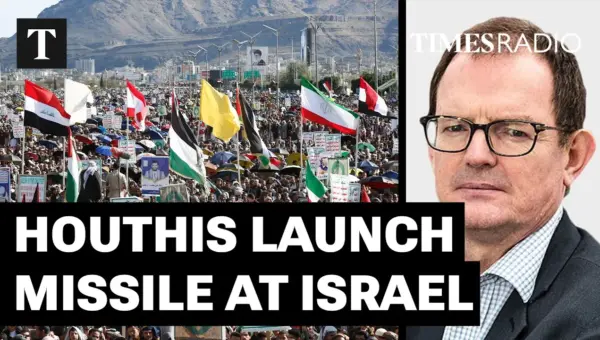
Houthis Fire Missile at Israel, Iran’s Guard Takes Center Stage
Yemen's Houthi group has fired a missile at Israel, signaling a potential escalation of the regional conflict. Meanwhile, Iran's powerful Islamic Revolutionary Guard Corps (IRGC) appears to be consolidating its control over the country's leadership following reported strikes. This shift places hardline figures at the forefront of decision-making.

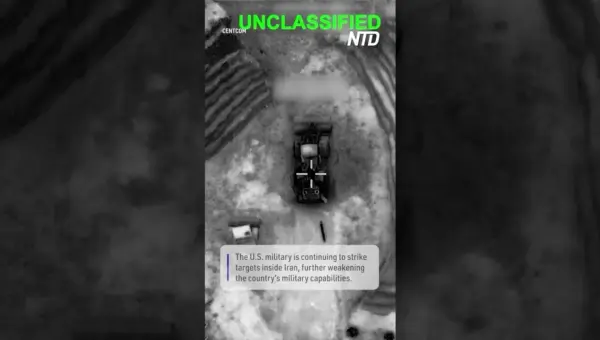
US Strikes Cripple Iran’s Military Might, CENTCOM Reports
U.S. Central Command reports ongoing strikes inside Iran are significantly weakening its military power. This direct action aims to reshape regional security dynamics, but carries risks of escalation. The long-term impact depends on Iran's response and ability to adapt.

U.S. Iran Tensions Rise Amid Shifting Alliances
Rising tensions between the U.S. and Iran are creating a volatile geopolitical situation. With conflicting signals on de-escalation and potential shifts in alliances like NATO and U.S.-Israel relations, the path forward remains uncertain. The global economy and regional stability hang in the balance.