Iran Protests Continue Amidst Shifting Regional Power Dynamics
Iranian university students have reignited anti-government protests, showing defiance despite past crackdowns. A Middle East expert notes the opposition's fragmentation and the regime's coercive power. The analysis also highlights Iran's reduced regional influence and President Trump's potential underestimation of the Islamic Republic's political will.

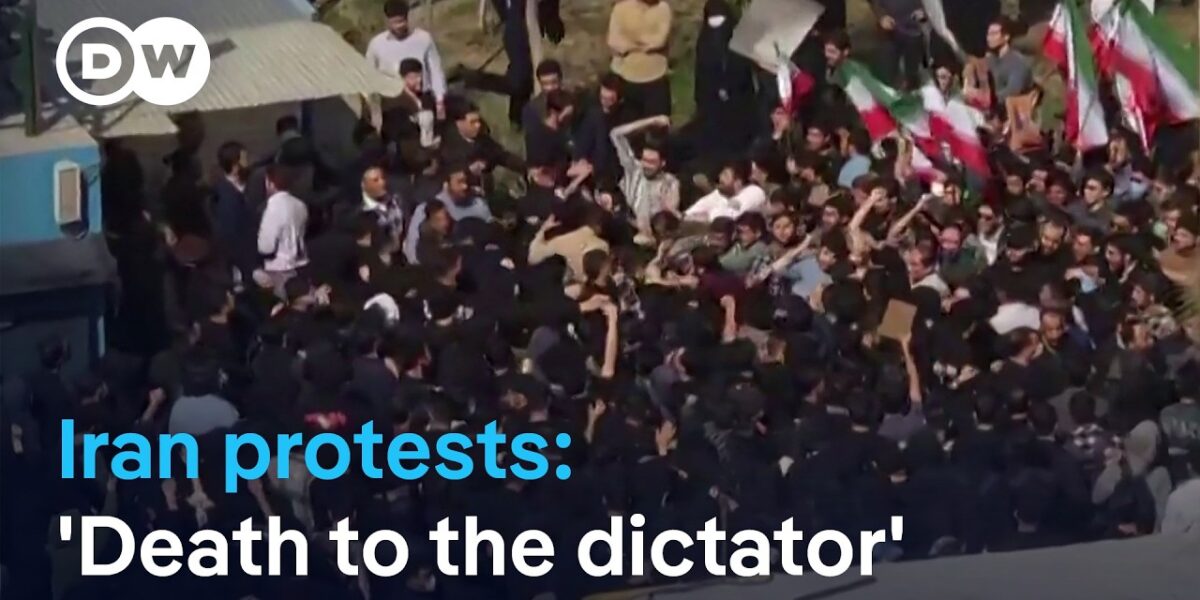
New Wave of Defiance in Tehran as Students Take to Streets
Tehran, Iran – Anti-government protests have re-emerged in Iran’s capital, with university students staging significant rallies on Monday. The demonstrations, held in tribute to thousands killed in previous crackdowns, mark the first major show of public defiance since last month’s heavy-handed suppression of dissent. While organized groups of students voiced opposition, parallel progovernment counterprotests also took place, highlighting the deep societal divisions within the country.
Expert Analysis: Fragmented Opposition Faces State Power
Fawas Jurgis, a Middle East expert interviewed by DW News, characterized the current state of opposition within Iran as fragmented. “The opposition is fragmented. It lacks unity. It lacks leadership and it also faces the coercive capacity of the state,” Jurgis explained. He further noted that a significant portion of the population still supports the Islamic Republic, leading to a deeply polarized society. Jurgis expressed skepticism about the opposition’s ability to effect substantial change without an unforeseen “black swan” event.
Eroding Regional Influence and Shifting Perceptions
The expert also shed light on Iran’s diminished standing in the region. “Iran’s regional influence has eroded a great deal in the past few years, particularly since October the 7th, 2023,” Jurgis stated. Paradoxically, as Iran’s influence waned, traditional rivals such as Saudi Arabia and the United Arab Emirates have begun to perceive it less as an immediate threat. This shift has led many regional powers to advocate for diplomatic solutions rather than military conflict, reportedly urging President Trump to prioritize diplomacy.
“The irony is, as Iran’s regional influence has eroded, regional powers, its traditional rivals like Saudi Arabia and the United Arab Emirates and other states no longer really view Iran as an immediate threat. And that’s why most of them have been appealing to President Trump to basically prioritize diplomacy over war.”
Fawas Jurgis, Middle East Expert
Trump’s Miscalculation of Iranian Resolve
The interview touched upon statements from U.S. special envoy Steve Witkoff regarding Iran’s perceived lack of concessions in negotiations. Jurgis clarified that the sentiment originated from President Trump himself, who questioned why Iran had not “submitted.” According to Jurgis, this reflects a fundamental misunderstanding of the Islamic Republic’s resilience. “President Trump misreads the Islamic Republic and underestimates the stamina and the political will of the Islamic Republic,” Jurgis asserted.
‘War is the Lesser of Two Evils’ for Tehran
Jurgis elaborated on the Iranian leadership’s perspective, suggesting that they feel cornered by external pressures and perceive submission to President Trump as political suicide. “Iranian leaders feel their back is to the wall and any kind of submission on the part of the Iranian leadership to President Trump really means political suicide,” he explained. This precarious position, he believes, leads the Iranian leadership to view war as a more palatable option than capitulation. “That’s why for the Iranian leadership, as we understand that basically war is the lesser of the two evils at this particular point,” Jurgis concluded.
Broader Implications and Future Outlook
The ongoing protests in Iran, coupled with the shifting geopolitical landscape in the Middle East, present a complex scenario. The internal pressures on the Iranian regime are significant, exacerbated by a population increasingly disillusioned by economic hardship and political repression. Externally, while Iran’s regional sway has diminished, the perception of threat has also evolved, with some regional actors now viewing other powers as more destabilizing. President Trump’s approach, seemingly reliant on military posturing, appears to misjudge the Iranian leadership’s determination to resist perceived capitulation. The coming months will be critical in observing whether internal dissent can coalesce or if external pressures will lead to further escalation, with the Iranian leadership appearing prepared to face conflict rather than concede.
Source: Expert: 'Trump underestimates the stamina and political will of the Islamic Republic' | DW News (YouTube)

Related Articles

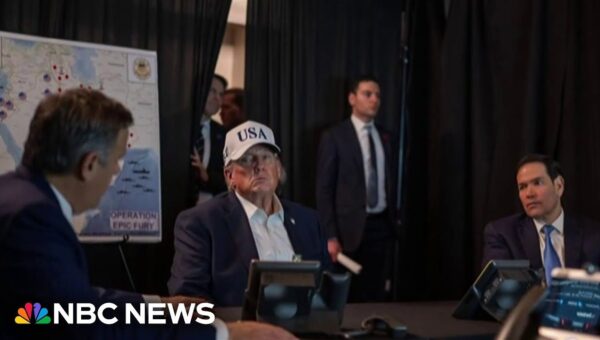
Trump: Iran Strikes Ahead of Schedule, Expects ‘Great Deal for World’
Three U.S. service members have been killed amid escalating conflict with Iran, President Trump confirmed. He stated that strikes are ahead of schedule, with senior Iranian leaders killed, and expressed optimism for a "great deal for the world" despite ongoing talks with Iranian officials.
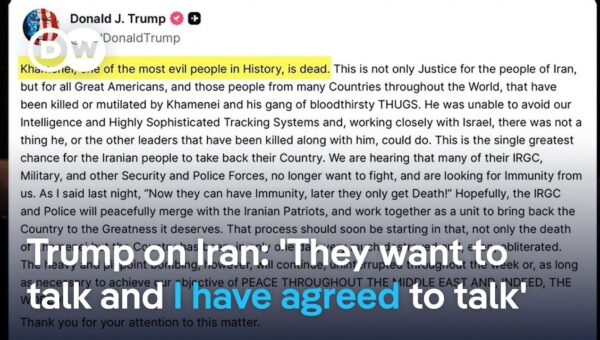
Trump Agrees to Talks with Iran After Major Strikes
President Donald Trump has agreed to talks with Iran's leadership following coordinated strikes that reportedly killed key figures, including the Supreme Leader. While Trump claims significant military successes, U.S. strategy remains unclear, and public opinion shows limited support for the actions amid rising American casualties.

Trump’s Putin Stance: US Strategy and Global Implications
Analysis suggests Donald Trump's approach to the Ukraine war involves pressuring Kyiv, but US involvement is crucial for resolution. China's influence and the 'MAGA' agenda's geopolitical implications are key factors.