Iran Outmaneuvers Trump, Dominates Strait of Hormuz
Iran appears to have outmaneuvered Donald Trump, gaining control over the Strait of Hormuz and disrupting global oil shipments. The situation is rooted in a disputed ceasefire agreement, with Iran claiming the U.S. is backtracking on terms that included Lebanon.

Iran Outmaneuvers Trump, Dominates Strait of Hormuz
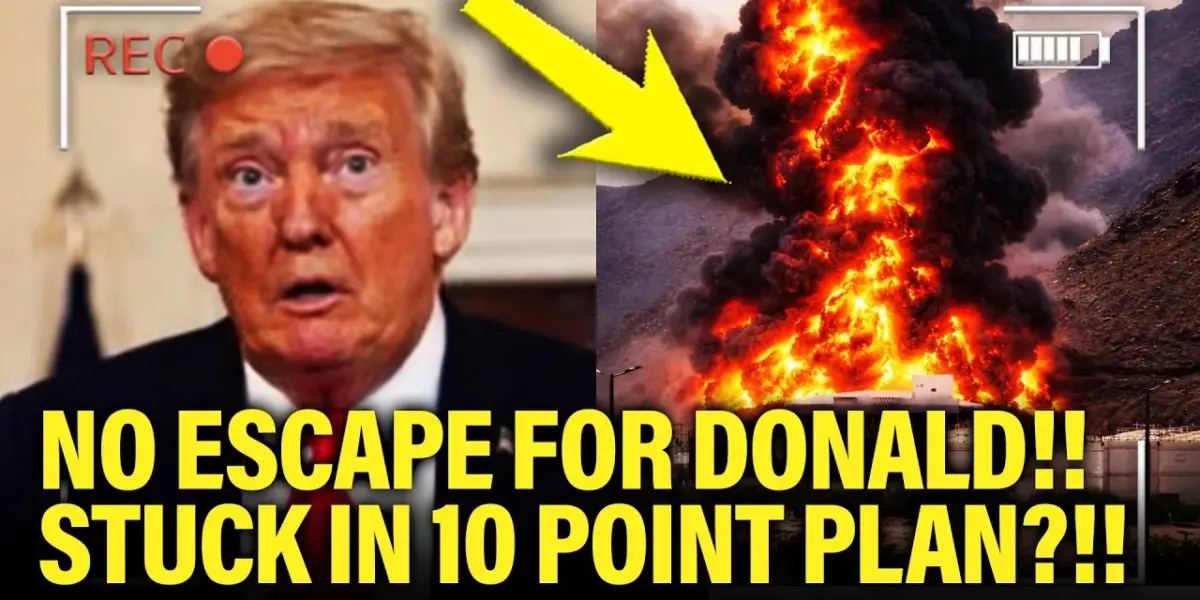
A dramatic standoff is unfolding in the Middle East, with Iran appearing to gain the upper hand against Donald Trump’s administration. The core of the conflict revolves around a proposed ceasefire agreement and control over the vital Strait of Hormuz. Iran claims it has trapped Trump in a deal he can’t escape, using leverage over global oil supplies.
The Ceasefire Chess Match
The situation began with a proposed 10-point settlement framework from Iran for a ceasefire. According to reports, Trump initially agreed to these terms. However, the plan was for Trump to then claim he had his own terms, not Iran’s. Iran, aware of this strategy, allegedly decided to call Trump’s bluff. They stated they would continue to control the Strait of Hormuz, a critical waterway for global oil transport, and would not allow any tankers to pass through.
This move has significant implications. The Strait of Hormuz is a choke point for a large portion of the world’s oil. By controlling it, Iran can exert immense pressure on global economies. Reports indicate that only Iranian ships have been allowed passage recently, with a near standstill for others. This action appears to be Iran’s response to perceived aggression, including potential Israeli actions in Lebanon.
Trump’s Reactions and Iran’s Stance
Donald Trump has responded with a flurry of social media posts, expressing frustration and making threats. He has claimed Iran is doing a poor job of allowing oil through the strait and warned against charging fees to tankers. However, Iran seems unfazed. Individuals close to Iranian leadership have stated that passage through the Strait of Hormuz has nearly stopped, with only Iranian shipments permitted. They also claim Iran has intensified restrictions following Israeli actions in Lebanon, directly linking their actions to the broader regional conflict.
Iranian Foreign Minister Zarif has publicly stated that if the U.S. allows the conflict to escalate, it would be a choice that would harm its own economy. He suggested that the U.S. would be making a mistake by letting Israeli Prime Minister Netanyahu’s actions derail diplomacy. This sentiment was echoed by J.D. Vance, a figure associated with Trump’s campaign, who had previously suggested that Iran’s choice to let the negotiation fail over Lebanon would be a mistake. Zarif’s response effectively turned Vance’s statement back on the U.S., highlighting the potential economic fallout.
Historical Context and the 10-Point Plan
The current dispute seems rooted in the specifics of the 10-point framework that Trump initially agreed to. Reports suggest this plan explicitly included a ceasefire in Lebanon. Pakistan’s Prime Minister Sharif, when announcing the ceasefire, also specifically mentioned Lebanon’s inclusion. This detail appears to be a crucial point of contention, with Iran accusing the Trump administration of backtracking on agreed-upon terms.
Iran’s Parliament leader, M.B. Ghalibaf, has been particularly assertive. He has posted statements emphasizing that Lebanon and the entire “resistance axis” are integral to the ceasefire. He cited point one of the 10-point proposal, which reportedly states the ceasefire applies to Lebanon. Ghalibaf also highlighted that Pakistan’s Prime Minister Sharif publicly confirmed Lebanon’s inclusion, leaving no room for denial. He has warned that ceasefire violations will have serious consequences and urged for the “fire” to be extinguished immediately, accompanied by an hourglass emoji, suggesting time is running out.
A Shifting Power Dynamic
The situation has led to widespread embarrassment for the United States, according to some observers. The narrative presented is one of Iran effectively dictating terms and leveraging its control over the Strait of Hormuz while the U.S. appears to be struggling to regain control. Reports suggest that for about three weeks, Trump had been seeking a ceasefire, with Iran initially ignoring his requests. The involvement of Pakistan as a broker for the deal, which Trump then agreed to, has led to the current complex situation.
Trump’s own social media posts, which were once seen as powerful tools, are now reportedly not having the desired impact. His claims of victory over Iran are being met with skepticism, especially as oil shipments remain disrupted. His attacks on media figures and political commentators, including Tucker Carlson and Megan Kelly, further fuel the perception of a chaotic and defensive response.
Wider Geopolitical Ripples
The events in the Strait of Hormuz are not happening in isolation. There are also concerns about the broader impact on international alliances, particularly NATO. Trump has reportedly been threatening to leave NATO, and some suggest that the current geopolitical maneuvers, including the Iran conflict, could be part of a larger plan to weaken the alliance. Ukrainian President Zelensky has questioned why sanctions on Russia are not being maintained if a ceasefire is in place, suggesting a potential link between the Iran conflict, sanctions relief for Russia, and the weakening of NATO.
Furthermore, reports indicate significant U.S. losses of MQ9 Reaper drones in the Iran conflict, amounting to hundreds of millions of dollars. The death of Kamal Kharrazi, a former Iranian foreign minister and advisor, from injuries sustained in an airstrike, adds another layer of tragedy and tension to the situation. His home was reportedly bombed by the U.S. and Israel while he was working with Pakistani officials on negotiations, resulting in the death of his wife and his own eventual passing.
Why This Matters
This situation highlights a critical shift in geopolitical power dynamics. Iran’s ability to effectively control a major global oil chokepoint demonstrates its growing influence and strategic capabilities. The perceived inability of the Trump administration to counter this move raises serious questions about U.S. foreign policy effectiveness and its standing on the world stage. The economic consequences of disrupted oil supplies could be severe, impacting global markets and potentially leading to inflation.
Implications and Future Outlook
The future outlook remains uncertain. Iran’s assertive stance suggests a willingness to engage in prolonged confrontation if its demands are not met. The U.S. faces a dilemma: either concede to Iran’s terms, potentially appearing weak, or escalate the conflict, risking further economic damage and regional instability. The credibility of international agreements and the effectiveness of diplomatic channels are also at stake. The ongoing tensions could lead to a more volatile Middle East, with wider implications for global security and energy markets.
The narrative presented is one of Iran effectively dictating terms and leveraging its control over the Strait of Hormuz while the U.S. appears to be struggling to regain control.
Source: Trump PANICS and TRAPS HIMSELF in WAR DEFEAT!!! (YouTube)

Related Articles
Strait of Hormuz Blockade to Last Months, Shipping Expert Warns
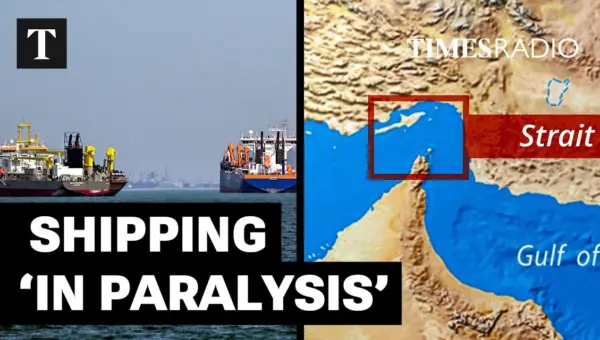
Shipping in the Strait of Hormuz remains severely disrupted despite a ceasefire, with an expert warning it could take months to clear. Iran has implemented an informal toll system, demanding payments from vessels transiting the vital waterway. Around 20,000 crew members are stranded as security risks prevent normal operations.
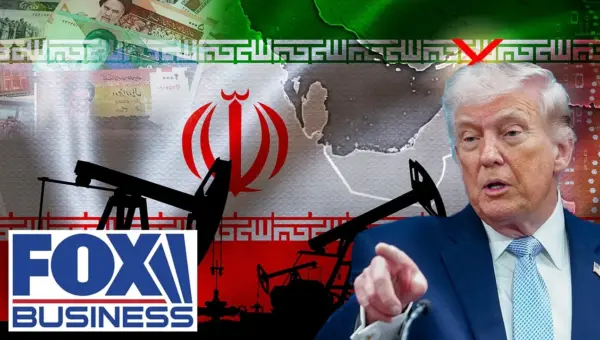
Trump Criticizes Iran as Oil Deal Hits Snags
President Trump has criticized Iran's handling of oil shipments through the Strait of Hormuz, adding uncertainty to a fragile deal. Despite geopolitical tensions, markets have shown resilience, but concerns linger over potential inflation and economic growth.

Oil Prices Surge 30% Amid Iran Ceasefire Uncertainty
Oil prices have surged over 30% as a fragile ceasefire between the U.S. and Iran fails to calm markets. Disruptions in the Strait of Hormuz and reduced Saudi production are driving up costs for energy, shipping, and potentially inflation, with significant economic consequences expected.