Iran Cyberattacks Expose U.S. Defense Gaps Post-Strike
Pro-Iran hackers have targeted U.S. medical device maker Stryker, exposing critical gaps in the nation's cybersecurity defenses following recent military actions. Experts highlight a weakened cybersecurity infrastructure and question the strategic planning behind the U.S. response to Iran.


Iran Cyberattacks Expose U.S. Defense Gaps Post-Strike
In the wake of U.S. and Israeli military actions against Iran, a new cyber threat has emerged on the home front, targeting a major American medical device manufacturer. Pro-Iran hackers successfully breached the systems of Stryker, a company known for producing critical medical equipment ranging from defibrillators to hospital beds. The company has warned that disruptions are expected to continue indefinitely, highlighting a significant vulnerability in U.S. cybersecurity infrastructure.
Iran’s Growing Cyber Prowess
Michael Feinberg, speaking on the incident, confirmed that the Wall Street Journal unequivocally reported the cyberattack as Iran-associated and inspired. While details of U.S. defensive capabilities and threat detection methods remain classified, Feinberg emphasized that Iran, despite its geopolitical standing compared to global powers like Russia or China, is remarkably proficient in cyber intrusions and exploitation. “They have, as has been publicly reported, gotten into not just companies and corporations accounts… but also into the accounts of high ranking U.S. officials. They are not to be underestimated within this threat sphere,” Feinberg stated.
Undermined Cybersecurity Infrastructure
The timing and impact of these attacks have raised alarms about the state of U.S. cybersecurity defenses. Feinberg pointed to a concerning depletion of critical infrastructure designed to thwart such threats. “The infrastructure that the United States had a year and a half ago for stopping these sort of attacks has been gutted,” he asserted. He specifically cited the case of CISA, the Department of Homeland Security’s primary cybersecurity arm, which he claims was significantly weakened for political reasons, following its former head’s comments on the 2020 election. “For blatantly political reasons of revenge, there is an entire agency devoted to stopping this sort of thing that functionally does not exist,” Feinberg lamented.
Strategic Miscalculation on Iran’s Response
Mark Vazzetti’s reporting sheds light on a perceived miscalculation by the Trump administration regarding Iran’s potential response to the U.S.-Israeli strikes. Inside the administration, some officials reportedly grew pessimistic about the lack of a clear strategy to conclude the conflict, though they were cautious in expressing these concerns to the President, who publicly declared the military operation a resounding success. Vazzetti suggested that the approach to war was haphazard and lacked public preparation for its potential consequences. While military forces were bolstered in the Middle East, it remains unclear how extensively other government sectors were prepared to counter the diverse threats Iran could pose.
Iran’s Asymmetric Warfare Capabilities
Vazzetti elaborated on Iran’s capacity to inflict damage beyond conventional military confrontation. “Iran is what it doesn’t have militarily to go head-to-head with the United States or Israel. It has plenty of other ways to use leverage to inflict pain,” he explained. These methods include economic disruption, as seen in the Strait of Hormuz, and cyber warfare, which Michael Feinberg highlighted. Iran is adept at targeting financial institutions and other entities to cause economic hardship, as well as executing physical attacks on civilian areas and U.S. military bases. “These are how Iran can get its leverage and and and get a war to conclude on its terms,” Vazzetti noted. He questioned whether sufficient groundwork was laid prior to the conflict to mitigate these threats, especially given the last-minute uncertainty surrounding the war’s initiation and potential diplomatic off-ramps.
Intelligence Suggests Regime Stability
Further complicating the strategic landscape, recent U.S. intelligence assessments indicate that the Iranian government is not at risk of imminent collapse. According to Reuters, multiple intelligence reports consistently suggest that Iran’s leadership remains largely intact and secure, maintaining control over the public. This intelligence contradicts the maximalist goals previously articulated by some U.S. officials, including demands for Iran to name a leader who would submit to U.S. authority. The administration’s stated rationales for the conflict have not included plans for the complete dismantling of the Iranian government, even as the President has encouraged public uprisings.
Failed Objectives and Regional Instability
The article suggests a spectacular failure to achieve explicit objectives, citing the lack of action against Iran’s nuclear program, specifically mentioning the failure to target a significant uranium enrichment facility located deep underground. The outcome of the U.S. actions, according to the critique, has been widespread “chaos and carnage,” potentially escalating into a larger regional conflict or even a global one. The absence of consideration for regional stability, the safety of Americans in the region, and domestic security implications has been described as a “catastrophe of moral, economic, and political proportions.”
Looking Ahead
As the situation unfolds, the focus will be on the U.S.’s ability to fortify its cybersecurity defenses against increasingly sophisticated state-sponsored attacks. Furthermore, a clear and coherent long-term strategy for the region, addressing both immediate threats and the underlying causes of instability, will be crucial. The effectiveness of U.S. intelligence in accurately assessing and responding to the resilience of the Iranian regime will also be a key area to monitor.
Source: "Chaos and carnage": Iran war EXPOSES U.S. counterintelligence gaps (YouTube)

Related Articles


Iran Targets US With Cyberattacks, Escalating Digital Warfare
Iran is increasingly using cyberattacks to challenge the U.S., as seen in a recent hack of the FBI director's account. Experts say this is a strategic shift due to Iran's limitations in conventional warfare. The U.S. needs to strengthen its digital defenses, focusing on encryption and cloud computing, rather than solely relying on traditional security measures.

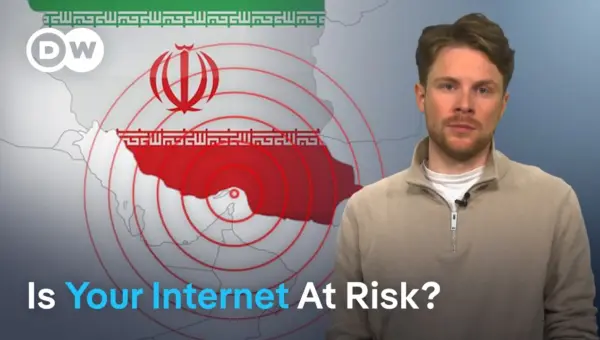
Iran Conflict Threatens Global Internet: Cables at Risk
The ongoing conflict involving Iran is putting global internet infrastructure at risk. Threats to data centers and vital undersea fiber optic cables could disrupt online services worldwide. Redundant systems may not be enough if backups are also in the line of fire.


Iran Recruits Minors for Global Spying via Telegram
Iran's intelligence agencies are reportedly using apps like Telegram to recruit individuals, including minors, for global spying operations. The regime offers small sums for tasks such as filming people of interest, a tactic that poses significant challenges for law enforcement due to its deceptive and widespread nature.