Iran Appoints New Leader Amidst Escalating Regional Conflict
Iran has appointed Moabah Hami as its new Supreme Leader amid escalating regional hostilities, drawing international scrutiny. The Foreign Ministry spokesperson defended the appointment as constitutional and asserted Iran's right to self-determination, while labeling the ongoing conflict as an "act of aggression" by the US and Israel.

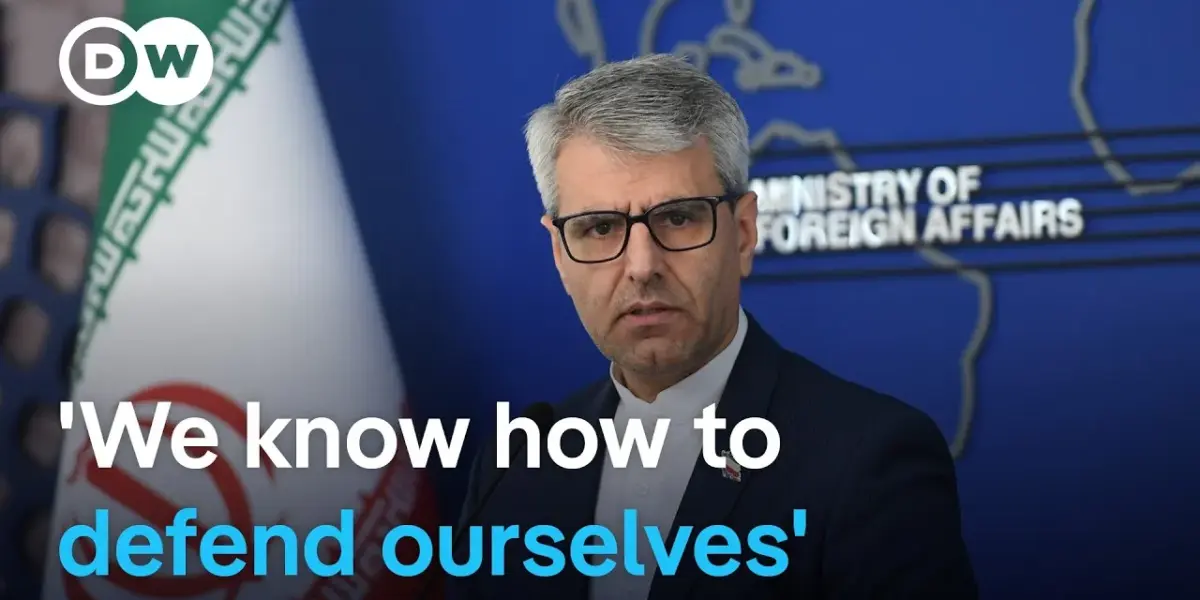
Iran Names New Supreme Leader Amidst Intensifying War
Tehran, Iran – In a significant political development amidst a backdrop of escalating regional hostilities, Iran has appointed Moabah Hami as its new Supreme Leader. Hami, the son of the recently deceased Ayatollah Ali Hami, who was killed in what Iran describes as US-Israeli attacks on February 28th, assumes leadership of the nation during a period of heightened tension. The appointment, confirmed by the Assembly of Experts in accordance with the country’s constitution, signals a continuation of Iran’s internal political structure despite external pressures.
New Leadership Faces International Scrutiny
The selection of Moabah Hami, characterized by analysts as a hardliner deeply entrenched in Iran’s political and military establishment, comes at a critical juncture. The appointment has drawn immediate reactions from the international community, particularly the United States. US President Donald Trump had previously stated that any successor not chosen with US involvement “isn’t going to last long.”
In an interview with DW News, Ismile Bagayi, spokesperson for the Iranian Foreign Ministry, addressed these international concerns. “We don’t care what kind of signals others take or get from this selection,” Bagayi stated. “This has been done in accordance with the constitution.” He emphasized Iran’s right to self-determination, asserting that external intervention or commentary on the nation’s leadership is “against international law” and constitutes “lawless behavior.”
“It doesn’t concern any outsider to intervene or to tell us who should rule Iran. We are doing we are exercising our right of self-determination.”
Ismile Bagayi, Spokesperson for the Iranian Foreign Ministry
Denials of Repression and Claims of Self-Defense
When questioned about whether the new leadership would continue policies of repression, mirroring those of his father, Bagayi strongly refuted the characterization. He described such notions as “negative stereotyping and cliches” and asserted that Iran operates as a “democratically elected system in accordance with the constitution.”
Bagayi addressed the issue of recent internal unrest, acknowledging an “uprising” but attributing violence to “infiltrators” taking orders from the United States and Israel. He claimed that over 3,000 people were killed, including security forces and bystanders, by these “gunmen” aiming to inflate casualty figures to justify foreign intervention. He also defended the government’s decision to shut down internet access during these periods, stating it was a measure to prevent communication among “infiltrators” and “terrorists” and to maintain “rule of law and security.”
Iran Labels Conflict as “Act of Aggression”
The ongoing hostilities, referred to by some as a “war,” are unequivocally labeled by Iran as an “act of aggression.” Bagayi insisted on precise terminology, stating, “If you want to be true to your audience, you have to call a spade a spade. This is an act of aggression, unprovoked and unwarranted, imposed by the United States and Israel against the nation of Iran.” He highlighted that Iran was engaged in negotiations for the second time in nine months when the aggression began.
Iran maintains that its military actions are purely defensive. Bagayi explained that strikes targeting neighboring countries are aimed at “military bases, those assets that are being used by the United States to attack Iran.” He cited UN General Assembly Resolution 2625, which prohibits states from allowing their territory to be used for military attacks against another nation, as justification for targeting such installations.
Accusations of Civilian Casualties and Counter-Claims
Despite Iran’s claims of targeting only military installations, reports and questions were raised regarding strikes on civilian infrastructure, including oil and gas facilities, desalination plants, and residential buildings. Bagayi countered these accusations by questioning whether similar questions were posed to the United States and Israel. He alleged that on the first day of the attacks, the US and Israel targeted an elementary school in Minab, resulting in the deaths of over 170 children, and damaged sports complexes.
“We care, we are very careful, our armed forces are very careful not to attack any non-military objective or targets,” Bagayi asserted, while also accusing the US and Israel of “organized laundering of their crimes” and drawing parallels to the situation in Palestine, where he claimed “70,000 innocent people” had been killed.
Leadership and Control Amidst Strikes
The interview also touched upon the apparent contradiction between the Iranian President’s apology for “inconvenience” caused to neighboring countries and the continuation of strikes. Bagayi clarified that the President expressed sorrow for any “inconvenience” caused by “defensive operations” but did not apologize for defending the nation. He reiterated that Iran does not attack countries that are not aiding the United States and Israel, and that military actions are justified under international law to defend against aggression originating from foreign military bases on regional soil.
When pressed on who is in charge of the armed forces, Bagayi confirmed that they are operating under the constitution, with the Supreme Leader and an interim council overseeing operations. He stressed that the armed forces are entitled to defend Iran’s territory and sovereignty.
International Support and Diplomacy
Regarding support from allies like Russia, Bagayi stated that Iran is a “sovereign nation” capable of defending itself, while acknowledging defense cooperation with Russia that he insisted has not been directed against any specific country. He vehemently denied any Iranian involvement in the Ukraine conflict, labeling such claims as “another big lie propagated in Western media.”
On the prospect of de-escalation, Bagayi questioned Iran’s role in escalating the conflict, reiterating that the war was imposed upon the nation. He referenced a previous statement by Iran’s Foreign Minister suggesting no immediate reason to negotiate or seek a ceasefire, explaining that this was a response to a question about diplomacy following the betrayal of diplomatic processes by the United States. He concluded that Iran’s “full concentration right now is to defend our territorial integrity and sovereignty” amidst ongoing attacks.
Looking Ahead
As Iran navigates this complex geopolitical landscape under new leadership, the international community will be closely watching its actions and rhetoric. The emphasis on self-defense, coupled with accusations of foreign aggression, sets a tense stage for future diplomatic engagements, should they materialize. The commitment to defending territorial integrity and sovereignty suggests a protracted period of heightened regional tension.
Source: Iranian Foreign Ministry spokesperson talks to DW about the war | DW News (YouTube)

Related Articles

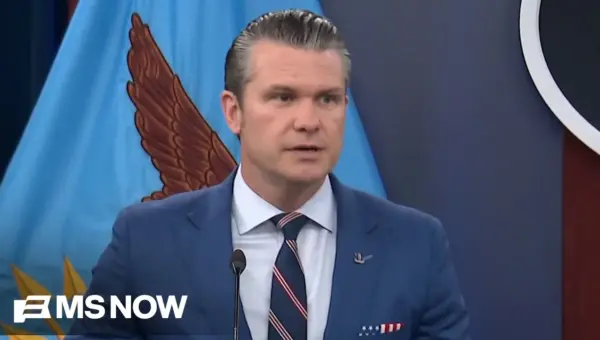
US Escalates ‘Epic Fury’ Strikes Against Iran
The U.S. has intensified Operation Epic Fury with its most significant strikes inside Iran to date, targeting missile stockpiles, naval capabilities, and nuclear ambitions. Officials described the operation as decisive, efficient, and a stark departure from previous prolonged conflicts.


Iran Soccer Players Granted Asylum in Australia After Anthem Protest
Five Iranian women's soccer players have been granted asylum in Australia after a silent protest during their national anthem at a tournament sparked backlash at home. Australian Prime Minister Scott Morrison confirmed the players are in a safe location after receiving humanitarian visas. The move follows international calls for protection, with fears they would face severe consequences if returned to Iran.


Bitcoin Surges Amidst Global Turmoil, Eyes Next Resistance
Bitcoin shows remarkable resilience, rallying amidst growing geopolitical tensions and oil market volatility. The digital asset's ability to overcome key resistance levels and navigate global uncertainty will determine if its upward momentum can continue.