Iceland Considers EU Membership Amid Geopolitical Shifts
Iceland is preparing to hold a referendum on joining the European Union, a move influenced by global instability and shifting geopolitical alliances. The nation's strategic location and vital fishing industry are key considerations in the upcoming public debate.

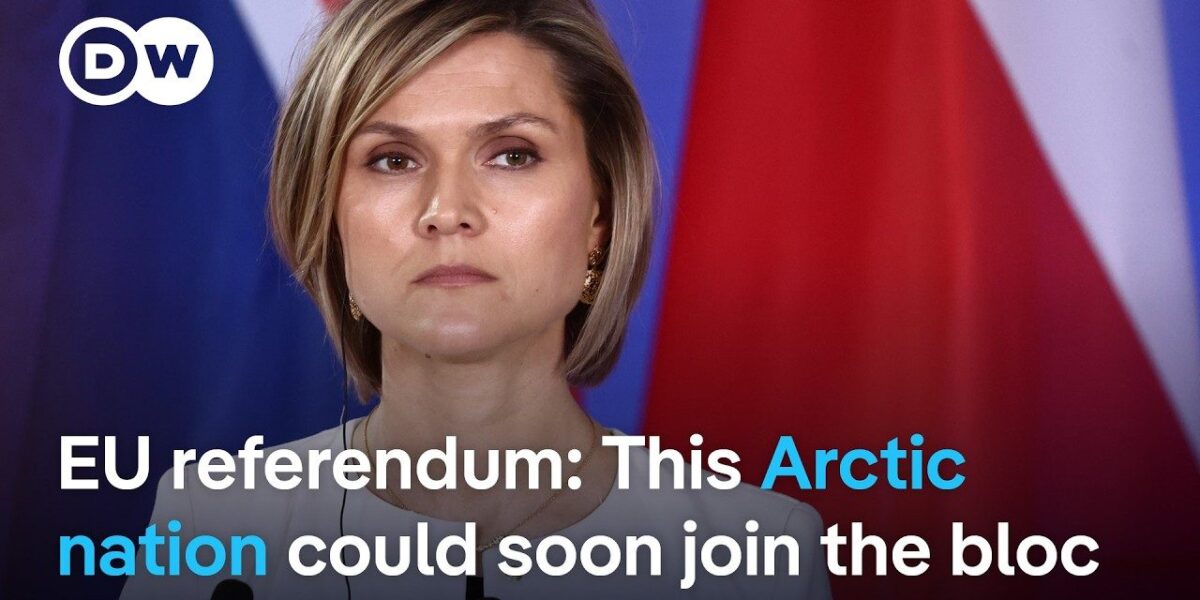
Iceland Eyes EU Membership: Referendum Planned Amid Global Instability
Reykjavik, Iceland – Iceland is set to hold a referendum in the coming months on full membership in the European Union, a significant policy shift driven by escalating global instability and renewed geopolitical considerations. The announcement, made by Prime Minister Katrín Jakobsdóttir, signals a potential return to a path the nation abandoned in 2013, reflecting a broader re-evaluation of international alliances and security in the wake of Russia’s invasion of Ukraine.
A Nation at a Crossroads: Why Now?
While Iceland has long maintained a close working relationship with the EU, participating in the Schengen Area for passport-free travel, the prospect of full membership has gained renewed traction. Prime Minister Jakobsdóttir articulated a vision of Iceland contributing significantly to the bloc. “I think Iceland has a lot to bring to the EU,” she stated. “Iceland has shown its strength and its perseverance throughout centuries. We have been able to develop our resources in a positive way. We’ve been able to drive GDP growth in the right direction. Um, we have had a good welfare system. We have solid values and we have respect for one another.”
However, she also acknowledged Iceland’s unique position as an Arctic nation, distinct from mainland Europe. “We’re not mainland Europe. So even though we share certain values, we don’t share borders in the same way that a lot of central European or mainland European countries understand. So this is a different element to Europe.” This nuanced perspective highlights the complex considerations involved in such a momentous decision.
Geopolitical Tremors Drive Reconsideration
The renewed debate over EU membership is not isolated to Iceland. According to Marisol Maddox, a Senior Arctic Fellow at the Institute of Arctic Studies at Dartmouth College, similar discussions are unfolding in neighboring countries. “We’re seeing renewed talks about engagement with the EU, whether it’s expanding defense cooperation or actually reconsidering membership not just from Iceland, but also from Norway as well as Canada,” Maddox observed. “So, we’re really seeing that just really it’s a result of this geopolitical upheaval that is really driving renewed debate within all of these countries.”
Maddox pointed to shifts in U.S. foreign policy as a key catalyst. “I think there have been very significant changes from the U.S. that are making Europe and Canada really have to question whether the United States is a reliable ally,” she explained. “And really seeing the need to diversify different coalitions being able to have more bargaining power, not being overly reliant where they really lose leverage and then can’t kind of advocate for their own people from a position of strength.” Tariffs, in particular, have emerged as a significant concern for smaller economies.
Strategic Importance: The Greenland-Iceland-UK Gap
Iceland’s strategic location cannot be overstated. Situated within the Greenland-Iceland-UK (GIUK) gap, it represents a critical naval choke point in the North Atlantic. This region is vital for monitoring submarine activity, particularly from Russia, as it lies along key transit routes from the Arctic into the wider Atlantic. “So Iceland is the eye in GIUK gap, right? So that’s the Greenland Iceland UK gap, which is a strategic naval choke point,” Maddox elaborated.
This strategic significance has led to increased U.S. military cooperation with Iceland through NATO in recent years. Maddox noted recent developments such as the first U.S. nuclear-powered submarine port call in Iceland and air power exercises involving MQ9 Reapers. These activities are seen as responses to Russian military expansion and underscore the growing importance of the Arctic region in global security dynamics. “The United States continues to exercise with our allies in Europe just in a more calibrated way now that the new administration is kind of reprioritizing an interpretation of the western hemisphere and in the Pacific,” she added.
Domestic Politics and Public Opinion
Ingólfur Sigfússon, a journalist at RÚV, Iceland’s national broadcaster, provided insight into the domestic political landscape. He characterized the decision as “plain politics,” stemming from the current three-party coalition government, two of which favor EU membership. While not an explicit campaign promise, the move to revisit EU accession talks was anticipated.
Sigfússon highlighted that a robust national debate on the matter has yet to fully materialize, despite Iceland’s previous application. “There hasn’t really and there never really has been which may sound odd given that we applied to join as you mentioned some 13, 14 years ago,” he said. “And I think that will probably be one of the interesting things coming in the few in the coming months is the debate about actually why would we or why wouldn’t we join. That is the debate that the population in particular has still to have.” He also noted that the announcement itself was largely expected within Iceland, perhaps more tailored for European audiences.
The Sticking Point: Fisheries and Sovereignty
One of the most significant hurdles anticipated in any EU accession talks is Iceland’s vital fishing industry. The nation has a deep cultural and economic connection to its fisheries, famously defending its fishing grounds in the “Cod Wars” with the United Kingdom. Iceland prides itself on a sustainable, science-based quota system, which many fear could be jeopardized by EU membership.
“Icelanders will probably talk about sovereignty, which is hard to define, but fisheries is not hard to define,” Sigfússon explained. “Iceland is a country that both sort of culturally but also economically is very tight to fisheries. We are also very proud of having fought the Brits for our fishing grounds in the cod wars.” Concerns exist that EU membership could lead to a loss of control over these valuable resources. “People fear that what we’ve been able to protect here, the fish that we still are able to sustainably catch, that that simply won’t be around if everyone and anybody can just show up here in an EU boat and do what they want to,” he added. The ability to secure exceptions or special arrangements regarding fisheries will likely be a critical factor.
Beyond the EU: Security Guarantees
Iceland’s unique security posture, as a founding member of NATO without its own standing military, further complicates the discussion. Defense relies on a 1951 agreement with the United States. In an era of shifting alliances and perceived unreliability, the prospect of enhanced security through EU membership is increasingly appealing.
Sigfússon questioned the certainty of external support: “Do you want to trust that Donald Trump will come to your defenses something happens? I think that’s debatable.” This sentiment underscores a broader desire for more robust and diversified security arrangements, potentially offered by full EU integration.
Looking Ahead: The Path to Membership
The upcoming referendum represents a pivotal moment for Iceland’s future. The nation must now engage in a comprehensive public debate, weighing the economic and security benefits of EU membership against concerns over sovereignty, particularly regarding its crucial fishing sector. The geopolitical landscape, marked by increased tensions and a re-evaluation of global partnerships, provides a compelling backdrop to this historic decision. The outcome will not only shape Iceland’s trajectory but also send ripples through the broader European and Arctic security architecture.
Source: Iceland to hold referendum on full EU membership | DW News (YouTube)

Related Articles

Trump: Iran Strikes Ahead of Schedule, Expects ‘Great Deal for World’
Three U.S. service members have been killed amid escalating conflict with Iran, President Trump confirmed. He stated that strikes are ahead of schedule, with senior Iranian leaders killed, and expressed optimism for a "great deal for the world" despite ongoing talks with Iranian officials.

Trump’s Putin Stance: US Strategy and Global Implications
Analysis suggests Donald Trump's approach to the Ukraine war involves pressuring Kyiv, but US involvement is crucial for resolution. China's influence and the 'MAGA' agenda's geopolitical implications are key factors.


US Strikes Iran: Mounk and Fukuyama Discuss Unpredictable Conflict
Leading political scientists Yascha Mounk and Francis Fukuyama analyze the recent US strikes on Iran, warning of unpredictable outcomes and internal instability. They question the objectives of the "war of choice" and its potential to destabilize the region, while also discussing the shifting global perceptions of Israel.