High-Speed RAM: Gamers Can Save Cash, Pros Still Pay
New testing reveals that gamers, particularly those with AMD X3D CPUs, can save money on DDR5 RAM without significant performance loss. However, professionals still face a high cost for speed-dependent productivity tasks.

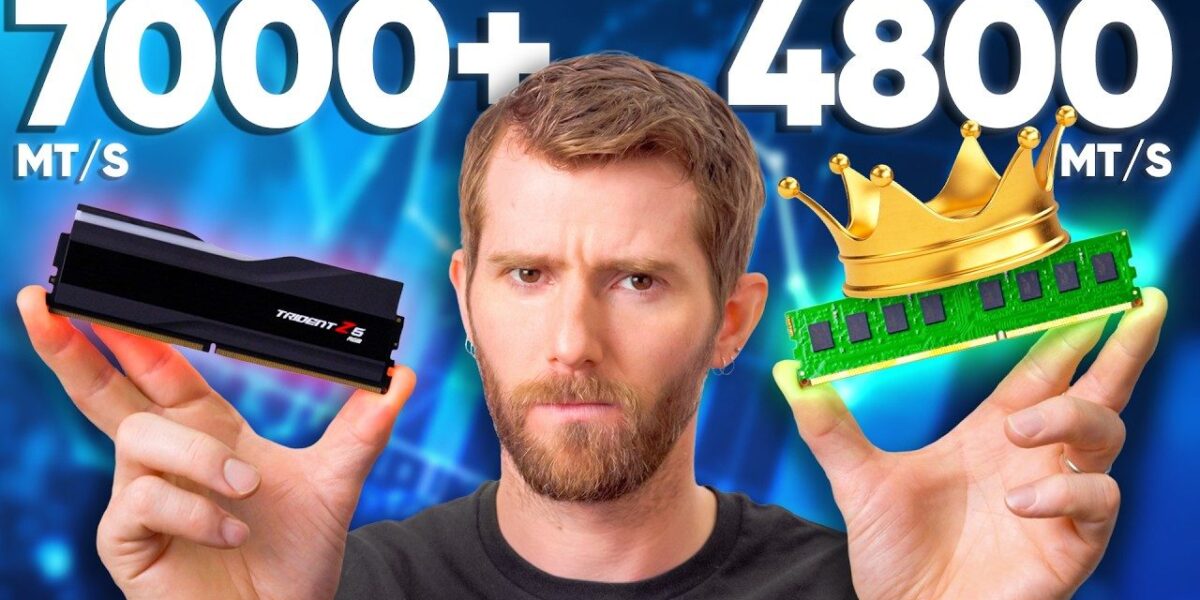
High-Speed RAM: Gamers Can Save Cash, Pros Still Pay
The ongoing RAM price hikes have left many PC builders questioning the value of premium memory. A recent deep dive into DDR5 performance across various CPUs and speeds reveals that for gamers, especially those wielding AMD’s popular X3D processors, the significant price premium for the fastest RAM might not be worth it. However, for professionals who rely on their machines for demanding productivity tasks, the investment in high-speed, low-latency memory could still be a necessity, albeit a costly one.
Gaming Performance: X3D CPUs Shine with Slower RAM
The core takeaway for the gaming community is a resounding message: you might not need to break the bank for the absolute fastest DDR5 kits. Extensive testing involving four different CPUs, run at eight varying DDR5 speeds, demonstrated that at typical gaming resolutions and settings, the performance difference between industry-standard speeds and high-end overclocked gaming RAM is often negligible. This is particularly true for AMD’s Ryzen X3D processors. The company’s own claims that these CPUs are less sensitive to memory speed appear to hold up under scrutiny. While the slowest DDR5 kit tested (4,800 MT/s) did trail behind faster kits on AMD’s 9800X3D, the sweet spot of 6,000 MT/s CL30 still proved effective, and the performance gap narrowed significantly as resolution and graphical settings were increased. Even for Intel’s Raptor Lake (e.g., 14900K), while faster RAM showed a more pronounced benefit, the 1% low framerates across tested games and resolutions showed minimal differences, often within a handful of FPS. Unless you have an on-screen FPS counter, these minor gains are unlikely to be perceptible during gameplay, especially at higher resolutions like 1440p or 4K.
The Context of Cost: Why RAM Speed Matters (or Doesn’t)
The article emphasizes the importance of context when discussing RAM performance. Previously, a $20-$30 difference for a few percent performance improvement on a $1500+ gaming PC was an easy recommendation. However, with current pricing, the jump to higher-speed kits can cost an additional $200-$300, fundamentally changing the value proposition. For gamers, this cost increase often outweighs the marginal performance gains, making slower, more affordable RAM a sensible choice. This is especially true for AMD X3D users, whose processors seem to extract excellent performance even from less expensive memory kits.
Productivity: Where Speed Still Commands a Premium
The narrative shifts when looking at professional use cases. While some productivity tasks on Intel chips mirrored gaming results, a significant number showed measurable improvements with faster memory. For instance, a GDAU compile test on the Intel 14900K yielded a decent performance boost with higher-speed RAM. This suggests that if your machine is a tool for generating income, investing in high-speed, low-latency memory might still be justifiable, even with today’s inflated prices. The article points out that while corporate workstation budgets might absorb these costs more readily, individual professionals and small businesses face a tougher decision. The need for faster or larger amounts of RAM for tasks like software development or complex creative work makes it a particularly difficult time for these users to upgrade.
Intel vs. AMD: A Tale of Two Platforms
When comparing Intel and AMD platforms, the findings are nuanced. Intel’s latest chips, like the Core Ultra 285K, showed a preference for faster DDR5, though even here, the performance gap at the 1% low metric was often too small to notice in real-world gaming. The older 14900K, however, clearly benefited from higher-speed DDR5, especially in specific games. For AMD, the 9800X3D’s resilience to slower RAM was a standout, reinforcing its position as a gaming powerhouse that doesn’t demand the absolute fastest memory. The 9950X, while not as sensitive as Intel’s top-tier CPUs, did show that faster RAM, particularly kits optimized with AMD’s EXPO profiles, could yield benefits, especially in productivity scenarios. Overall, AMD’s X3D chips continue to offer a compelling gaming experience without the stringent RAM speed requirements seen on some competing platforms.
Who Should Care and Why?
Gamers: Especially those using AMD X3D processors, can likely save money by opting for more moderately priced DDR5 kits (e.g., 5600-6000 MT/s) without sacrificing noticeable performance. Intel users might see more benefit from faster RAM, but the cost-to-performance ratio needs careful consideration given current prices.
Content Creators & Developers: Professionals relying on memory-intensive applications (video editing, 3D rendering, code compilation) may find that investing in higher-speed, lower-latency DDR5 kits can lead to tangible productivity gains. However, the high cost remains a significant barrier.
Budget Builders: The current RAM market makes it challenging. However, understanding that gamers don’t necessarily need the absolute fastest kits opens up more budget-friendly options, allowing funds to be allocated elsewhere in the build.
Availability and Pricing
The article notes that while slower DDR5 kits have been impacted by price increases, they still offer a more accessible entry point compared to the bleeding-edge, high-speed kits. Specific pricing details were not provided, but the commentary suggests that the premium for top-tier RAM remains substantial, making it difficult to recommend universally. The advice for professionals is to potentially delay upgrades and wait for the market to stabilize, hoping for a price correction.
Specs & Key Features
- RAM Types Tested: DDR5
- Speeds Tested: Ranging from 4,800 MT/s up to 8,400 MT/s
- CPUs Tested: Intel (Raptor Lake, Core Ultra), AMD (X3D series, non-X3D series)
- Key Performance Metrics: Geo Mean across games, 1% Lows, Productivity benchmarks (e.g., Blender, GDAU compile)
- Form Factors: Standard DIMMs
- Features: Support for JEDEC standards, Intel XMP, AMD EXPO
The Verdict: Savvy Choices in a Tough Market
In conclusion, the era of blindly recommending the fastest RAM is over, at least for the average gamer. The significant price increases have shifted the value proposition, particularly benefiting users of AMD’s X3D processors who can achieve excellent performance with more affordable memory. While professionals may still need to invest heavily in high-speed RAM for critical workloads, the market is currently making that choice painful. The advice is clear: gamers should prioritize value and consider mid-range DDR5 kits, while professionals should weigh the productivity gains against the steep costs, perhaps waiting for market normalization. The takeaway is to be a discerning buyer and avoid unnecessary expenses, especially when the performance uplift is marginal.
Source: Stop WASTING Money on Fancy RAM (YouTube)

Related Articles


QD OLED Gaming Monitors Hit New Price Low
AOC's Q27G4ZD QD OLED gaming monitor is now available for an unprecedented $420, bringing the stunning visual benefits of OLED technology to a mainstream audience. While it utilizes an older panel generation with some minor trade-offs, its 1440p resolution, 280Hz refresh rate, and incredible contrast offer a premium gaming experience at an affordable price.


Costco Gaming PCs: A Smart Buy or a Big Box Trap?
Costco's expanding electronics section now includes gaming PCs, offering a compelling blend of convenience and value. While not without its quirks, like a VRAM specification confusion, these pre-built systems provide a solid entry point into PC gaming with excellent warranty and return benefits.


Honor’s ‘Robot Phone’ Adds a Gimbal Arm
Honor's 'Robot Phone' made waves at MWC with its integrated gimbal-stabilized camera arm and 200MP sensor. This innovative device aims to redefine mobile videography with advanced AI tracking and dynamic shooting capabilities.