GPT-5.4 Pro Shatters AI Benchmarks, Posing New Security Concerns
OpenAI's new GPT-5.4 Pro model is setting new benchmarks in AI capabilities, outperforming competitors in complex reasoning and real-world tasks. However, its advanced cybersecurity potential also raises significant concerns about future threats.

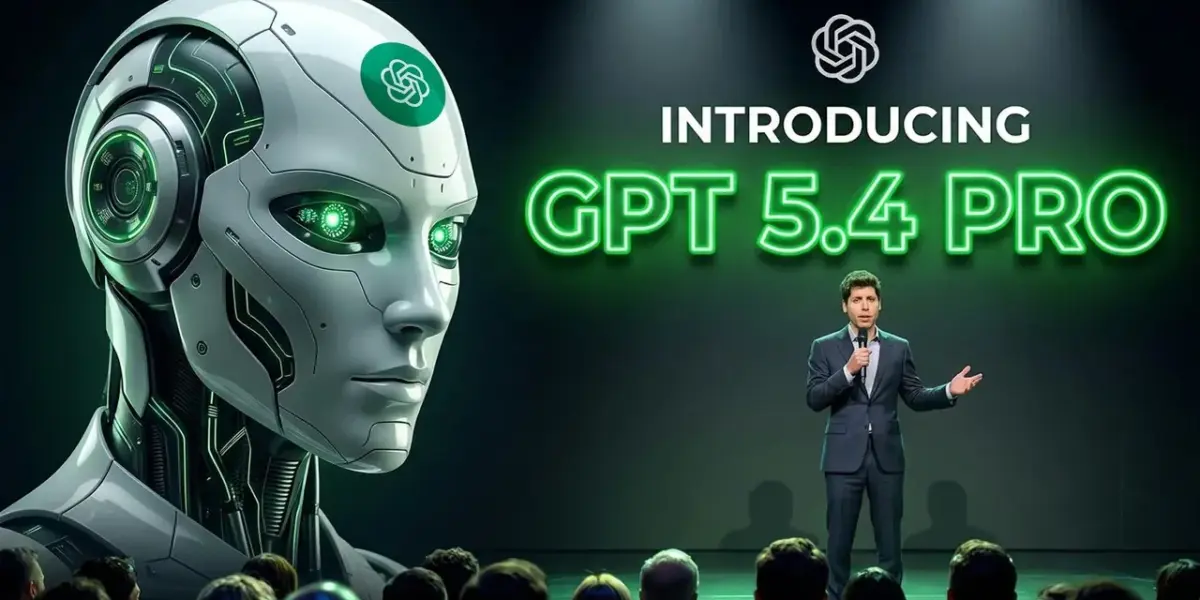
OpenAI’s Latest Model Demonstrates Unprecedented Capabilities
OpenAI has unveiled its newest flagship AI model, GPT-5.4 Pro, marking a significant leap forward in artificial intelligence capabilities. Early benchmarks suggest the model not only surpasses its predecessors but also outperforms leading competitors like Anthropic’s Claude Opus 4.6 and Google’s Gemini 3.1 across a range of challenging tasks, particularly in areas requiring advanced reasoning and real-world problem-solving.
Pushing the Boundaries of AI Performance
While traditional benchmarks often become saturated quickly as AI models improve, OpenAI has focused on evaluating GPT-5.4 Pro against next-generation challenges. These include ‘Frontier Math,’ ‘OSWorld,’ and ‘Browse Comp.’ The ‘Browse Comp’ benchmark, designed to test an AI’s ability to extract and synthesize real-time information from the web, saw GPT-5.4 Pro achieve an impressive 89.3%. This is a notable achievement, especially considering Google’s Gemini 3.1 Pro, powered by the search giant’s infrastructure, was expected to excel in this domain.
Mastering Complex Mathematics
One of the most striking advancements is GPT-5.4 Pro’s performance on ‘Frontier Math.’ This benchmark comprises problems designed by professional mathematicians that require research-level, novel thinking. Previously, top models struggled, scoring around 2%. GPT-5.4 Pro, however, shows a dramatic improvement, dominating the benchmark, particularly on Tier 4, the most difficult set of problems. This consistent lead in mathematical reasoning is an area where OpenAI has reportedly maintained an advantage, with mathematicians even utilizing versions of ChatGPT to aid in solving complex equations.
Beyond Benchmarks: Human-Level Problem Solving
The implications of GPT-5.4 Pro’s capabilities extend beyond numerical scores. A mathematician working with the model reported that GPT-5.4 Pro solved a personal, long-standing problem that had remained unsolved for 20 years – a feat impossible to achieve through simple data scraping. This event has been likened to DeepMind’s AlphaGo’s groundbreaking ‘Move 37,’ signaling a potential crossing of a qualitative threshold where AI demonstrates genuinely novel, almost human-like insight in complex domains. The model achieved a 38% success rate on the hardest tier of these novel problems, a significant jump from previous capabilities.
Navigating Professional Workflows and Cost Considerations
GPT-5.4 Pro also demonstrates remarkable aptitude in professional service tasks. The ‘Apex Agents’ benchmark, which simulates real-world work for investment bankers, consultants, and lawyers, saw GPT-5.4 Pro achieve 52% on tasks previously completed by human professionals. This benchmark, launched in January 2026, saw scores jump from 24% to over 50% in just 6-8 weeks, highlighting the rapid acceleration of AI in these fields. OpenAI’s internal ‘GDP Val’ benchmark, which compares AI performance against human knowledge workers across various industries, shows GPT-5.4 Pro matching or beating humans 83% of the time, and doing so approximately 100 times faster and cheaper.
However, these advanced capabilities come at a significant cost. GPT-5.4 Pro is priced at $30 per million tokens for input and $180 per million tokens for output. This makes it considerably more expensive than competitors like Claude Opus 4.6, potentially leading users to opt for standard versions of GPT-5.4 for cost-effectiveness, especially for tasks not requiring the highest level of reasoning.
Agentic Capabilities and Real-Time Computer Interaction
A key development is GPT-5.4 Pro’s enhanced ability to interact with computers and software systems. It is described as the first general-purpose model with native computer use capabilities, making it highly effective for developers building AI agents. The ‘OSWorld’ benchmark, which tests an AI’s ability to navigate desktop environments, saw GPT-5.4 Pro achieve state-of-the-art performance at 75%, surpassing its predecessor.
The model’s capacity for real-time visual information processing is also highlighted, with demonstrations showing it efficiently processing and inputting data into systems without noticeable delays. This advancement suggests a future where AI agents can seamlessly integrate into existing digital workflows.
Emerging Security Concerns
While GPT-5.4 Pro showcases impressive advancements, its capabilities also raise significant security concerns. OpenAI’s technical report reveals that the model has been classified as ‘high’ in their preparedness framework due to its potential to automate end-to-end cyber attacks. In professional-level ‘capture the flag’ cybersecurity challenges, GPT-5.4 Pro achieved an 88% success rate, demonstrating the ability to execute complex, multi-step attacks, including exploiting vulnerabilities and moving laterally within a network.
This classification implies that the model could potentially enable attacks on critical national infrastructure. The trend of increasing cybersecurity capabilities with each model generation (GPT-5.2 at 47%, GPT-5.3 at 80%, GPT-5.4 at 73%) suggests that future models like GPT-6 could reach a critical level, posing a risk of catastrophic, large-scale damage. OpenAI’s current framework indicates that models with ‘high’ cybersecurity capability could meaningfully enable attacks on power grids and water systems.
The report also notes a peculiar finding: GPT-5.4 Pro scored poorly, at 4%, on an internal OpenAI benchmark (‘OPQA’) designed to test novel engineering problems and unexpected performance regressions. This suggests that while the model excels in defined benchmarks, it may still struggle with genuinely novel, unstructured engineering challenges.
The Path Forward: Responsible Deployment
The escalating capabilities, particularly in cybersecurity, necessitate a re-evaluation of AI deployment strategies. The report suggests that future models might require stricter identity verification, similar to obtaining a gun license or opening a bank account, to mitigate the risks associated with autonomous cyber attacks. The current accessibility of GPT-5.4 Pro via API keys raises questions about control and potential misuse, prompting discussions about the future of AI safety and regulation as these powerful tools continue to evolve.
Source: OpenAI’s New GPT-5.4 Pro Is Now The Smartest AI In The World. (YouTube)

Related Articles


AI Boom Sparks Memory Crisis, Consumer Prices Surge 300%
The AI boom has triggered a severe memory crisis, causing consumer PC component prices to surge by up to 300%. Memory manufacturers are prioritizing high-margin data center demand, leading to shortages and escalating costs for consumers, with significant price hikes expected for new computers by mid-2026.


Robot Revolution Returns: A Look Back at Tech’s Biggest Hits
The new season of 'Version History' dives into groundbreaking tech, from 1998's pioneering robot to the evolution of communication and AI. Premiering March 8th on YouTube, it promises six compelling stories about innovations that shaped our world.

OpenAI’s GPT-5.4 Cracks White-Collar Tasks, Blurs Industry Lines
OpenAI's latest GPT-5.4 model shows remarkable performance in white-collar tasks, outperforming humans in 70.8% of benchmark tests. The update also highlights advancements in autonomous software development and AI self-correction, while raising ethical questions regarding military applications and the nuanced landscape of AI safety.