Global Stocks Surge Past U.S., Investors Eye Diversification
International equities surged past U.S. markets in 2025, with developed markets up 32% and emerging markets gaining 34%. Investors are diversifying portfolios due to U.S. concentration risk, geopolitical concerns, and a weakening dollar.

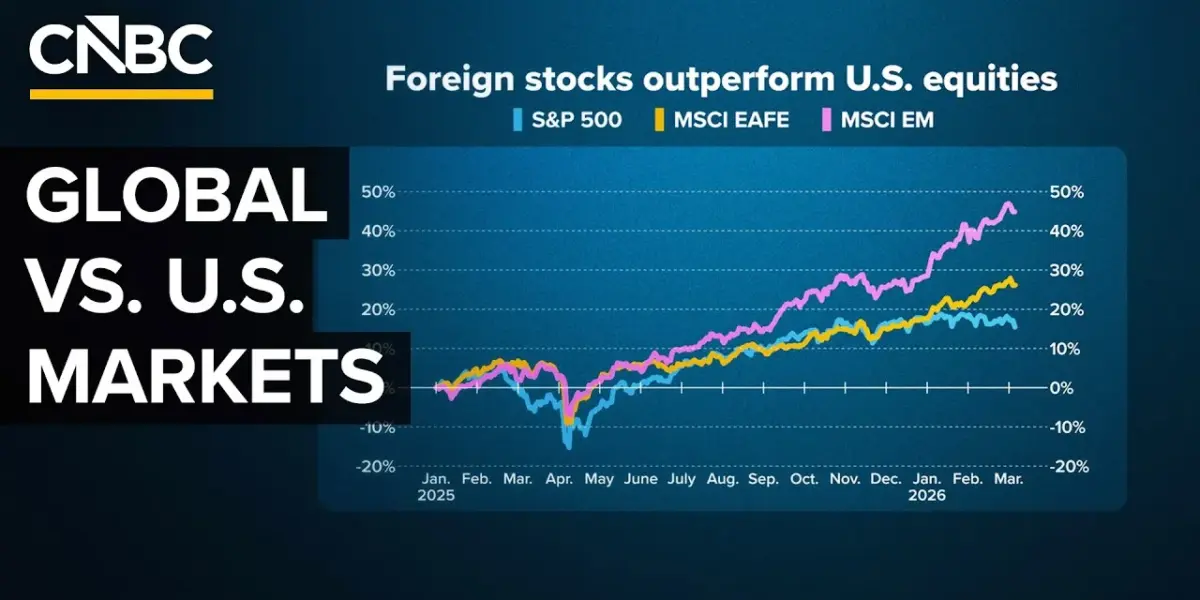
Global Equities Outshine U.S. as Investors Seek Diversification
In a significant shift from decades of American market dominance, international equities delivered robust returns in 2025, outpacing U.S. benchmarks. Developed international markets surged by 32%, while emerging markets posted an even more impressive gain of 34%. This performance starkly contrasts with the S&P 500’s nearly 18% return, signaling a potential long-term trend that has captured the attention of global investors.
Shifting Investor Sentiment Towards Global Markets
Following a year where international markets demonstrated superior performance, analysts and investors are anticipating this trend to persist into 2026 and beyond. This recalibration of market expectations is prompting a notable increase in investor exposure to global assets. Conversations among market participants reveal a growing desire to diversify portfolios, moving beyond a heavy concentration in U.S. markets, including private U.S. markets.
Concentration Risk and the AI Effect
A key driver behind the pivot to global markets is the concept of concentration risk. A substantial allocation to the U.S. market now means an outsized exposure to the technology sector, particularly companies at the forefront of artificial intelligence (AI). The dominance of the “Magnificent Seven” – a group of the largest U.S. technology companies – is so pronounced that they account for roughly one-third of the market capitalization of the S&P 500. This concentration raises concerns about the sustainability of returns and the potential impact of sector-specific downturns.
“I am short the U.S. and I’m long, you know, global markets.” This sentiment reflects a growing belief among some investors that the U.S. market faces headwinds not present to the same degree elsewhere.
Uncertainty in U.S. Market Returns
The U.S. market is grappling with a transition from an “asset-light” to an “asset-heavy” business model for many large companies. This shift has created uncertainty regarding future returns on capital, leading to significant price adjustments in various sectors and companies. This uncertainty, fueled by apprehension about future economic prospects, is seen as a greater impediment to the U.S. market compared to global counterparts.
Geopolitical and Fiscal Risks Weigh on U.S. Equities
Heightened fiscal and geopolitical risks within the U.S. are also contributing to investor caution. Concerns surrounding the U.S. fiscal deficit, strained international trade relations, and potential political interference with the Federal Reserve’s independence are factors that could catalyze a “Sell America” scenario. A “Sell America” trend typically involves a weaker U.S. dollar, declining U.S. stocks, rising U.S. interest rates, and stronger international currencies and stocks.
While a significant “Sell America” period was observed last year following the announcement of specific tariffs, it has not maintained sustained momentum. However, the underlying fears have prompted some investors to explore opportunities in international markets.
Weakening U.S. Dollar Boosts International Appeal
The continued weakening of the U.S. dollar further enhances the attractiveness of international investments. In 2025, the dollar depreciated by more than 9% and is anticipated to decline further. A weakening dollar has a direct positive impact on the returns of international investments for U.S.-based investors, as overseas profits translate into more dollars when repatriated. This effect was particularly beneficial for emerging markets in the past year, contributing to their strong performance, a trend expected to continue into 2026.
The “Bearish Dollar Trade” and Global Growth
The persistent weakness of the U.S. dollar, often referred to as a “bearish dollar trade,” is considered a durable trend. This is partly attributed to the current pro-cyclical phase of the global economic cycle. Coupled with a Federal Reserve perceived to be on hold with interest rates, and positive growth forecasts for the rest of the world, these factors suggest continued upside risks for global markets relative to the U.S.
Market Impact and Investor Considerations
While no immediate collapse of U.S. public markets is anticipated due to their depth and liquidity, a significant number of global investors are actively re-evaluating their portfolio allocations. The focus is on diversifying away from U.S. market concentration and identifying long-term investment opportunities in non-dollar denominated assets. The outperformance of global markets, coupled with forecasts for sustained international gains, underscores the importance for investors to closely monitor global economic trends and their potential implications for U.S. equities.
Key Takeaways for Investors:
- International equities, particularly developed and emerging markets, significantly outperformed the U.S. in 2025, with gains of 32% and 34% respectively.
- Investor sentiment is shifting towards global diversification due to rising fiscal and geopolitical risks in the U.S. and concentration risk in U.S. tech stocks.
- The “Magnificent Seven” companies’ significant weight in the S&P 500 (approx. one-third of market cap) contributes to U.S. market concentration risk.
- Uncertainty surrounding future returns on capital for asset-heavy U.S. companies is a concern.
- A weakening U.S. dollar, down over 9% in 2025, enhances the attractiveness of international investments and is expected to persist.
- Global growth prospects and a steady Federal Reserve policy are seen as supportive of international markets.
- Investors are increasingly looking to diversify out of U.S. dollar-denominated assets and explore long-term bets in global markets.
Source: Why Investors Are Looking Beyond The U.S. Market (YouTube)

Related Articles


Diversification Shields Investors in Uncertain Markets
In uncertain markets, the focus shifts from selling to strategic diversification. Investors are embracing a mix of assets like Bitcoin, S&P 500, and dividend stocks, alongside dollar-cost averaging and dividend reinvestment, to build resilience and capture potential upside.


Middle East Tensions Spark Oil Jumps, Test Tech Stocks
Middle East tensions have triggered a 7% jump in oil prices, but historical data suggests such conflicts rarely end bull markets. Investors are closely watching big tech stocks and global equity performance for signs of stability amidst mixed economic signals.


Russia’s Ruble Support Weakens, Currency Faces Decline
Russia is set to withdraw support for its national currency, the ruble, which has been artificially strengthened through capital controls and market interventions. As oil revenues fall and the country prioritizes its reserves, analysts predict a significant depreciation of the ruble.