Germany Unveils Hypersonic Drone, Escalating Ukraine’s Air War
Germany has unveiled a previously unknown, jet-powered drone during a joint manufacturing visit with Ukraine. This high-speed UAV signals a significant shift in Ukraine's drone strategy, emphasizing speed and survivability, and represents a deeper European industrial integration into the conflict.

Germany Unveils Hypersonic Drone, Escalating Ukraine’s Air War
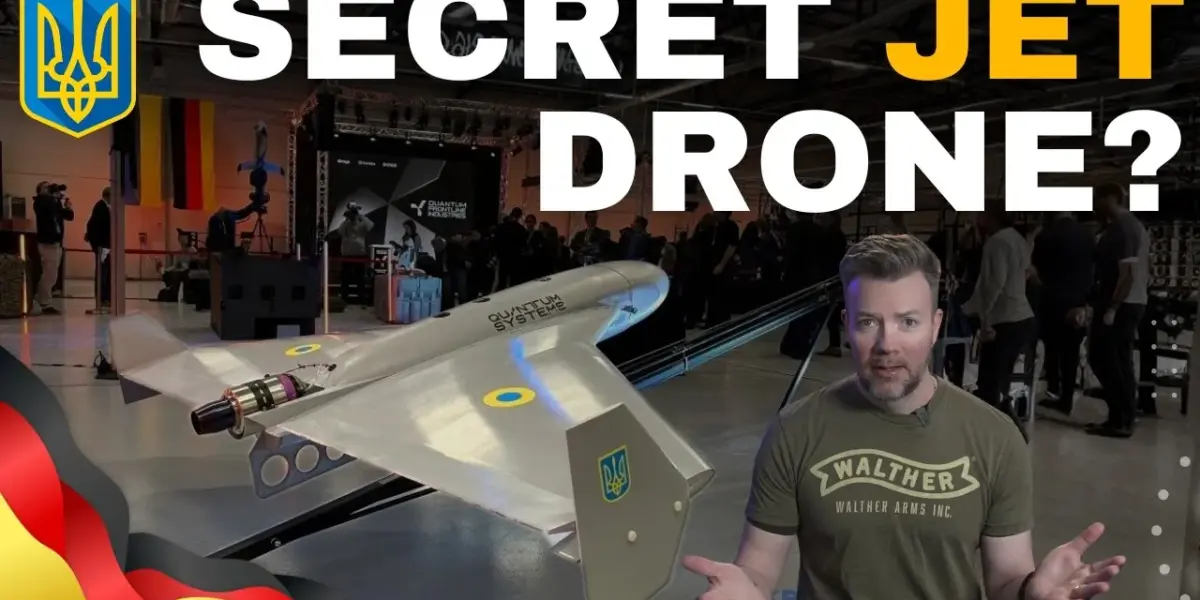
In a move that signals a significant escalation in Ukraine’s aerial capabilities, Germany has quietly revealed a previously unreported, jet-powered drone. The unveiling occurred not at a formal press conference, but rather as a deliberate background element during a joint Ukrainian-German drone manufacturing visit to Munich. This strategic placement suggests an intentional message to a discerning audience, highlighting Germany’s deepening industrial commitment to Ukraine’s defense.
A New Era of Drone Warfare
The visit, which included Ukrainian President Volodymyr Zelensky and German Defense Minister Boris Pistorius, centered on the Quantum Frontline Industries enterprise – a collaboration between Germany’s Quantum Systems and Ukraine’s Frontline Robotics. This venture aims to scale up the production of Ukrainian-designed drones, leveraging German automation expertise. While the formal announcement focused on expanding the manufacturing of existing Ukrainian drone systems, with Frontline Robotics projecting an output exceeding 10,000 drones annually, the true revelation was the presence of an unknown jet-powered UAV.
This new drone represents a departure from Ukraine’s current drone arsenal, which has largely been characterized by cost-effective, propeller-driven systems. These existing platforms, while adaptable and scalable, are constrained by their speed. In modern aerial combat, speed is a critical determinant of survivability, reaction time, and the effectiveness of defensive measures. Slower drones provide air defense crews with crucial windows for tracking, aiming, and interception. A jet-powered drone, by contrast, fundamentally alters this dynamic, compressing decision cycles for air defense units and reducing their margin for error.
Potential Roles and Capabilities
While no official specifications or performance claims have been released, the drone’s visible characteristics suggest two primary mission profiles. Its compact, sleek design with a relatively short wingspan, coupled with its intake configuration, points towards a small turbojet or compact turbofan engine. This places it in a middle tier, larger and faster than FPV (first-person view) drones, but smaller than traditional cruise missiles.
- Medium Strike Attack Drone: In this role, the jet propulsion would enable faster ingress to targets, minimizing exposure to short-range air defense systems. The increased speed would reduce engagement windows for mobile fire teams and complicate interception by slower counter-drone systems.
- Interceptor: Ukraine has already explored drone-on-drone combat with propeller-driven interceptors. However, a jet-powered interceptor would offer a significant advantage, allowing for active pursuit of hostile drones or even certain classes of cruise missiles, rather than relying solely on ground-based engagement envelopes.
In both scenarios, speed is the defining characteristic. The introduction of such a platform suggests a potential shift in Ukrainian drone doctrine, moving beyond purely saturation-based strategies towards tempo-driven maneuver warfare in the drone domain.
European Industrial Integration
Quantum Systems is not a new player in Ukraine’s defense landscape. Its Vector reconnaissance UAV has been a workhorse for intelligence, surveillance, and reconnaissance (ISR) missions, known for its electric propulsion, vertical takeoff capabilities, and AI-assisted data processing. The company’s focus on integrating automation, autonomy, and AI into its systems makes the unveiling of a jet-powered UAV within a joint manufacturing context particularly telling. It suggests this platform is part of a larger technological roadmap emphasizing speed, automation, and scalable production.
The joint enterprise between Quantum and Frontline signifies more than just a new drone model; it represents the deep integration of European industrial capacity into Ukraine’s defense production ecosystem. The projected output of over 10,000 drones annually from this venture underscores the critical need for Ukraine to match Russia’s strategy of mass production and saturation with its own blend of innovation and industrial scale. The combination of German automation and Ukrainian battlefield design creates a potent hybrid model, where battlefield-tested Ukrainian concepts are manufactured with European industrial precision.
A Generational Leap in Drone Warfare
If this jet-powered UAV transitions from prototype to serial production, even in limited numbers, it would mark a generational leap in Ukraine’s drone capabilities, shifting the focus from incremental adaptation to a significant increase in speed and survivability. This industrialization of drone warfare, while perhaps less glamorous than individual heroic actions, is a methodical process that can decisively win conflicts.
The emergence of this advanced drone aligns with broader European defense trends. France is enhancing intelligence support through satellite systems, Sweden and Denmark are bolstering short-range air defense, and Germany is scaling up joint drone manufacturing. This is not merely episodic aid; it is structural integration, with European defense firms recognizing that the drone war is not static but rapidly accelerating. A faster drone compresses warning times, complicates enemy defensive planning, and potentially introduces airborne counter-drone patrols capable of engaging threats at higher speeds than current systems.
Analysis and Future Outlook
While the specifics of the drone’s range, payload, and operational status remain unknown, its unveiling carries significant weight. In military development, early-stage systems are often revealed selectively to signal evolving capabilities, and this signal appears deliberate. The drone war in Ukraine is increasingly won not by single platforms, but by integrated ecosystems that can iterate faster than the adversary. Russia relies on volume and psychological pressure; Ukraine’s counter-strategy is evolving to incorporate layered defense, distributed innovation, and crucial allied industrial backing.
The introduction of a jet-powered UAV suggests that speed is becoming as vital as cost in Ukraine’s drone evolution. This shift impacts engagement windows, interception geometry, and fundamental planning assumptions for all involved. Germany’s involvement further indicates that this progress is not solely the result of improvised innovation but is increasingly a product of industrialized adaptation. The ecosystem producing these advanced systems is already operational, and this underlying industrial capacity, rather than just the airframe itself, should be a primary concern for Moscow.
Why This Matters
The development and potential deployment of a jet-powered drone by Germany for Ukraine represent a critical inflection point in the conflict. It signifies a move beyond attritional, cost-effective drone warfare towards higher-tempo, technologically advanced aerial engagements. This shift has several key implications:
- Escalation of Technological Competition: The introduction of faster, more sophisticated platforms forces Russia to constantly adapt its air defense systems and operational doctrines, potentially straining its resources and forcing reactive, rather than proactive, measures.
- Enhanced Ukrainian Survivability and Strike Capability: Increased speed translates directly to reduced vulnerability and the ability to strike targets with greater surprise and effectiveness, potentially changing the calculus of battlefield operations.
- Deepening European Commitment: Germany’s active role in co-developing and manufacturing advanced drone technology demonstrates a profound and evolving commitment to Ukraine’s long-term defense needs, moving beyond simple matériel transfers to integrated defense industrial partnerships.
- Setting Future Military Trends: The lessons learned and technologies developed in Ukraine, particularly in the rapidly evolving drone domain, are likely to shape future military doctrines and procurement decisions globally.
The drone war in Ukraine has become a crucial testing ground for 21st-century warfare. The unveiling of this German-engineered, jet-powered UAV suggests that the future of this conflict, and potentially future conflicts worldwide, will be defined by speed, sophisticated integration, and a relentless pace of technological innovation driven by international collaboration.
Source: Germany Just Revealed a High-Speed Drone for Ukraine (YouTube)

Related Articles


Ukraine Strikes Cripple Russian Oil Exports
Ukrainian drone strikes are crippling Russia's oil exports and damaging its economy, leading to falling domestic support for President Putin. The targeted attacks on refineries and terminals aim to cut off war funding and have significant geopolitical consequences.


US Military Pursues Secret Tech, Lunar Base Plans Emerge
Reports indicate the US military and defense contractors are exploring advanced technologies, possibly reverse-engineering unknown craft. Concurrently, NASA plans a lunar base, while millions of UAP-related files are allegedly deleted, raising transparency concerns. These developments could reshape global power dynamics.


Russia’s TV Dreams of Dividing Europe
Russian state television broadcasts increasingly aggressive rhetoric, discussing the division of Europe and dismissing Ukraine's statehood. This contrasts with battlefield realities and official diplomatic stances, highlighting a dual strategy of projecting strength and seeking geopolitical advantage. Analysts warn that these televised fantasies ignore the ongoing war and Ukraine's fight for sovereignty.