Germany Navigates China Trade: Balancing Exports and Competition
German Chancellor Friedrich Merz embarks on a crucial visit to China, aiming to balance robust economic ties with growing concerns over industrial competition. The trip underscores Germany's challenge in navigating trade relations with Beijing amidst global geopolitical shifts and pressure from the United States. Key objectives include fostering fair competition and reducing dependencies, while also addressing international conflicts.

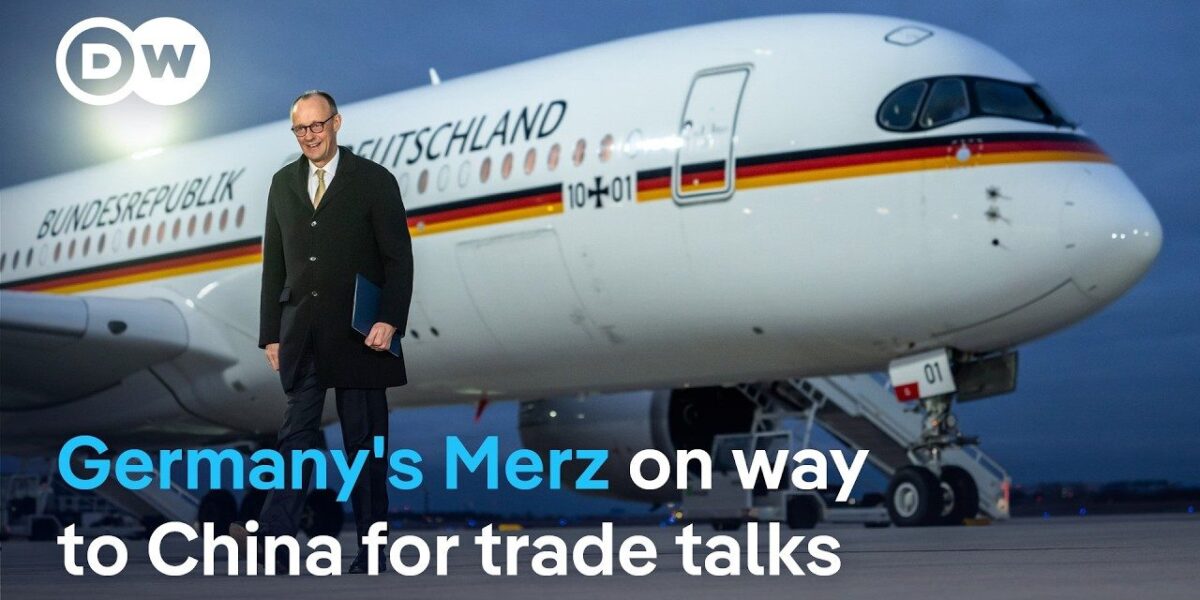
Chancellor Scholz Visits China Amid Economic Tensions
German Chancellor Friedrich Merz is undertaking his first visit to China since assuming office, a trip fraught with complex economic and geopolitical considerations. The visit occurs as German industry voices increasing concerns over intensified competition from China and as Berlin seeks to balance its economic ties with Beijing against pressure from Washington. The timing, during the auspicious Year of the Horse, marks Merz as the first high-profile international visitor to Beijing in this lunar year, leading a substantial business delegation.
Economic Interdependence and Geopolitical Pressures
The core of Merz’s agenda is expected to revolve around securing closer cooperation with Beijing as a strategic hedge against rising global trade protectionism and tariffs. “Foreign policy and economic policy belong together just as much as defense policy and domestic policy. We can no longer separate them today,” stated Merz prior to his departure, underscoring the integrated nature of these policy areas. He emphasized the need to discuss future cooperation between Europe, Germany, and China, referring to the latter as the “great middle kingdom.”
Merz’s visit follows a pattern of international leaders seeking to stabilize economic ties and navigate shifting geopolitical landscapes. Recent months have seen visits from leaders of Britain, Canada, and South Korea, all keen to forge business deals amidst global trade disputes. However, Merz faces the delicate task of strengthening ties with China without alienating the United States. President Trump’s previous threats of significant tariffs on countries engaging in trade talks with Beijing serve as a stark reminder of potential repercussions, although the US Supreme Court’s recent rulings on tariffs have introduced some uncertainty.
Domestic Concerns: Competition and “China Shock”
Domestically, German politicians and business associations have increasingly raised alarms about escalating industrial competition from China and the potential for a “new China shock.” China’s evolution into a sophisticated manufacturer, rapidly advancing in key technologies, presents a significant challenge to Germany’s historically export-driven economy. Last year, China’s exports exceeded its imports by a staggering one trillion dollars. For Germany, the impact is tangible, with exports to China falling by over 9% in 2025, and overall car exports to China plummeting by two-thirds since 2022.
“What Germany really needs to do is talk less about China and do more. So, I don’t think he’s going to go to China sort of with all guns blazing, criticizing China publicly. Uh I think he will have a very tough message for the Chinese leadership um behind closed doors.”
This sentiment highlights the tightrope walk Merz must perform: protecting vulnerable German industries from potentially subsidized Chinese goods while simultaneously attempting to mend strained bilateral ties. This balancing act is seen as a defining challenge for his chancellorship.
Navigating the Fine Line: Expert Analysis
Mara Olberg, an expert at the German Marshall Fund’s Indo-Pacific program, commented on the complexities facing Chancellor Merz. She expressed cautious optimism, suggesting that Merz is not approaching the visit naively and is aware of the challenges Germany faces concerning China. “Compared to prior visits of previous chancellors, I actually have reasonably high hopes that um, he’s Chancellor Merittz is not going there completely naive,” Olberg stated.
Olberg emphasized that a definitive “win” from this visit is unlikely. Instead, the success of Germany’s China policy hinges on its domestic and European strategies. “Ultimately, any uh win for German China policy is not going to be struck on this visit. Um I feel like whether or not we can get our China policy right ultimately is up to the China policy and whether we um derisk properly at home, whether we um derisk from our dependencies from China with other countries via the EU,” she explained. This involves building leverage and utilizing policy instruments to elicit concessions from China, rather than simply asking politely.
Decoupling vs. Derisking and European Unity
The question of decoupling from China was addressed by DW political correspondent Simon Young. He noted that while the trade relationship remains crucial – China being Germany’s second-largest trading partner – the emphasis is shifting towards “derisking” rather than complete decoupling. Merz himself stated that decoupling would be akin to “shooting ourselves in the foot” given the economic significance of the relationship. However, German companies operating in China report challenges such as market access issues, opaque regulations, and perceived preferential treatment for Chinese competitors. Concerns also extend to China’s dominance in critical raw materials, such as rare earths, essential for technological products.
Chancellor Merz outlined five pillars for Germany’s China policy: operating from a position of German and European strength, reducing dependencies, fostering fair competition, cooperating on international conflicts, and maintaining a united European front. “We Germans have embedded our policy towards China within the European context. We do this out of European conviction and also because only thus can we effectively represent our common interests,” Merz stated, highlighting the importance of coordinated action with European partners like France and the UK.
Beyond Trade: Geopolitics and Human Rights
While trade is a primary focus, Merz is also expected to address geopolitical issues, including urging China to pressure Russia to end the war in Ukraine. He indicated that Xi Jinping could influence Putin to cease hostilities, emphasizing China’s potential role in global conflict resolution. “He said that Xiinping could tell Putin from one day to the next to end the war and that would have an effect,” Young reported.
Topics such as Taiwan and human rights concerns, including the treatment of Uyghurs and Tibetans, were not explicitly highlighted by Merz as central to his public agenda. Germany maintains a “one China” policy. Merz indicated an approach of “firmness, confidence and mutual respect,” suggesting that discussions on sensitive issues like human rights would likely occur behind closed doors, avoiding public “lecturing.” The overarching focus of the visit is expected to remain on trade and economic matters, with other geopolitical and security issues playing a background role.
Looking Ahead
Chancellor Merz’s visit to China represents a critical juncture for German and European policy towards Beijing. The coming months will reveal the extent to which Germany can successfully navigate the dual imperatives of economic engagement and strategic competition, while maintaining transatlantic alignment and advancing European interests. The effectiveness of Germany’s “derisking” strategy and its ability to foster fair competition will be key indicators of future success.
Source: How tough can Merz be when more than a milion German jobs depend on exports to China? | DW News (YouTube)

Related Articles

Trump: Iran Strikes Ahead of Schedule, Expects ‘Great Deal for World’
Three U.S. service members have been killed amid escalating conflict with Iran, President Trump confirmed. He stated that strikes are ahead of schedule, with senior Iranian leaders killed, and expressed optimism for a "great deal for the world" despite ongoing talks with Iranian officials.

Trump’s Putin Stance: US Strategy and Global Implications
Analysis suggests Donald Trump's approach to the Ukraine war involves pressuring Kyiv, but US involvement is crucial for resolution. China's influence and the 'MAGA' agenda's geopolitical implications are key factors.


US Strikes Iran: Mounk and Fukuyama Discuss Unpredictable Conflict
Leading political scientists Yascha Mounk and Francis Fukuyama analyze the recent US strikes on Iran, warning of unpredictable outcomes and internal instability. They question the objectives of the "war of choice" and its potential to destabilize the region, while also discussing the shifting global perceptions of Israel.