Gemini 3.1 Pro Powers Next-Gen AI Coding with Anti-Gravity
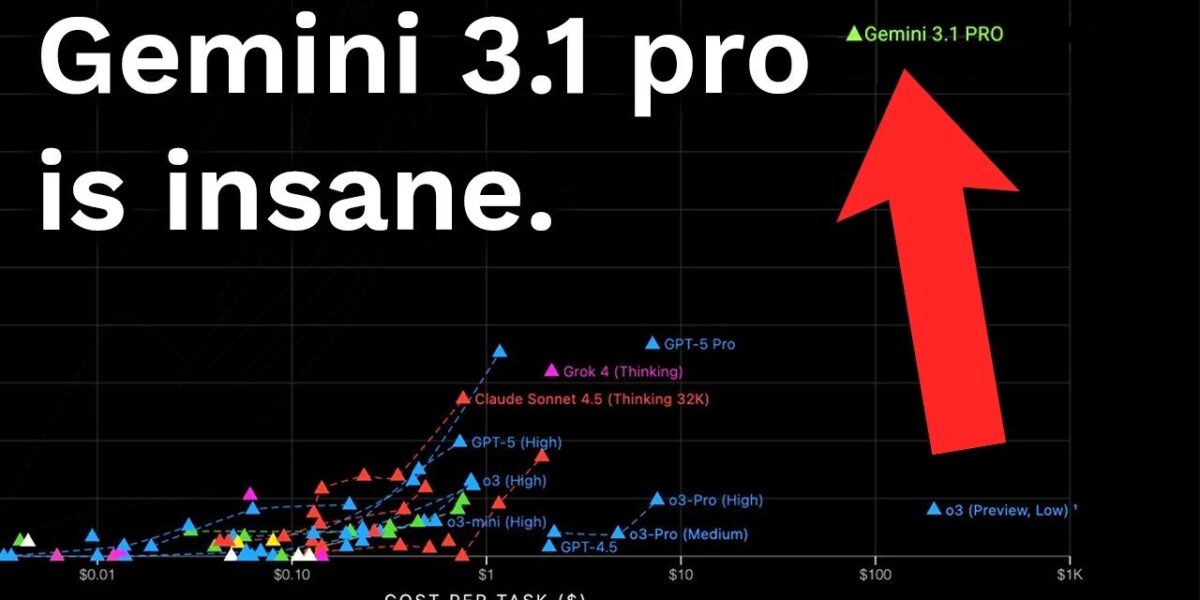
Google's Gemini 3.1 Pro, integrated with the AI-native IDE Anti-Gravity, is setting new benchmarks in software development. This powerful combination allows for the creation of complex applications using natural language, showcasing significant advancements in AI's coding and design capabilities.

Gemini 3.1 Pro Powers Next-Gen AI Coding with Anti-Gravity
Google’s latest AI model, Gemini 3.1 Pro, is making significant waves in the developer community, particularly through its integration with the coding environment Anti-Gravity. This powerful combination is enabling developers to build complex applications and AI agents with unprecedented ease and speed, showcasing a leap forward in AI-assisted software development.
Gemini 3.1 Pro: A Benchmark Breaker
Google recently unveiled Gemini 3.1 Pro, a model that early benchmarks suggest could be among the world’s best. The model has demonstrated remarkable performance across several key AI benchmarks:
- Arc AGI 2 (Abstract Reasoning): Gemini 3.1 Pro achieved a score of 77%, outperforming models like Opus and GPT-4.
- GPQA Diamond (Scientific Knowledge): The model scored an impressive 94%, significantly ahead of its competitors.
- Browse Comp (Agentic Search): Gemini 3.1 Pro reached 85%, showing a strong capability in complex search and reasoning tasks.
These results indicate Gemini 3.1 Pro is a highly versatile model, excelling particularly in areas requiring deep reasoning, mathematical understanding, and scientific knowledge.
Anti-Gravity: The AI-Native IDE
Anti-Gravity is emerging as a leading platform for AI-powered coding. Billed as the next generation Integrated Development Environment (IDE), it’s specifically designed to manage and orchestrate multiple AI agents working collaboratively on a project. This multi-agent approach, managed through Anti-Gravity’s unique Agent Manager, sets it apart from traditional IDEs and even other AI coding assistants like Cursor.
The setup process for Anti-Gravity is straightforward. Users can download and install the application, then authenticate with a Google account. This authentication is key, as it grants free access to Gemini 3.1 Pro. While a free tier is available, users with paid Google AI plans may experience faster model performance due to higher usage limits.
Building a Geopolitical Risk Dashboard with Gemini 3.1 Pro
To demonstrate the capabilities of Gemini 3.1 Pro within Anti-Gravity, a complex application—a 3D globe showcasing a live geopolitical risk dashboard—was built. This project integrated real-time data feeds, including breaking news, oil prices, flight alerts, and defense stock tickers, powered by the Firecrol API.
The development process highlighted Gemini 3.1 Pro’s ability to understand and execute complex instructions in plain English. In a two-step process within Anti-Gravity, the AI first generated a plan for building the full-stack web app and then proceeded to construct the entire application end-to-end. This included generating the necessary folder structure, writing code, and even self-debugging and testing.
A notable aspect of the demonstration was the AI agent’s autonomy. It autonomously opened a browser, navigated to the local development server, and began testing and analyzing the application’s output. When prompted to improve the visual appearance of the 3D globe, Gemini 3.1 Pro executed commands to download textures and implement visual enhancements, showcasing a sophisticated level of problem-solving.
Firecrol API: Powering AI Agents
The project heavily utilized the Firecrol API, an open-source tool designed to facilitate web scraping and crawling for AI agents. Firecrol provides data in structured formats like JSON or Markdown, simplifying the process for AI models to consume and act upon web-scraped information.
Firecrol offers a generous free tier, allowing users to scrape up to 500 pages. Additionally, a promotional code ‘David’ can be used to obtain an extra 1,000 free credits, making it an accessible tool for developers experimenting with AI agents. The integration of Firecrol within Anti-Gravity allowed the Gemini-powered agent to seamlessly gather real-time data for the geopolitical risk dashboard.
Why This Matters: Democratizing App Development
The synergy between Gemini 3.1 Pro and Anti-Gravity represents a significant step towards democratizing software development. The ability to describe an application in plain English and have an AI model build, test, and refine it lowers the barrier to entry for aspiring developers and entrepreneurs. Complex projects that previously required extensive coding expertise can now be initiated and developed with minimal technical background.
This advancement is particularly impactful for:
- Rapid Prototyping: Quickly bring ideas to life and test market viability.
- Citizen Developers: Empower individuals without formal coding training to build functional applications.
- Productivity Boost: Significantly accelerate development cycles for experienced developers by automating repetitive tasks and complex coding challenges.
Performance Comparisons and Use Cases
While Gemini 3.1 Pro excels in many areas, comparisons with other leading models like Opus 4.6 and GPT-4 Turbo (referred to as GBD 5.3 CEX in the transcript) are important. The transcript suggests that Opus 4.6 might still be preferable for very deep, complex coding issues, while GPT-4 Turbo could be suited for tasks requiring extremely long processing times. However, for front-end design, landing pages, and creating visually impressive applications, Gemini 3.1 Pro appears to be the strongest contender.
This is further supported by Gemini 3.1 Pro’s leading performance in SVG design benchmarks, where it significantly outperformed previous versions and competitors. Its multimodal capabilities, likely stemming from Google’s vast and diverse training data (including YouTube, Google Search, and Android), give it an edge in visual and creative tasks.
It’s crucial to note that Gemini 3.1 Pro’s performance can vary significantly depending on the environment. While it shines within Anti-Gravity, its API integration in other tools like OpenCopilot reportedly led to issues, including unmanageable conversational loops. This suggests that Google’s integration with Anti-Gravity is highly optimized, potentially indicating a strategic partnership or specific design choices to maximize Gemini’s potential within that ecosystem.
The Future of AI-Assisted Development
The advancements demonstrated by Gemini 3.1 Pro and Anti-Gravity signal a transformative era for software development. The ability for AI to not only write code but also to manage complex projects, debug issues, and improve designs autonomously is a testament to the rapid progress in artificial intelligence. As these tools become more accessible and sophisticated, they promise to reshape how applications are conceived, built, and deployed, making powerful development capabilities available to a much wider audience.
Source: Gemini 3.1 Pro just made Antigravity 10x more powerful… (it’s wild) (YouTube)

Related Articles


AI’s Economic Shift: Ownership is the New Wage
Artificial intelligence is projected to significantly reduce the economic value of human labor within a decade. Experts suggest that capital ownership, rather than wages, will become the primary means of wealth accumulation. Investors are urged to consider this shift in their long-term strategies.


Germany’s Fake Laws: AI Disinformation Campaign Exposed
Viral AI-generated videos falsely claim Germany has enacted absurd laws, including fines for flushing toilet paper. Experts reveal a disinformation campaign aiming to portray Germany as chaotic, with potential commercial or political motives behind the fabricated content.


AI ‘Vibe Coding’ Promises Speed, But Delivers Chaos
The rise of 'vibe coding' promises to revolutionize software development by allowing users to create apps through natural language prompts. While platforms like Lovable showcase incredible speed and accessibility, this new paradigm introduces significant challenges in reliability, security, and developer satisfaction.