Friedman: Iran’s ‘Out-Crazy’ Strategy Challenges US Power
Thomas Friedman analyzes the Iran conflict, highlighting its 'strategy of out-crazy' and the power imbalance between the US and Tehran. He also critiques US policy in Ukraine and draws parallels between Minnesota's diversity and America's national challenges.

Friedman: Iran’s ‘Out-Crazy’ Strategy Challenges US Power
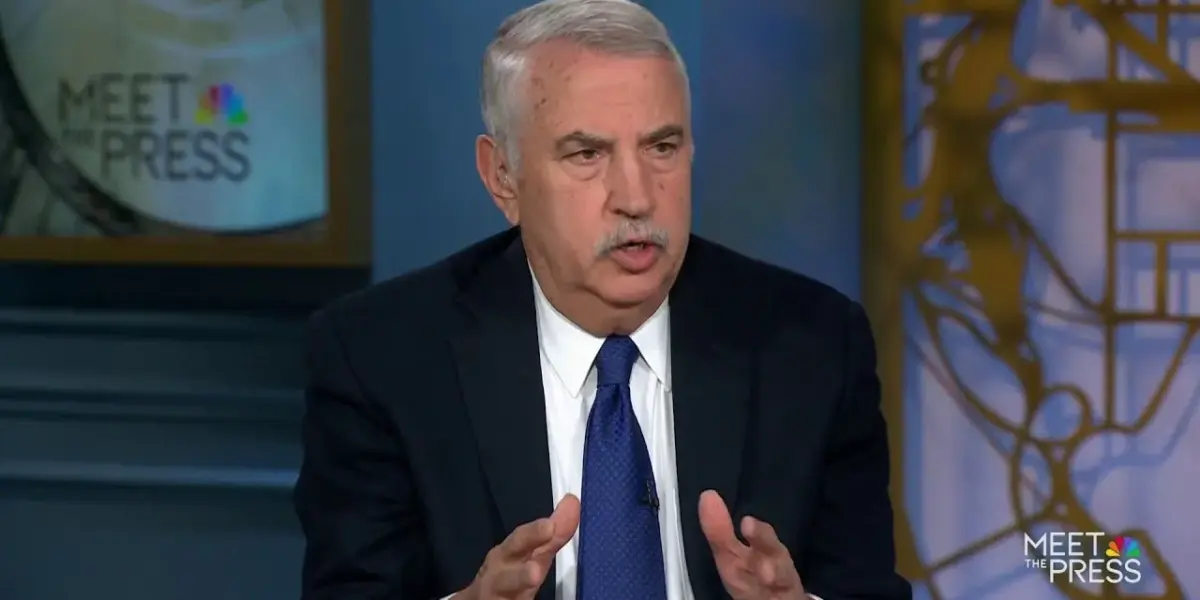
New York Times columnist Thomas Friedman offered a stark analysis of the escalating tensions between the United States and Iran, characterizing Iran’s approach as a “strategy of out-crazy.” Speaking on “Meet the Press,” Friedman detailed a complex dynamic where Iran, despite its military inferiority, possesses the ability to inflict significant disruption on global energy markets, particularly through the Strait of Hormuz.
The Power Dynamic: Strong vs. Weak
Friedman highlighted the fundamental asymmetry of power in the conflict. “On the one hand, the United States has the power to inflict terrible damage to Iran’s military and infrastructure,” he stated. “At the same time, Iran has the power, the power of the weak, that with just one drone or one cruise missile we can cut off the Strait of Hormuz, 20% of the world’s oil and natural gas.” This vulnerability, affecting hundreds of ships daily, creates a precarious balance that dictates the conflict’s trajectory.
Iran’s Regional Gambit
President Trump expressed surprise at Iran’s targeting of its Arab neighbors, an aspect Friedman believes is central to Iran’s strategy. “What I call the strategy of out-crazy,” Friedman explained. “We will out-crazy, okay?” He noted that Israel has historically fared better against Iran precisely because they have resisted mirroring this extreme approach. The attacks on Gulf neighbors, while seemingly counterintuitive given their vulnerability, serve a dual purpose: to pressure the U.S. to de-escalate and to reshape regional alliances. “It will have long-term implications for Iran’s relations with those states,” Friedman warned, referencing the financial and social ties many Iranians have with these Gulf nations.
The Question of Regime Change
The possibility of regime change in Iran was also a focal point. Friedman discussed reports of the Supreme Leader’s son, Mojtaba Khamenei, potentially taking over, noting the ambiguity surrounding the succession. He proposed a phased approach to resolving the conflict, advocating for a ceasefire now. “The morning after any ceasefire, the Iranians will come out and say, ‘We defeated the Big Satan and the Little Satan,'” Friedman posited. “The morning after the morning after, millions of Iranians are going to be saying to the leadership, ‘Come here. That’s my house there on the ground. That’s my factory. That’s my school. What the hell are you thinking? What are you going to do about that?'” This internal political reckoning, he believes, is the only sustainable path to changing the regime’s character, a process that will emerge from the top down, not the bottom up, after the immediate political fallout.
A Deal for Iran?
Regarding a potential deal, Friedman expressed skepticism about achieving a perfect outcome but defended the Obama administration’s Joint Comprehensive Plan of Action (JCPOA). “I thought that was a reasonable deal at the time,” he stated. “It wasn’t perfect, but it was the best you can get at the time.” He reminded listeners that under Obama, Iran was a year away from a bomb, a timeline significantly shortened under the Trump administration. “Iran is weeks away from a bomb, and that’s something President Trump will have to take responsibility for and answer for one day,” Friedman asserted. He suggested that any resolution would likely be staged, perhaps leading to an “Islamic Republic 2.0” with some reformers, or a deal with the Trump administration, but dismissed the idea of an immediate popular revolution as highly improbable.
Ukraine and Putin’s Leverage
The conversation then shifted to the war in Ukraine, with Friedman criticizing President Trump’s approach to negotiations. He observed a pattern of the U.S. applying maximum leverage on Ukrainian President Zelenskyy while applying little on Russian President Putin. “There’s always been something bizarre about the President’s relationship to Putin,” Friedman remarked. He differentiated between a “dirty deal” and a “filthy deal” for Ukraine. A dirty deal might see Russia keep its gains but include an American-backed peacekeeping force and EU membership for Ukraine. A filthy deal, however, would leave Ukraine without security guarantees and potentially excluded from the EU. “If President Trump is responsible for a filthy deal in Ukraine, shame on him,” Friedman declared.
‘How Minnesota Beat Trump’: A Microcosm of America
Friedman concluded by discussing his recent column, “How Minnesota Beat Trump,” which uses his home state as a case study for America’s broader governance challenges. He described the acts of civic courage he witnessed in Minnesota—citizens supporting each other through donations and mutual aid—as remarkable. “My version of America First is not America Alone and America Selfish, which is Trump’s version,” Friedman clarified. “My version of America First is that we be the first country in the world that demonstrates how to make out of many one when the many is now so radically diverse.” He stressed the interconnectedness of global challenges, such as AI, migration, and pandemics, arguing that collective action is not merely an option but a necessity for a stable future. “We’re going to rise together, baby, or we’re going to fall together, baby, but baby, whatever we’re doing, we’re doing it together,” he concluded.
Source: Thomas Friedman explains Iran’s ‘strategy of out-crazy’ against the U.S.: Full interview (YouTube)

Related Articles
G7 Allies Clash Over Iran War Strategy, Urge Focus on Russia
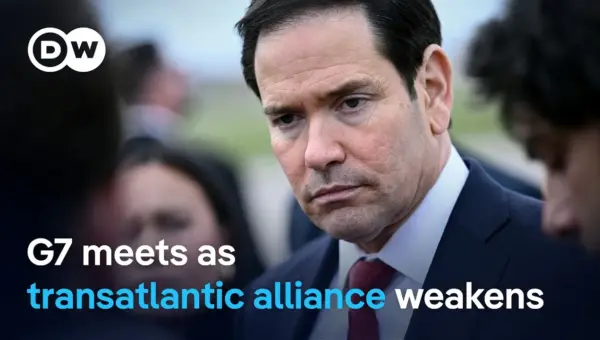
G7 foreign ministers met in Paris, revealing deep divisions over the U.S. war with Iran. European allies urged the U.S. to pressure Russia, linking its actions to the conflict and fearing support for Ukraine will wane.

Iran Blocks China Ships, Exposing Beijing’s Weak Grip
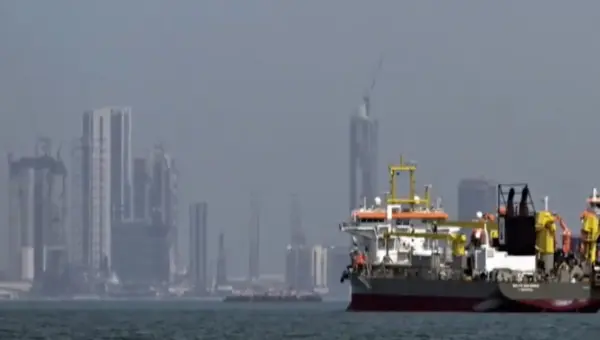
Iran's recent decision to block Chinese ships at the Strait of Hormuz is exposing the limits of Beijing's influence in the Middle East. This action is causing delays and cancellations for Chinese manufacturers, turning a perceived geopolitical win into an economic strain.
Rubio: US Can Achieve Iran War Goals Without Troops
Senator Marco Rubio outlined a strategy to counter Iran without deploying U.S. ground troops, focusing on weakening the regime and enhancing maritime security. He also criticized Cuba's economic system and expressed concerns about West Bank violence.