Fox News Downplays Iran War’s Economic Fallout: A Risky Narrative
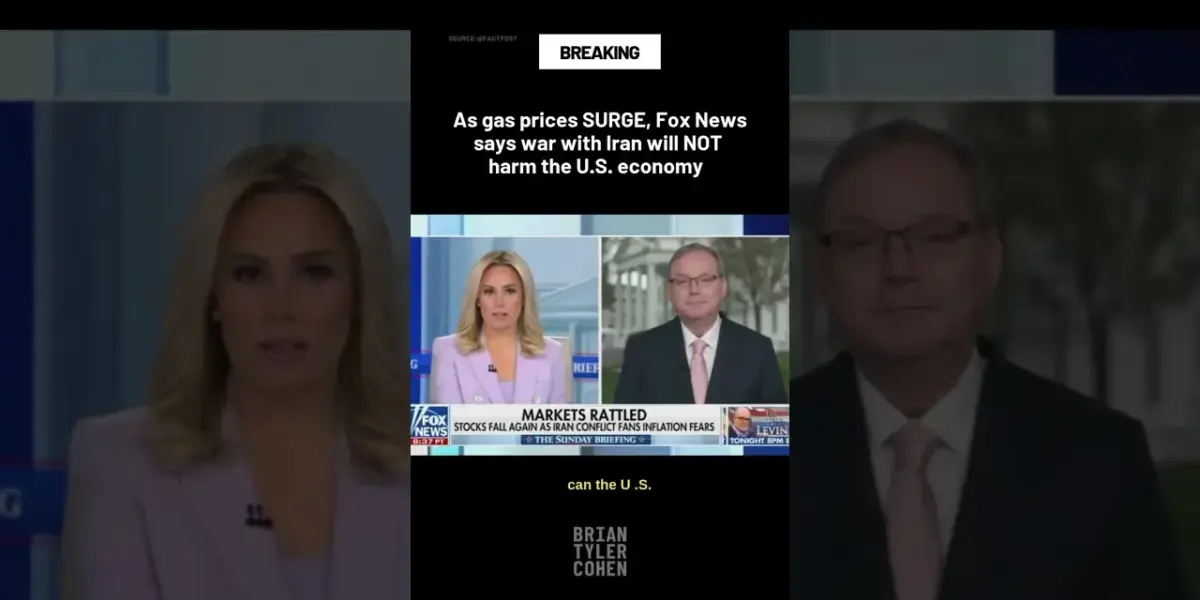
As gas prices surge and markets react to geopolitical tensions, Fox News downplays the economic risks of a potential conflict with Iran. This analysis examines the narrative's contrast with market sentiment and historical precedent, questioning its implications for public understanding and economic preparedness.

Fox News Downplays Iran War’s Economic Fallout: A Risky Narrative
As global tensions escalate and the specter of conflict looms, the economic ramifications of geopolitical instability become a critical concern for citizens and policymakers alike. Recent reports highlight a significant surge in gas prices, with the average cost of a gallon of regular gasoline climbing to $3.70, a notable increase from $3.45 just a week prior and $2.93 a month ago. This price hike, coupled with a downturn in major stock market indices – the Dow, Nasdaq, and S&P 500 all closed in the red on Friday – suggests that financial markets are keenly aware of the risks associated with potential disruptions to global oil supplies.
The Strait of Hormuz: A Critical Chokepoint
A significant portion of the world’s oil, approximately one-fifth, transits through the Strait of Hormuz, a vital maritime passage. Any prolonged disruption to this chokepoint, whether due to conflict or political instability, could send shockwaves through the global economy. The question arises: can the U.S. economy absorb such a shock without tipping into a recession? This is a question that demands careful consideration, moving beyond simplistic assurances.
Fox News’s Contrasting Viewpoint
In stark contrast to the market’s apprehension and the evident economic pressures, a recent segment on Fox News offered a remarkably optimistic, if not dismissive, perspective on the potential economic impact of a conflict with Iran. According to the transcript, a representative from the Trump administration’s briefing suggested that any disruption would be short-lived, estimating a duration of “four to six weeks” and asserting that the U.S. is “ahead of schedule” in managing the situation. Furthermore, the narrative presented downplayed any significant long-term harm to the U.S. economy, acknowledging only “pocketbook issues” that would need to be addressed.
Historical Context: The Fragility of Oil Markets
This assertion, that a conflict involving a major oil-producing region would have minimal economic impact, runs counter to historical precedent. The oil crises of the 1970s, triggered by the Yom Kippur War and subsequent OPEC embargo, demonstrated vividly how geopolitical events could cripple economies reliant on oil. Supply disruptions led to soaring prices, inflation, and significant economic stagnation in many Western nations. More recently, the instability in the Middle East following the invasion of Iraq in 2003 also contributed to oil price volatility, impacting global energy markets and consumer costs.
The argument that the U.S. economy is now insulated from such shocks due to increased domestic production or diversification of energy sources, while partially true, overlooks the interconnectedness of the global energy market. Even with increased shale oil production, the U.S. remains a major consumer and importer of oil, and global price benchmarks are heavily influenced by supply and demand dynamics in regions like the Middle East. A conflict that significantly disrupts supply from the Strait of Hormuz would inevitably lead to higher prices at the pump for American consumers, regardless of domestic production levels.
Analyzing the Fox News Narrative
The Fox News narrative, as presented in the transcript, appears to prioritize a specific political messaging over a nuanced economic analysis. By framing the potential conflict as short-term and economically inconsequential, it serves to alleviate public anxiety and bolster the administration’s stance. However, this approach risks creating a false sense of security and may lead to inadequate preparation for the real economic consequences.
The assertion that a disruption “wouldn’t really do a lot of harm to the U.S. economy” is a bold claim, especially when considering that a fifth of the world’s oil supply is at stake. While it’s true that the U.S. economy is more resilient than in past decades, it is not immune to significant price shocks in critical commodities. The “pocketbook issues” mentioned are not trivial; they translate to higher costs for transportation, manufacturing, and virtually every sector of the economy, potentially impacting inflation, consumer spending, and overall economic growth.
Why This Matters
The divergence in viewpoints between the financial markets, which are clearly pricing in risk, and the media narrative that downplays potential economic fallout is significant. It raises questions about transparency, the dissemination of information during times of heightened geopolitical tension, and the potential for political agendas to influence public perception of economic realities.
- Informed Public Discourse: Citizens need accurate and balanced information to understand the potential economic consequences of foreign policy decisions. Downplaying risks can lead to public complacency and a lack of preparedness.
- Economic Preparedness: A realistic assessment of potential economic shocks is crucial for businesses and policymakers to develop contingency plans, manage supply chains, and mitigate inflationary pressures.
- Market Stability: Markets react to perceived risk. A narrative that consistently dismisses potential disruptions can create a disconnect between market sentiment and official communication, potentially leading to greater volatility when realities shift.
Implications, Trends, and Future Outlook
The current situation underscores a broader trend: the increasing weaponization of energy as a geopolitical tool. As nations navigate complex international relations, the control and flow of energy resources remain central to power dynamics. The narrative presented by Fox News, while possibly intended to project strength and stability, highlights a recurring challenge in public communication during crises – the tension between reassuring the public and providing a clear-eyed assessment of risks.
The future outlook depends heavily on de-escalation and diplomatic solutions. However, if tensions persist or escalate, the economic consequences, even if framed as minor by some outlets, could be substantial. The reliance on oil, though decreasing in some sectors, remains a vulnerability. The trend towards renewable energy offers a long-term solution to energy security, but the transition is gradual, and the immediate impact of disruptions in traditional energy markets will continue to be felt.
Ultimately, the way such potential economic impacts are communicated to the public is as important as the policies enacted to manage them. A balanced approach, acknowledging both risks and mitigation strategies, fosters a more resilient and informed society, better equipped to navigate the turbulent waters of global affairs.
Source: As gas prices SURGE, Fox News says war with Iran will NOT harm the U.S. economy (YouTube)

Related Articles


Iran Targets US With Cyberattacks, Escalating Digital Warfare
Iran is increasingly using cyberattacks to challenge the U.S., as seen in a recent hack of the FBI director's account. Experts say this is a strategic shift due to Iran's limitations in conventional warfare. The U.S. needs to strengthen its digital defenses, focusing on encryption and cloud computing, rather than solely relying on traditional security measures.
Ukraine Strikes Russian Oil Refinery, Eyes Iran Threat
Ukrainian forces struck a key Russian oil refinery, disrupting Moscow's war capabilities. Meanwhile, Finland's president urged continued U.S. support for Ukraine, as Kyiv shares its air defense expertise globally amid growing geopolitical complexities involving Iran and potential sanctions against Hungary.
Iran’s Missile Threat Reduced by 90%, Analyst Says
An analyst reports that Operation Epic Fury has degraded Iran's missile launchers by 90%, despite challenges in targeting hidden sites. The conflict's duration and media coverage are also discussed, with implications for global energy markets and investor confidence.