Ford’s F-350 vs. F-450: Which Super Duty Reigns Supreme?
Ford's F-350 with the 'Godzilla' V8 and the F-450 dually with the Power Stroke diesel face off. We compare their power, looks, interiors, and towing prowess to determine which Super Duty reigns supreme for different needs.

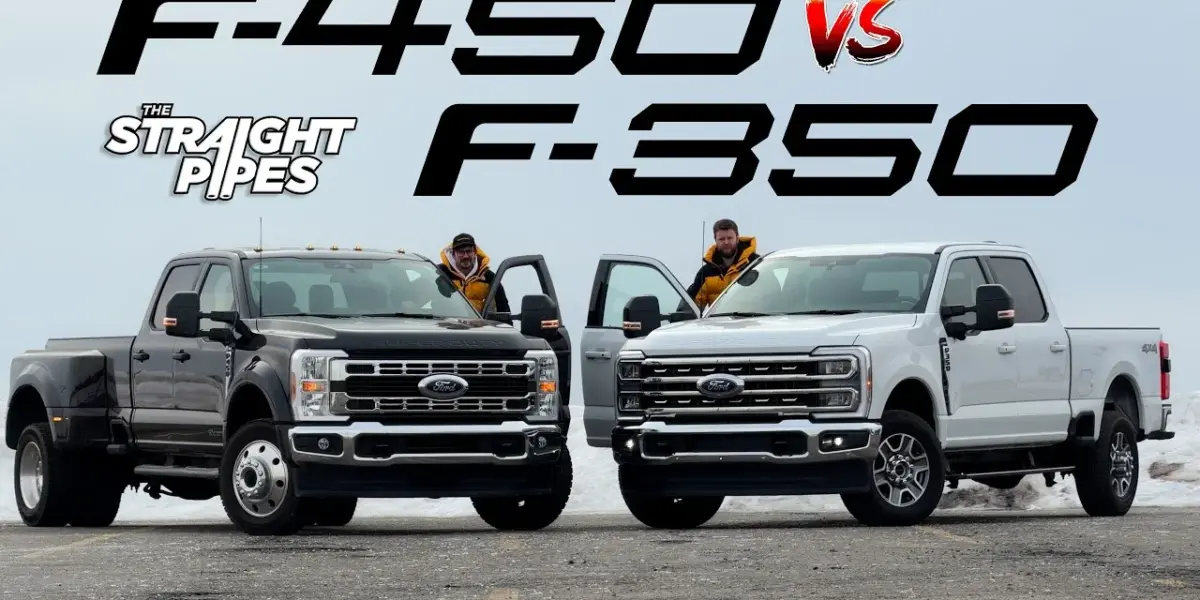
Ford’s Super Duty Showdown: F-350 Godzilla vs. F-450 Power Stroke Dually
When it comes to heavy-duty trucks, Ford’s Super Duty lineup offers choices for almost any need. But what happens when you pit the potent gasoline-powered F-350 against the mighty diesel F-450 dually? We took both for a spin to find out if the extra set of tires and diesel power truly justify the difference.
Engine Power and Performance
Under the hood of the F-350, the 7.3-liter ‘Godzilla’ V8 engine roars to life. It puts out a healthy 430 horsepower and 485 pound-feet of torque. This gasoline powerhouse, paired with a smooth 10-speed transmission, offers a refined driving experience that some might even wish for in an F-150.
On the other side, the F-450 dually boasts the formidable 6.7-liter Power Stroke turbodiesel V8. This diesel engine is a torque monster, delivering an impressive 475 horsepower and a colossal 1,050 pound-feet of torque. While this truck is built for serious work, the sheer power of the diesel is undeniable.
The Dually Difference: Looks and Presence
Visually, the F-450 dually stands apart. Its wider track, thanks to the dual rear wheels and flared fenders, gives it a commanding and aggressive presence. This widebody look is complemented by marker lights on the front, similar to a Raptor or commercial truck, which the narrower F-350 lacks.
The F-450 rides on commercial-grade tires, like the Continental Conti HDR5s, capable of handling up to 110 PSI. These robust tires, combined with the dually setup, create a stance that’s both intimidating and undeniably cool. While the F-350 is a capable truck, the F-450’s dually configuration simply looks more menacing and purpose-built.
Driving a dually, however, comes with practical challenges. Parking lots become a battle, drive-thrus are off-limits, and navigating tight city streets requires constant attention. It’s a truck that commands attention but demands a certain level of inconvenience. Yet, for some, this imposing presence is part of the appeal, making it a fashion statement as much as a workhorse.
Interior Comforts and Technology
Stepping inside, the differences become apparent, especially depending on the trim level. Our F-350 featured an XLT trim with cloth seats, a smaller infotainment screen, and a traditional key. It’s a more basic, no-frills setup focused on utility.
In contrast, the F-450, in Lariat trim, offered a luxurious experience. Leather seats, a large digital gauge cluster, a massive infotainment screen, and a key fob with remote start are just a few of the premium features. The Lariat trim also included creature comforts like heated and cooled seats and a heated steering wheel, making long hauls much more pleasant.
While both trucks offered Apple CarPlay and hard buttons for climate control, the F-450’s infotainment system felt more modern, especially with its larger screen and integrated features. The F-350’s system, while functional, felt a bit dated by comparison. The F-450 also offered power-folding and extending mirrors, a significant advantage for maneuvering and towing.
Towing and Payload Capabilities
This is where the F-450 truly shines. When properly equipped, the F-350 can tow up to 19,500 pounds with a conventional hitch. This is more than enough for many campers, boats, or smaller trailers.
However, the F-450 dually redefines heavy-duty towing. It can handle an astonishing 30,000 pounds with a conventional hitch. This massive capability is ideal for fifth-wheel or gooseneck trailers, making it suitable for large RVs, heavy equipment, or even hauling multiple vehicles.
The payload ratings also reflect this difference, with the F-450 offering significantly more capacity. For those who regularly tow or haul extremely heavy loads, the F-450 is the clear choice, offering peace of mind and the ability to tackle jobs the F-350 simply cannot.
Value and Target Buyer
The pricing reflects the capabilities and features of these trucks. The F-350, as tested in XLT trim, came in around $73,400 Canadian (approximately $53,500 USD). The F-450 Lariat, with its higher trim and dually setup, was priced at $99,400 Canadian (approximately $72,800 USD).
The target buyer for the F-350 is someone who needs substantial towing and hauling power but doesn’t require the absolute maximum capacity of a dually. It’s a versatile truck that can serve as a capable work vehicle or a robust personal hauler, offering a good balance of capability and everyday usability.
The F-450 dually is for the serious professional or the dedicated enthusiast who needs to tow the heaviest loads. This could include commercial operators, large-scale farmers, or RV owners who tow massive fifth-wheel trailers. While it’s an expensive truck, for those who need its capabilities, it represents good value, especially when considering the potential for business write-offs.
Verdict
Choosing between the F-350 Godzilla and the F-450 Power Stroke dually comes down to your specific needs. If you need a powerful, versatile truck for heavy-duty tasks but don’t require the extreme towing capacity of a dually, the F-350 with the Godzilla V8 is an excellent choice. It offers a great balance of performance, comfort, and capability.
However, if your work or hobby demands the absolute maximum in towing and payload capacity, the F-450 dually is the undisputed champion. Its diesel engine provides immense torque for effortless hauling, and its dually configuration offers unparalleled stability and capability. While it’s less practical for daily driving, for those who need to tow the biggest toys or the heaviest loads, the F-450 is the ultimate Super Duty machine.
Source: F450 Dually Powerstroke 6.7 vs F350 Godzilla 7.3 (YouTube)

Related Articles


BMW Wagon Sells for $52,500: A Future Classic?
A 2010 BMW 535i Xdrive Sports Wagon sold for $52,500, setting a new benchmark for the model. This rare manual, all-wheel-drive wagon with M Sport package is proving to be a highly sought-after modern classic.


Scout’s Range Extender: A Hybrid Solution for High Gas Prices?
With gas prices soaring, the upcoming Scout SUV featuring a range extender could be the perfect solution for drivers seeking flexibility. This innovative hybrid system combines electric power with a gasoline generator, offering both efficiency and extended travel capability without range anxiety.

Maserati MC20 GT2 Stradale: Track Ready, But Does It Deliver?
The Maserati MC20 GT2 Stradale aims to be a track-ready supercar, boasting aerodynamic upgrades and sharper suspension. While it offers improved track capability, it struggles with everyday usability due to its race-focused interior and compromises on driver engagement.