Force Majeure Hits Oil: Middle East Tensions Spark Supply Fears
Major oil and gas producers in the Middle East have declared force majeure due to escalating conflict, leading to significant disruptions in global energy supply. Producers like Qatar and Kuwait are halting exports, raising fears of price spikes not seen since the 1970s.

Middle East Conflict Triggers ‘Force Majeure’ Declarations, Threatening Global Oil Supply
Global energy markets are grappling with a significant disruption as escalating conflict in the Middle East has led major oil and gas producers to declare force majeure, a legal clause allowing for contract suspension due to unforeseen events. This development signals a serious threat to global oil production and has sent shockwaves through international markets, with analysts warning of price surges not seen in decades.
Understanding Force Majeure in the Oil Market
The term force majeure, French for “superior force,” is a contractual provision that frees parties from their obligations when an extraordinary event beyond their control prevents contract fulfillment. In the context of oil and gas, when a producer declares force majeure, it means they can no longer guarantee the delivery of contracted volumes due to circumstances such as war, natural disasters, infrastructure damage, or the closure of critical shipping routes. This is precisely what is now unfolding in the Middle East.
Qatar and Kuwait Lead Declarations Amidst Escalating Tensions
Qatar, a major player in the global liquefied natural gas (LNG) market, was among the first to issue a force majeure declaration. The country halted LNG exports, citing security concerns that forced facility shutdowns amidst the escalating conflict. This is particularly impactful as Qatar accounts for approximately 20% of global LNG exports. The disruption is especially concerning for European nations that have increasingly relied on LNG imports to replace Russian pipeline gas following the war in Ukraine. A shortage of LNG could not only drive up electricity costs but also potentially lead to power generation shortages.
Kuwait has also declared force majeure on some of its oil exports due to a dramatic slowdown in tanker movements through the Gulf. The nation has begun cutting crude production and reducing refinery operations as shipping becomes increasingly challenging. While these are the most prominent formal declarations, several other producers, including the United Arab Emirates and Iraq, are reportedly adjusting offshore production and reducing output, even without formally invoking force majeure. This is a direct consequence of logistical nightmares: oil must be stored somewhere, and with shipping routes disrupted, storage facilities are rapidly filling up, forcing producers to curtail output.
The Complexities of Shutting Down Oil Production
The decision to cut production, while seemingly straightforward, is operationally complex. Oil wells are designed for continuous flow, and abruptly halting production can alter reservoir pressure, potentially causing fluids to shift within the geological formation. This can lead to long-term damage, reducing the field’s future productivity. Therefore, producers are highly reluctant to stop the flow of oil, but the inability to ship or store crude leaves them with little choice.
Disruption Beyond Physical Damage
While there have been reports of limited physical damage to energy infrastructure, including Israeli strikes on Iranian fuel depots and drone attacks on Qatar’s LNG complex and Saudi oil facilities, the primary driver of current market disruption is not widespread destruction. Instead, it stems from fear, logistical paralysis, and soaring insurance costs. Shipping companies are suspending voyages, vessels are refusing to enter the Gulf, and insurance premiums have skyrocketed. This has severely hampered the movement of oil through the Strait of Hormuz, a critical chokepoint through which approximately 20% of the world’s daily oil and gas flows. Any threat to this waterway has an immediate and significant impact on the global energy system.
Historical Parallels and Future Price Projections
The current situation draws parallels to historical energy crises triggered by Middle Eastern geopolitical instability. The 1973 oil crisis saw prices quadruple from $3 to $12 per barrel following an OPEC embargo, fueling global inflation and recession. The 1979 crisis, stemming from the Iranian revolution, pushed prices up over 150% from $15 to $39 per barrel, causing another inflationary shock. The 1990 Gulf War, triggered by Iraq’s invasion of Kuwait, removed 4-5 million barrels per day from the market, more than doubling oil prices from $17 to $41 per barrel in just a few months.
These historical events underscore the global economy’s sensitivity to oil supply disruptions originating from this region. Today, with major producers like Saudi Arabia, Iraq, and the UAE collectively producing over 15 million barrels per day, any significant production cuts could have an enormous impact. Analysts are already issuing aggressive price forecasts, with some predicting a breach of $100 per barrel. Barclays has suggested prices could reach $120, while Qatar’s foreign minister has warned of potential spikes as high as $150 per barrel if the conflict escalates further.
Market Impact and Investor Considerations
The current market dynamics suggest that the disruption may extend beyond a short-term shock. The combination of force majeure declarations, production cuts due to storage constraints, and severe logistical challenges through the Strait of Hormuz could represent one of the most significant energy supply disruptions since the 1970s. Investors are closely monitoring the situation, as sustained high oil prices could fuel inflation, impact corporate earnings across various sectors, and potentially trigger broader economic slowdowns. The geopolitical risk premium embedded in oil prices is likely to remain elevated as long as tensions persist and supply routes are threatened. The ability of major economies to manage potential energy shortages and price volatility will be a key factor in the coming months.
This article was adapted from a YouTube video transcript. It aims to provide an objective analysis of market developments and does not constitute investment advice.
Source: FORCE MAJEURE Declared (YouTube)

Related Articles
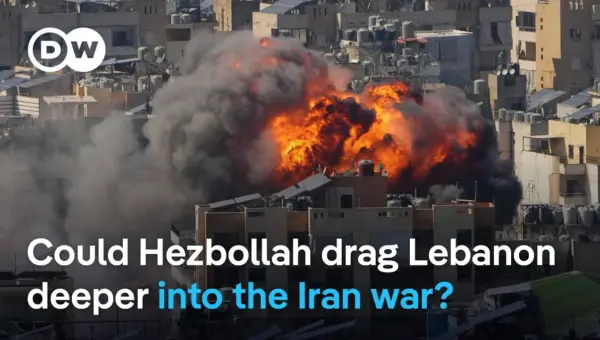
Hezbollah Fuels Lebanon’s Descent into Wider Iran-Israel Conflict
Lebanon is being drawn into the wider Iran-Israel conflict, with hundreds killed and over half a million displaced by recent Israeli strikes targeting Hezbollah. The Lebanese president has accused Hezbollah of jeopardizing the nation's stability, while the militant group vows to defend its existence.


Carville Slams Trump’s Iran Stance as ‘Surrender,’ Warns of Economic Fallout
Political strategist James Carville sharply criticized President Trump's Iran policy as a "surrender" and warned of economic fallout from rising oil prices. He argued that the conflict's unpopularity and the administration's handling of the economy would significantly impact upcoming elections.


Trump Declares Iran War ‘Complete’ Amid Market Rebound
President Trump declared the war in Iran "very complete," leading to a market rebound and dropping oil prices. However, mixed messaging from the administration on the conflict's timeline and ongoing regional tensions persist. The U.S. also faces severe weather and a thwarted bomb plot in New York.