Europe’s Tech Might: Can It Challenge US Giants?
A recent analysis suggests Europe holds significant leverage over American tech giants, potentially disrupting profits by targeting key economic 'choke points' like market access and data regulation. The core question is whether Europe will choose to actively utilize this power.


Europe’s Economic Leverage: A Hidden Powerhouse?
In the complex landscape of global trade, Europe is often perceived as caught between the economic titans of Washington and Beijing. However, a closer examination of its economic influence, particularly within the tech sector, suggests a far more potent position than commonly acknowledged. A recent analysis, highlighted on ‘The Dip Podcast,’ posits that Europe possesses significant leverage over American tech giants, potentially capable of disrupting their profits and market dominance without resorting to overt conflict.
The American Tech Dependence on Europe
The economic ties between the United States and Europe, especially in the technology sector, are substantial. American tech behemoths, which form the backbone of the digital economy, derive a significant portion of their revenue and profits from European markets. According to the analysis, a staggering one in four of these companies’ profits are generated within the continent. This deep integration raises a critical question: what if Europe were to shift from a passive recipient of these economic relationships to an active player, leveraging its market power?
The implications of such a shift could be profound. By strategically employing economic countermeasures, Europe might be able to inflict considerable damage on the US tech industry. This isn’t about initiating a trade war in the traditional sense, but rather about understanding and utilizing ‘choke points’ – the critical junctures in global supply chains and digital infrastructure that, when controlled or influenced, can dictate the flow of commerce and profit.
“Economic warfare is all about choke points, chips, data, market access. Who controls the bottlenecks? And who actually uses them.”
This statement from the podcast underscores the strategic nature of modern economic competition. The ability to influence or control access to essential resources, technologies like semiconductors (chips), vast amounts of data, and the crucial gateway of market access, represents a form of power that can be wielded effectively.
Identifying Europe’s Economic Choke Points
The concept of ‘choke points’ is central to understanding Europe’s potential leverage. These are not necessarily physical locations but rather critical nodes in economic systems. In the context of the tech industry, these can include:
- Market Access: Europe represents a massive consumer market with significant purchasing power. Restricting or imposing stringent conditions on market access for US tech firms could directly impact their revenue streams.
- Data Regulation: The European Union has been at the forefront of data privacy regulation with frameworks like GDPR (General Data Protection Regulation). These regulations impose significant compliance burdens and can limit how US companies collect, process, and utilize user data within the EU, a key component of their business models.
- Digital Infrastructure and Standards: Europe plays a role in setting standards for digital infrastructure, telecommunications, and emerging technologies. Influencing these standards can shape the competitive landscape for global tech players.
- Semiconductor Supply Chains: While not solely a European domain, the continent is a significant player in various stages of the semiconductor value chain, from design to manufacturing of specific components. Any disruption or preferential treatment within these European segments could have ripple effects.
- Antitrust and Competition Policy: The EU has a history of robust antitrust enforcement, often targeting large multinational corporations. A more assertive stance could lead to significant penalties or structural changes for dominant tech companies.
The Question of European Resolve
The critical question, as raised by the podcast, is whether Europe is willing to recognize and utilize its own power. The perception of weakness might stem from a reluctance to engage in confrontational economic tactics, perhaps due to historical reasons, a preference for multilateralism, or a genuine fear of retaliatory measures. However, the analysis suggests that this caution might be preventing Europe from effectively asserting its interests and rebalancing the economic playing field.
The dependence of American tech giants on the European market is a tangible vulnerability. Companies like Google, Meta (Facebook), Amazon, and Apple all rely heavily on European consumers and businesses. A coordinated European response, perhaps through regulatory action, the enforcement of digital sovereignty principles, or the strategic promotion of European tech alternatives, could indeed ‘blow a hole’ in the profitability and growth projections of these US-based firms.
Broader Implications for Global Trade
The potential for Europe to assert greater economic influence has broader implications for the global trade order. It challenges the narrative of a bipolar economic world dominated solely by the US and China and highlights the agency of other major economic blocs. If Europe were to successfully leverage its position, it could:
- Promote Fairer Competition: A more assertive Europe could push for a more level playing field, ensuring that global tech giants adhere to local regulations and contribute more equitably to the economies they operate within.
- Enhance Digital Sovereignty: It could bolster Europe’s efforts to establish greater control over its digital infrastructure, data, and the rules governing the digital economy, reducing reliance on non-European technology providers.
- Reshape Global Regulatory Standards: European regulatory approaches, particularly in areas like data privacy and antitrust, have often set global precedents. A more assertive stance could further solidify these as international norms.
- Diversify Economic Alliances: It could lead to a more multipolar global economic system, where economic power is distributed more broadly, potentially reducing the influence of any single dominant player.
What’s Next for Europe’s Economic Strategy?
The discussion on ‘The Dip Podcast’ serves as a compelling call for Europe to reassess its economic strategy and its potential leverage. The coming months and years will likely reveal whether European policymakers and businesses will choose to capitalize on the identified choke points. Key areas to watch include the ongoing evolution of EU digital regulations, the continent’s investment in domestic technology and semiconductor capabilities, and the willingness of European governments to adopt a more assertive stance in trade negotiations and regulatory enforcement against dominant global tech players. The question remains: will Europe choose to flex its economic muscle, or will it continue to be perceived as a passive player in the global economic arena?
Source: EU vs US: who could win in a trade war? | The Dip Podcast (YouTube)

Related Articles

Leaked Putin WW3 Plans: Millions Dead, Europe in Crosshairs
Leaked documents from a Russian Telegram channel allegedly outline Putin's plans for a future European war, potentially causing 20 million deaths. The analysis suggests that while the infrastructure for escalation is being built, the upcoming 2026 election may act as a temporary deterrent to immediate, large-scale conflict.

Trump Threatens Global Tariffs Over Supreme Court Ruling
Donald Trump has issued a dire warning to the global community via Truth Social, threatening increased tariffs on any nation that abides by a recent Supreme Court ruling. This declaration has sparked concerns over the stability of international trade and the rule of law.
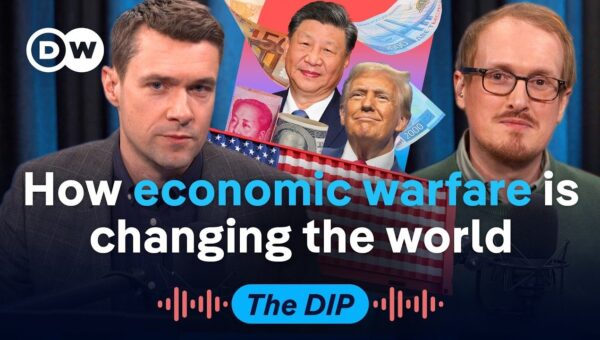
US Economic ‘Choke Points’ Reshape Global Order
The U.S. dollar's dominance grants America significant economic leverage through 'choke points,' but China is building parallel infrastructure as an insurance policy, not a replacement. A recent Supreme Court ruling curtails U.S. tariff powers, while Europe grapples with its position between global giants.