Europe’s Defense Boom: A Risky Bet on Economic Revival?
Europe's defense sector is booming amid geopolitical tensions, with companies doubling in value since 2022. While this surge offers economic opportunities and drives innovation, concerns remain about the balance between traditional hardware and future technologies, and the persistent issue of industry fragmentation.

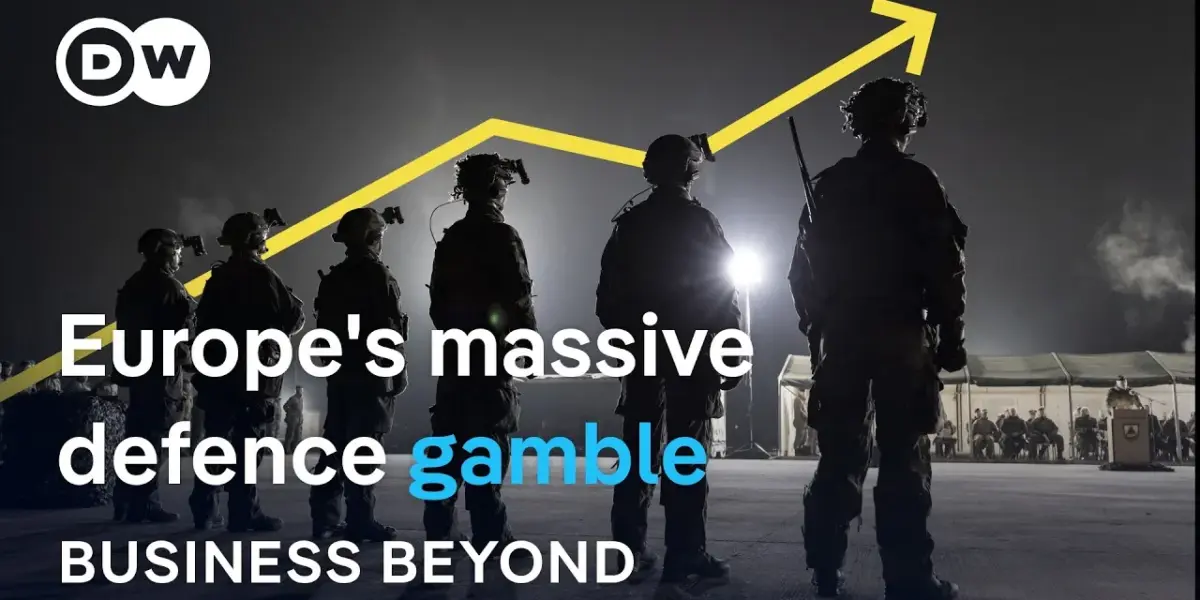
Europe Re-arms: A New Era of Defense Spending
In a significant shift, Europe is dramatically increasing its investment in defense. Once a neglected sector, the continent’s security needs have become starkly apparent, driven by geopolitical tensions and evolving international alliances. This surge in defense spending has led to booming fortunes for European defense companies, with many doubling and even tripling in value since Russia’s full-scale invasion of Ukraine in 2022. This renewed focus on military capabilities is not only reshaping security landscapes but also raising questions about its potential to inject much-needed momentum into the European economy.
Steel for Security: A Supplier’s Perspective
The impact of this rearmament is felt across various industries. At Ilenberger Groblett, a German steel manufacturer, the defense sector has emerged as a crucial new market. For years, the European steel industry has grappled with high energy costs, low prices, and overcapacity, leading to a period of de-industrialization. However, the company’s strategic investment in ‘secure steels,’ including armor-grade steel for military applications, offers a potential lifeline.
Torsten Gintout, the company’s managing director, explained the challenges: “The last two years were not good. Not good, not good at all. And why is that? Because as every steel company we are suffering uh due to high energy costs we have here in Europe we have to deal with and at the same time we are suffering with quite low steel prices too low steel prices to compared to the cost level we have.” He highlighted the stringent quality standards and lengthy approval processes required for defense contracts, noting that while still a relatively small part of their output, secure steels represent a growing and vital niche.
Defense Giants See Surge in Growth
The broader European defense sector is experiencing unprecedented growth. EU member states collectively spent nearly 400 billion euros on defense in 2023. Major players like Airbus Defense and Space, Germany’s Rheinmetall, and the UK’s BAE Systems are at the forefront of this expansion. Turnover in the European defense sector climbed by 48% between 2021 and 2024, exceeding 180 billion euros. The industry is also a significant employer, providing jobs for over 1.1 million people in the EU, with more than 300,000 new positions created in the last decade.
Eurofighter Typhoon: A Symbol of Collaboration and Demand
At the Airbus military aircraft production facility in Manching, Germany, the scale-up of European defense production is evident. The Eurofighter Typhoon fighter jet, a product of pan-European cooperation involving Airbus (Germany and Spain), BAE Systems (UK), and Leonardo (Italy), stands as a symbol of this renewed focus. This project, once struggling against the dominance of the US-made F-35, has seen a resurgence in demand.
Andreas Hammer, Head of Combat Air Systems at Airbus, noted the program’s critical role: “The Euro fighter is playing an incredible role in for for bringing sovereignty and and and deterrence and and defense capabilities to to these countries and yes we have an incredible momentum right now and uh and we are ramping up.” Germany’s significant orders for the Eurofighter, including a €3.75 billion order for 20 new jets in October 2023, in addition to 38 ordered in 2020, underscore this trend. Spain, Italy, and Turkey have also placed substantial orders, ensuring full order books for the coming years.
Beyond Security: Innovation and Economic Impact
The defense sector’s impact extends beyond immediate security. Marco Gumb, Head of Sales for Combat Air Systems at Airbus, a former Eurofighter pilot, emphasized the wider benefits: “Besides just providing just quote unquote providing security and deterrence it’s obviously also securing high-tech jobs uh in in the areas for our countries. Um and you know in the past let’s say 20 30 years ago all the high-tech innovation most notably GPS for instance came from military equipment.” He believes the current investments in new technologies, including AI and unmanned systems, will foster significant dual-use innovation with civilian applications.
The Eurofighter program alone is estimated to create 100,000 jobs across Europe, with 25,000 in Germany, supported by over 400 suppliers. This economic stimulus is seen as a vital component of the rearmament strategy.
Criticisms and Challenges: The Innovation Gap and Fragmentation
Despite the positive economic outlook, criticisms are emerging. A significant concern, particularly in Germany, is that a large portion of new defense spending is directed towards traditional military hardware like tanks and fighter jets, with insufficient investment in innovative technologies such as AI-enabled military tech and drones, which have proven crucial in recent conflicts. Data suggests that between 95% and 98% of new spending since 2022 has been on traditional tech.
Moritz Schularick of the Kiel Institute for the World Economy has highlighted this issue. Mike Schulhorn, CEO of Airbus Defence and Space, acknowledged these concerns: “I know more as well and and I I know his statement and I and I concur with them. I think this is not um the end point of what it should be. Now we also have to recognize that Germany and the Bundesphere as as the German armed forces come from a time when there was huge holes in what they should should have been able to do in the first place. Those holes need to be plugged.” He anticipates that spending on innovative technologies will increase significantly as procurement processes adapt.
Fragmentation within the European defense industry remains a major challenge. With 27 different national governments, collaboration is complex, leading to a proliferation of systems compared to the more streamlined approach in the United States. Schulhorn stated, “The US is better at scaling is better at at driving the cost point down and that’s that’s still a huge issue in Europe.” He cautioned against nationalistic tendencies that could exacerbate this problem, while highlighting companies like Airbus that aim to combat fragmentation through large-scale European projects.
The Future Combat Air System (FCAS) Saga
The Future Combat Air System (FCAS) project, a Franco-German-Spanish initiative, exemplifies the difficulties in achieving effective collaboration. While the core components, including unmanned systems and sensors, are reportedly progressing well, the manned fighter jet element has faced significant challenges between key industrial players. Schulhorn described FCAS as “much much more than a plane. It’s a combat cloud at the very core of it.” He suggested that even if the project involves two separate fighter aircraft, the overall collaboration could remain resilient.
He explained that FCAS, conceived during a period of relative peace, requires restructuring to adapt to the current geopolitical reality where speed is paramount. “The times where you could define something very precisely with long requirements lists that would then come 15 or 20 years later are over.”
Balancing Security and Social Spending
Concerns are also voiced about the diversion of funds from social programs like healthcare and education to defense. Schulhorn expressed understanding for these worries but argued for a balanced approach: “I think it’s not an eitheror. I think we need to do both. But we have definitely underspent on defense now uh in the past. We now need to catch up.” He believes that robust defense spending is essential to secure the future of Western democracies and liberal values.
Economic Rejuvenation: A Cautious Optimism
The prospect of defense spending revitalizing Europe’s industrial base is met with cautious optimism. Drawing parallels with the United States and Israel, where defense spending has historically driven economic growth and technological innovation, Schulhorn believes Europe can achieve similar results. “Europe’s not yet there. Europe has to learn that.” He reiterated the need to prioritize innovative systems and R&D to ensure a lasting economic impact. The current spending, while necessary to fill immediate capability gaps, needs to evolve towards fostering long-term economic growth.
Looking Ahead: The Long-Term Economic Dividend?
The current wave of defense investment presents Europe with a critical juncture. While the immediate focus is on bolstering security in a volatile world, the long-term economic implications are significant. If Europe can successfully navigate the challenges of industrial fragmentation, prioritize innovation, and foster genuine collaboration, this defense spending spree could indeed serve as an ‘electroshock treatment’ for its economy, driving technological advancements and economic dynamism. However, if the spending remains heavily skewed towards traditional hardware without a strategic focus on R&D and cutting-edge technologies, the potential for a transformative economic dividend may be limited, leaving Europe more secure but economically stagnant.
Source: Has Europe staked its economic future on war? | Business Beyond (YouTube)

Related Articles

Ex-MI6 Chief: UK Faces Iran Threats, Starmer Lacks Churchill’s Conviction
Former MI6 chief Sir Richard Dearlove discusses the threat of Iranian intelligence operations on UK soil following recent arrests. He also draws a stark comparison between current political leadership and historical figures, suggesting a lack of conviction in figures like Keir Starmer.


Karoline Leavitt’s War Spin Crumbles Under Scrutiny
Karoline Leavitt faces mounting pressure to spin escalating US-Israel military actions against Iran, struggling with shifting justifications and contradictory claims about threats and preparedness. The analysis delves into the administration's messaging, historical precedents, and the implications for 'America First' policy.


Iran War Threatens US Economy, Congressman Warns
Congressman Jim Himes warns that a war with Iran poses a severe economic threat to the U.S., citing unsustainable military spending and rising energy prices. He criticizes the lack of diplomatic strategy and the potential for wider conflict.