Epstein’s Unfolding Saga: Billion-Dollar Questions, Political Cover-Ups, and Trump’s Legal Tangles
Recent revelations in the Jeffrey Epstein saga, including a contentious deposition and a new truth commission, highlight persistent questions about elite impunity. Concurrently, the Supreme Court struck down Donald Trump's sweeping tariffs, while his administration's Department of Justice faces scrutiny for alleged rights violations and a controversial prosecution of a journalist, underscoring ongoing challenges to the rule of law and accountability.

Epstein’s Unfolding Saga: Billion-Dollar Questions, Political Cover-Ups, and Trump’s Legal Tangles
The intricate and disturbing narrative surrounding Jeffrey Epstein continues to unravel, casting a long shadow over powerful figures and institutions. Recent developments, including a high-stakes congressional deposition and the establishment of a dedicated truth commission, underscore persistent questions about the scope of Epstein’s sex trafficking network and the alleged efforts to conceal its full extent. Simultaneously, former President Donald Trump faces significant legal challenges, from a Supreme Court rebuke of his tariff policies to ongoing scrutiny of his administration’s Department of Justice and a criminal prosecution against a journalist that critics liken to his personal litigation tactics. These concurrent events paint a complex picture of power, accountability, and the rule of law in contemporary American politics.
The Shadow of Jeffrey Epstein: New Revelations and Unanswered Questions
The enduring mystery of Jeffrey Epstein’s vast and illicit enterprise continues to yield new, unsettling details, reigniting public demands for accountability among those who enabled or benefited from his criminal activities. Despite years of investigations, the full truth about Epstein’s network of power, abuse, and alleged cover-ups remains elusive, with recent events bringing fresh urgency to the pursuit of justice.
Les Wexner’s Deposition: A Billion Dollars and a Hot Mic Warning
A pivotal moment in the ongoing Epstein saga recently transpired with the deposition of retail magnate Les Wexner before the House Oversight Committee. Wexner, the billionaire founder of L Brands, which once included iconic brands like Victoria’s Secret, was a long-time associate and financier of Epstein. His testimony has shed light on the extraordinary financial relationship between the two men. During the deposition, Wexner reportedly admitted to providing Epstein with an astonishing sum—more than a billion dollars—over their decades-long association. Yet, remarkably, he struggled to articulate the precise services Epstein rendered in return, raising profound questions about the nature of their business dealings and Epstein’s unusual influence despite a seemingly limited professional background.
The deposition took a dramatic and unprecedented turn when, amidst Wexner’s testimony, his lawyer was reportedly caught on a hot mic issuing a chilling warning: "I’ll f***ing kill you if you answer another question with more than five words." This extraordinary incident, captured during a formal congressional proceeding, highlights the intense pressure and potential sensitivities surrounding Wexner’s testimony. It immediately triggered speculation about what information his legal counsel sought to suppress and the broader implications for transparency in such a high-profile investigation. The absence of any Republican members from the House Oversight Committee during Wexner’s deposition further fueled concerns about a potential political cover-up, particularly given the committee’s stated mandate to ensure government accountability and investigate high-level misconduct.
Adding another layer of complexity, Wexner explicitly stated under oath that neither the Federal Bureau of Investigation (FBI) nor the Department of Justice (DOJ) had ever directly contacted him regarding Epstein or his accomplice, Ghislaine Maxwell. This assertion directly contradicts prior public statements made by House Oversight Committee Chair James Comer, who had suggested Wexner had been previously investigated. The glaring discrepancy raises serious questions about the thoroughness of past investigations into Epstein’s network and the veracity of public statements made by those overseeing the current inquiry, further complicating the pursuit of truth and justice.
The Zorro Ranch: A New Mexico Truth Commission and Allegations of Cover-Up
Another critical development in the Epstein narrative centers on his infamous Zorro Ranch in New Mexico. Purchased by Epstein in 1993, the sprawling property has long been implicated as a central hub for his illicit activities, serving as a remote location for the abuse and trafficking of minors. In a recent and controversial transaction in 2023, the ranch was sold to Don Huffines, a prominent Republican politician with known ties to former President Donald Trump, through a shell company identified as San Raphael LLC. This sale immediately attracted scrutiny from local authorities and activists.
In response to persistent public pressure and the gravity of the allegations surrounding the ranch, a truth commission has been established in New Mexico. This commission is tasked with thoroughly investigating what transpired at the Zorro Ranch, with existing files reportedly indicating extensive sex trafficking and even potential murders may have occurred on the premises. The involvement of a Trump-aligned politician in the purchase of such a historically significant property in the Epstein saga adds another layer of political complexity to the ongoing investigation.
The timing of the sale and subsequent actions by Huffines have drawn particular scrutiny. Huffines claims the ranch is being converted into a "Christian retreat for children," with construction suddenly underway. Critics, however, argue that this abrupt renovation could be a deliberate attempt to destroy or conceal crucial evidence, potentially hindering the truth commission’s efforts to uncover the full scope of activities at the ranch. The concern is that physical evidence, forensic traces, or structural features relevant to the alleged crimes could be irrevocably altered or removed under the guise of legitimate development, obstructing justice for victims.
The "Epstein Class" and the Illusion of Impunity
The narrative emerging from these investigations points to a disturbing pattern of elite impunity, a phenomenon some have termed the "Epstein Class." This concept describes a segment of the powerful and wealthy who appear to operate above the law, protected by their extensive connections, vast resources, and a legal system that, in certain instances, seems to fail in holding them fully accountable. The transcript highlights instances of apparent indifference or even mocking laughter from figures like Wexner and Howard Lutnick when confronted with serious allegations, reinforcing the public perception that they believe themselves to be untouchable by ordinary legal standards.
This notion of elite immunity is starkly contrasted with international precedents. While the U.S. Supreme Court controversially established a doctrine of "absolute immunity" for a former U.S. President—a concept widely seen as antithetical to the nation’s founding principles of "no kings" and equal justice—other nations have demonstrated a greater willingness to hold powerful figures accountable. The transcript references Prince Andrew of the UK, who, despite his royal status, faced legal action and was stripped of his military titles and royal patronages in connection with his association with Epstein. Similarly, it cites the swift sentencing of an "insurrectionist leader" in South Korea and the imprisonment of Brazil’s former President Jair Bolsonaro for actions related to an attempted coup. These international comparisons underscore a perceived disparity in justice, where the U.S. legal system appears, in some instances, to afford greater protections to its powerful elite than even monarchical or developing nations.
The connections to Donald Trump within the broader Epstein narrative are also repeatedly emphasized. The transcript notes Trump’s presence at Victoria’s Secret fashion shows with Epstein, describing it as "odd" given his ostensible lack of involvement in the fashion industry. More disturbingly, it references Howard Lutnick, a Trump administration official, and his alleged dealings with Epstein, including the sale of adjacent townhouses in New York City. Lutnick’s dismissive claims about seeing a "massage table" in Epstein’s living room and his subsequent public denials of further contact were later contradicted by revelations from Epstein’s files, which reportedly suggested Lutnick brought his children to Epstein’s infamous "Pedo Island" and engaged in discussions about "nanny exchanges" with Epstein. Trump’s own public statements, expressing sympathy for Prince Andrew and the royal family rather than for Epstein’s numerous victims, further solidify the perception of his alignment with this "Epstein Class." The mention of Mar-a-Lago, Trump’s residence, as a location where sex trafficking reportedly occurred, coupled with unresolved allegations against Trump himself—including a civil finding of sexual assault by a federal jury and reports of missing FBI interview records related to accusers—contribute to the persistent and growing call for thorough, impartial, and transparent investigations into all individuals connected to Epstein’s crimes.
Supreme Court Strikes Down Trump’s Tariffs: An Economic Rebuff
In a significant legal and economic development, the United States Supreme Court delivered a decisive blow to former President Donald Trump’s unilateral tariff policies, striking down his sweeping levies against numerous countries. The 6-3 ruling, which saw conservative Justices John Roberts, Neil Gorsuch, and Amy Coney Barrett join their liberal colleagues, underscored a rare bipartisan consensus on limiting executive overreach in trade matters, serving as a powerful check on presidential power.
The International Emergency Economic Powers Act (IEEPA) and its Misapplication
Trump had initially invoked the International Emergency Economic Powers Act (IEEPA) to justify his tariffs. This statute, enacted in 1977, grants the President broad authority to regulate international commerce during declared national emergencies, typically reserved for genuine national security crises or foreign policy threats, such as sanctions against hostile regimes or responses to acts of terrorism. Trump first applied IEEPA to impose tariffs on goods from Canada and Mexico, alleging they were "inundating" the U.S. with fentanyl and other illicit drugs—a justification that many legal scholars and trade experts found tenuous for an economic measure. Subsequently, he expanded this application globally, citing a national emergency due to persistent trade deficits with other nations. Critics argued that these justifications stretched the intent and scope of IEEPA far beyond its legislative purpose, transforming a tool designed for genuine emergencies into a mechanism for protectionist trade policy and bypassing congressional authority over trade.
The Supreme Court’s decision, while not fully detailed in the transcript, likely centered on statutory interpretation and the principle of separation of powers. The Court likely found that Trump’s expansive use of IEEPA exceeded the authority Congress intended to grant the President for imposing tariffs, particularly when not directly linked to a bona fide national security threat. The alignment of conservative justices with their liberal colleagues suggests a shared concern across the ideological spectrum for maintaining the constitutional balance between the branches of government and preventing the executive branch from unilaterally reshaping international trade policy without clear and specific congressional authorization. This ruling serves as a vital check on presidential power, reinforcing the constitutional framework that vests primary authority over commerce with the legislative branch.
Trump’s "Temper Tantrum" Response and Future Implications
True to his characteristic style, Trump’s response to the Supreme Court’s decision was immediate and defiant. The transcript describes his reaction as a "temper tantrum," as he quickly vowed to impose new, higher tariffs—first 10%, then 15%—on goods from around the world. Crucially, he reportedly declared his intent to do so by "unlawfully invoking something to give himself powers that he doesn’t have." This statement indicates a potential disregard for the Supreme Court’s ruling and a continued willingness to push the boundaries of executive authority, even in the face of judicial limitations. Furthermore, Trump announced the removal of the "de minimis" tariff exemption for goods valued at $800 or less. This exemption traditionally allowed small-value imports to enter the U.S. without duties, facilitating e-commerce and reducing administrative burdens. Its removal would mean that even small consumer purchases imported into the U.S. would now be subject to direct tariffs, significantly impacting online shoppers, small businesses relying on international suppliers, and potentially leading to higher costs for everyday goods.
The implications of Trump’s proposed actions are far-reaching. Such unilateral tariffs, if implemented, could trigger immediate and widespread retaliatory measures from trading partners, leading to escalated global trade wars, increased consumer prices, reduced economic competitiveness for U.S. industries, and broader geopolitical instability. The legal battle over executive authority in trade is likely far from over, with potential future administrations having to grapple with the precedents set by these challenges to established trade law and constitutional norms, emphasizing the ongoing tension between presidential power and congressional oversight.
Federal Courts Rebuke Trump’s DOJ: A Crisis of Accountability
Beyond the high-profile Supreme Court ruling, numerous federal courts across the United States have issued scathing condemnations of the Trump administration’s Department of Justice (DOJ). These rulings, emanating from judges appointed by presidents spanning multiple administrations—from Reagan to Biden, George H.W. Bush to Obama, and even Trump himself—paint a consistent and deeply troubling picture of a DOJ frequently violating basic human rights, flouting court orders, and operating with an "unfathomable" disregard for legal process.
The criticisms leveled by federal judges are wide-ranging and severe. They include charges of unlawfully detaining individuals, particularly in immigration contexts, failing to process essential legal paperwork in a timely manner, and consistently disregarding judicial directives and consent decrees. These violations often touched upon the fundamental rights of individuals, including due process and protection from arbitrary detention. In one particularly egregious instance cited in the transcript, a Trump DOJ official was reportedly held in contempt of court for violating explicit court orders. Such contempt findings against government officials are exceptionally rare and signify a profound breakdown in the relationship between the executive and judicial branches, indicating a serious challenge to the rule of law and the judiciary’s ability to enforce its mandates.
These judicial excoriations highlight a systemic issue within the Trump-era DOJ, where the administration was accused by critics of weaponizing the legal system and undermining due process. The bipartisan nature of the judges issuing these rulings—including those appointed by Trump himself—lends significant weight to the criticisms, suggesting that the violations were not merely political disagreements but fundamental breaches of legal and ethical conduct. The long-term consequences of such systemic disregard for court orders could erode public trust in government institutions, undermine the integrity of the justice system, and set dangerous precedents for future administrations regarding executive branch compliance with judicial oversight. The consistent nature of these findings across different courts and judicial appointees underscores a pattern of behavior that raised serious concerns about the commitment of the Trump DOJ to upholding fundamental legal principles.
The Don Lemon Prosecution: A Case Study in Vexatious Litigation
The criminal prosecution of journalist Don Lemon offers a revealing glimpse into what critics describe as the Trump administration’s broader strategy of "vexatious litigation"—a tactic designed to harass, intimidate, and exhaust opponents through prolonged legal battles, often regardless of the actual merits of the case. Lemon was reportedly targeted and "unlawfully prosecuted" by the Trump DOJ for simply reporting on a peaceful protest at a church in St. Paul, Minnesota. Such actions, particularly against a member of the press, raise serious concerns about press freedom, the government’s use of its prosecutorial power to silence dissent or unfavorable coverage, and the chilling effect it could have on journalistic inquiry and public discourse.
Adding a layer of irony and reinforcing the "vexatious litigation" narrative, the Trump DOJ is now reportedly asking the federal judge to slow down the case, arguing its complexity and the need for significantly more discovery. This request stands in stark contrast to Lemon’s eagerness to proceed to trial, confident in his innocence and seeking a swift resolution. Critics view this delay tactic as a classic move in what they characterize as Trump’s litigation playbook, allegedly honed over decades of personal and business disputes. The strategy, as described, often involves filing high-profile, sometimes frivolous, lawsuits to generate headlines and create a public perception of wrongdoing, only to then employ every possible legal mechanism to delay, prolong, and complicate the legal process.
This approach, critics argue, aims to "torture and terrorize" defendants, forcing them to expend vast financial and emotional resources on legal defense. The ultimate goal is often to extort a settlement through attrition or, failing that, to drag the case out for so long that public memory fades, and any eventual dismissal or unfavorable outcome for the plaintiff receives little to no media attention. The initial filing, with its dramatic claims, captures headlines and achieves the desired public relations effect, while the quiet resolution years later is often lost in the perpetual news cycle. The Don Lemon case, therefore, serves as a potent contemporary example of how legal processes can allegedly be manipulated for political ends, undermining the principles of swift justice, fair play, and the protection of fundamental civil liberties like press freedom.
Conclusion: A System Under Strain
From the lingering shadows of the Jeffrey Epstein scandal and the profound questions of elite accountability, through the Supreme Court’s decisive rebuke of executive overreach in trade policy, to the systemic challenges within the Department of Justice and the alleged weaponization of legal processes, the recent legal and political landscape reveals a system under considerable strain. These interconnected events collectively highlight crucial and ongoing debates about the rule of law, the separation of powers, the pursuit of justice for victims, and the fundamental principles of democracy. As investigations continue, legal battles unfold, and public scrutiny intensifies, the calls for greater transparency, unwavering accountability, and a reaffirmation of foundational legal norms grow ever louder, reflecting a society grappling with complex questions of power and justice in a turbulent era.
Source: LIVE: Trump PANICS over EPSTEIN AND TARIFF RULING!!! | Legal AF (YouTube)

Related Articles
Trump: Iran Strikes Ahead of Schedule, Expects ‘Great Deal for World’
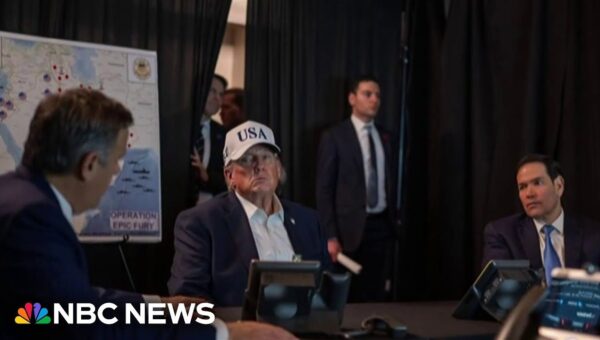
Three U.S. service members have been killed amid escalating conflict with Iran, President Trump confirmed. He stated that strikes are ahead of schedule, with senior Iranian leaders killed, and expressed optimism for a "great deal for the world" despite ongoing talks with Iranian officials.
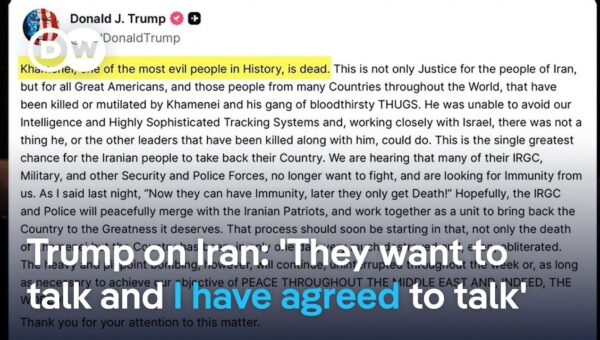
Trump Agrees to Talks with Iran After Major Strikes
President Donald Trump has agreed to talks with Iran's leadership following coordinated strikes that reportedly killed key figures, including the Supreme Leader. While Trump claims significant military successes, U.S. strategy remains unclear, and public opinion shows limited support for the actions amid rising American casualties.

Trump’s Putin Stance: US Strategy and Global Implications
Analysis suggests Donald Trump's approach to the Ukraine war involves pressuring Kyiv, but US involvement is crucial for resolution. China's influence and the 'MAGA' agenda's geopolitical implications are key factors.