Epstein’s Secret Pipeline: Wall Street & Beijing’s Dark Alliance
Newly uncovered documents reveal Jeffrey Epstein's role as a secret intermediary between Wall Street elites and the CCP, facilitating a network of financial and political influence. The revelations detail how Epstein coached executives on navigating Chinese power structures and creating 'interest traps' for mutual gain.

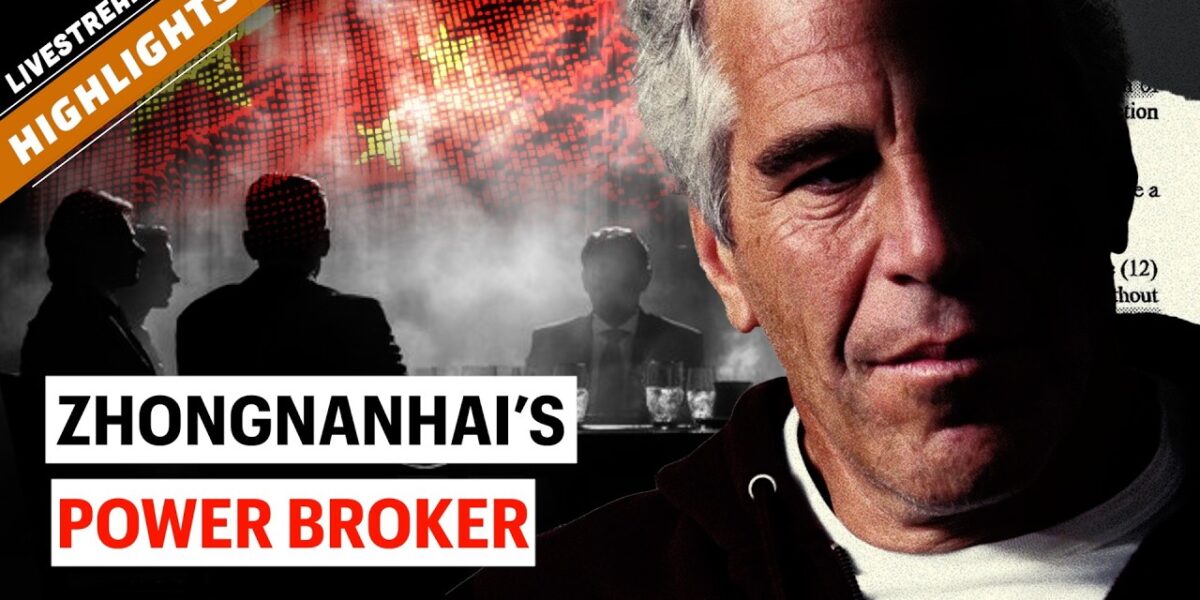
Epstein’s Secret Pipeline: Wall Street & Beijing’s Dark Alliance
Buried within millions of pages of Department of Justice documents, a disturbing picture emerges of Jeffrey Epstein’s role not merely as a convicted sex offender, but as a pivotal “fixer” and intermediary connecting Western elites to the inner circles of Beijing. Newly revealed emails and insights suggest Epstein orchestrated a complex network, leveraging Western financial ambition and the Chinese Communist Party’s (CCP) authoritarian power to create a “monstrous machine” of mutual interest and manipulation.
The Genesis of ‘Guanxi’
An email from 2009, sent by Epstein to a senior JP Morgan executive, Jess Staley (who later became CEO of Barclays), offers a stark glimpse into this clandestine operation. In the email, Epstein instructs Staley on the Chinese concept of “Guanxi,” a system of relationships and reciprocal obligations. He admonishes Wall Street elites for their naive approach to China, emphasizing that traditional legal contracts hold little weight within the “red wall” of the CCP. Instead, Epstein explained, CCP officials prioritize “a promise of survival” – a guarantee of safety for themselves and their families amidst political upheaval.
“Inside the red wall, contracts are just paper that can be tossed into a shredder at any time,” Epstein wrote, according to the transcript. “What they lack is a promise of survival, a guarantee that when political earthquakes hit and the system reshuffles, they and their families will still be safe.”
Epstein’s philosophy, dubbed “Guanxi,” involved integrating Western bankers into the family interests of CCP elites. The price of this integration, he explained, was for these banks to serve as “the CCP elite family’s private overseas safe and their placement office for children and relatives.”
Psychological Manipulation and ‘Interest Traps’
Epstein’s methods extended beyond theoretical advice. He meticulously crafted psychological scripts for Staley’s interactions in Beijing, dictating how to approach CCP officials. The advice was to avoid overtures about investment and profit, and instead adopt a posture of deference, seeking “guidance” and expressing admiration for Chinese “civilization and wisdom in governance.”
Beyond mere flattery, Epstein advised on sophisticated methods of bribery that avoided the appearance of impropriety. He suggested that traditional gifts like gold bars were “low-level stuff” that insulted officials’ intelligence. Instead, he recommended subtle gestures such as providing recommendation letters to elite schools for officials’ children, arranging introductions to Nobel laureates, or assisting family members in “recovering lost antiques” at New York auctions. These actions, Epstein argued, created “real concrete interest traps that locked both sides together.”
The ‘Sons and Daughters’ Hiring Program
Epstein’s influence was instrumental in shaping JP Morgan’s “China Initiative.” He proposed a dedicated China entity with an advisory board that would include members of the Politburo. The core function, he outlined, was to serve as an “overseas shelter for the family members of China’s top officials.” Epstein explicitly targeted senior officials’ families who enjoyed Western lifestyles and sought “an escape hatch.” This involved offering them “fancy titles like advisor,” “obscene salaries,” and crucially, access to JP Morgan’s global network for their children.
This strategy is seen as the precursor to the later “Sons and Daughters” hiring program, which faced significant scrutiny and resulted in JP Morgan being fined hundreds of millions of dollars by the SEC. While officially framed as a “localization strategy,” the transcript suggests it was, in reality, “naked crossborder hostage diplomacy and influence trafficking.” Other major financial institutions like Citigroup, Goldman Sachs, Credit Suisse, Deutsche Bank, Morgan Stanley, and UBS were also reportedly engaged in similar practices.
Financial Channels and Laundering
Epstein’s reach extended to the financial mechanisms used to move and manage wealth. He suggested employing complex financial instruments, such as credit default swaps (CDS), to create “secret untraceable asset management channels” for Chinese officials. This addressed critical CCP elite concerns: how to launder illicit funds generated within China and how to move them seamlessly into the global financial system without triggering anti-corruption investigations back home. This elaborate network, described as Epstein’s “Guanxi web,” facilitated the flow of family wealth through major financial institutions into the global system.
JP Morgan’s Unprecedented Access
Despite the CCP’s stringent control over its financial system, JP Morgan, under Epstein’s guidance, achieved unparalleled access. By early 2024, the bank had secured a dominant position, becoming the first foreign entity to fully own a futures company (2020), a securities company (2021), and an asset management business (2023) in China. While other foreign banks struggled to gain licenses and retreated, JP Morgan established a significant presence across major Chinese cities.
An internal email from Jess Staley dated September 2, 2010, reveals the depth of this access. Staley, exhilarated after a high-level meeting in Beijing, reported to Epstein about a two-hour session with Du Lian, the minister of the Organization Department of the CCP Central Committee – the department controlling personnel appointments and political fates. Staley noted that Du Lian would be on the Standing Committee in the next government, indicating his immense power. The meeting’s focus was clearly not on traditional business, but on the intricate politics of CCP power structures.
Staley’s email also mentioned a subsequent meeting with “the prince,” widely believed to be Xi Jinping, who was then China’s vice president and designated successor. This suggests a direct line of communication and influence between JP Morgan’s top executives, Epstein, and the highest echelons of the CCP, including future leadership.
Geopolitical Speculation and Power Shifts
Epstein’s network was not only facilitating financial deals but also engaging in geopolitical speculation. Shortly after Xi Jinping became China’s leader in November 2012, Epstein exchanged text messages with David Stern. The conversation alluded to a New York Times piece about the wife of Desmond Shum, a figure associated with the Bo Xilai family. Stern’s reply indicated that the new leadership was planning a “massive internal investigation into all asset holding structures linked to Winabo’s family,” a move personally designed by Jiang Zemin to “clear the field for Xi Jinping.” This suggests Epstein’s circle had an accurate, real-time understanding of internal CCP power struggles and Xi Jinping’s initial consolidation of power through asset investigations and purges.
In a May 2019 email, found within the Epstein files, an anonymous sender discussed the escalating US-China trade war and the fragility of Xi Jinping’s power. The message proposed actions “When Xi Jinping and Wang Qishan are removed or step down, break the radical cadre, install our guys, wreak havoc on collaborations in the west.” This chilling communication indicates that by 2019, Epstein’s associates were contemplating “kingmaking” and the potential replacement of Xi Jinping if his policies disrupted their global financial interests.
The Demons of Finance and Power
The transcript concludes by framing Epstein and Xi Jinping as “two demons betting against each other.” While Xi Jinping sought to be an emperor, Epstein and his backers aimed to be “kingmakers.” The revelations suggest that Epstein’s network was not merely a facilitator but a sophisticated player in global power dynamics, using financial access as leverage to influence political outcomes and extract wealth, positioning themselves to capitalize on regime power shifts.
Looking Ahead
The full implications of Epstein’s “backchannel” between Wall Street and Beijing are still unfolding. Future investigations will likely focus on the extent of this network’s influence on global financial markets, political decisions, and the long-term consequences of such clandestine alliances. The revelations raise critical questions about financial regulation, international influence operations, and the ethical responsibilities of global financial institutions.
Source: Epstein’s Backchannel: The Secret Pipeline Between Wall Street and Beijing (YouTube)

Related Articles


China’s Global Grip Loosens Amidst Sanctions and Shifting Alliances
Recent weeks have seen China facing increased scrutiny, from accusations of supplying Russia with military hardware to allegations of foreign influence operations targeting U.S. politics. Meanwhile, strategic alliances and economic countermeasures by rivals like the U.S. and Japan signal a potential shift in global power dynamics.

China’s Island Gambit Threatens US Security, Exposing Global Deception
China's strategic expansion across Pacific islands and alleged disinformation campaigns pose significant threats to U.S. national security. From the potential compromise of Diego Garcia to manufactured narratives surrounding military purges, Beijing's global ambitions are increasingly apparent.
Xi’s Reign of Terror: Are CCP Officials Really Dying?
Rumors swirl about Xi Jinping orchestrating deadly purges of CCP officials, with unverified reports of executions and suicides surfacing. A critical analysis reveals the challenges of discerning truth from fiction in China's opaque political system.