Doctors Strike Over Pay, AI Sparks Job Debate, Hungary Woos MAGA
UK resident doctors continue their strike over pay, impacting patient care and costing the NHS millions daily. Meanwhile, a debate emerges on whether society has passed its 'golden age,' with AI's rise prompting discussions about a four-day work week and the future of jobs. In international politics, U.S. Vice President JD Vance's visit to Hungary highlights the growing alliance between Viktor Orbán and the MAGA movement.


Doctors Strike, Disrupting Healthcare Amidst Pay Dispute
Resident doctors in the UK have begun a six-day walkout, marking the 15th strike by the British Medical Association (BMA) since 2023. This latest action stems from a long-running dispute over pay, with doctors arguing their earnings have significantly decreased compared to two decades ago. Health Secretary Victoria Streett stated the strikes cost the NHS an estimated £50 million per day, totaling £300 million for the week. The government claims the BMA rejected a deal that would have funded 1,000 new training places, which are now reportedly not materializing. Critics, including Health Secretary Streett, argue that the doctors’ actions are punishing patients and a struggling health service, potentially worsening working conditions through increased backlogs and system pressure. The total cost of strikes since 2023 is estimated at over £3 billion.
Golden Age Lost? Experts Debate Societal Shift
Amidst ongoing societal and economic discussions, commentators James and Charlotte Ivers explored the idea that Western society, particularly the middle class, may have experienced its peak in the late 1990s and early 2000s. This period, they suggest, was marked by high economic growth, increasing democracy worldwide, and a general sense of optimism about the future. James Ivers noted that throughout most of history, people have looked to the past for a ‘golden age,’ but the 20th century saw a shift towards believing the utopia lay in the future, driven by technological advancement and rising prosperity. He argues that we are now reverting to the historical norm of longing for the past, which he finds sad.
Charlotte Ivers agreed, expressing concern that younger generations feel their ‘birth rights’—stable jobs, homeownership, and good salaries—are being taken away. She warned that a combination of factors, including AI’s impact on graduate jobs and an overqualified workforce, could lead to societal unrest. However, she offered a caveat, suggesting the ‘peak’ might be slightly misplaced. While the 1990s and early 2000s saw economic booms, they were also periods of higher crime and perceived greater risk, making life feel harsher. The crucial element, she believes, was the overarching sense of a positive future trajectory, a feeling that things were improving and a better age was dawning.
AI Sparks Debate on 4-Day Work Week and Job Security
OpenAI CEO Sam Altman has proposed that companies adopt a four-day work week without reducing pay, suggesting workers should benefit from the efficiency gains brought by artificial intelligence. His company released a blueprint outlining policy recommendations for adapting to new technologies. This idea echoes John Maynard Keynes’s early 20th-century predictions of drastically reduced working hours due to technological progress.
While Charlotte Ivers supports the proposal, seeing it as a necessary step towards revolutionizing how we live and work, James Ivers expressed skepticism. He views Altman’s suggestion as a potential public relations move, especially given OpenAI’s financial situation and past predictions about AI’s imminent impact. Ivers questions whether companies will truly pass on AI-driven efficiencies to employees, citing a perceived shift in Altman’s predictions from widespread job loss requiring universal basic income to a less drastic four-day week.
A recent article in The Times highlighted that AI is more likely to eliminate lower-skilled jobs first, rather than high-level ones. The piece suggests that careers requiring emotional intelligence, creative vision, physical dexterity, and ethical judgment—such as mental health practitioners or those in skilled trades—may be more resilient. Ironically, this could mean that those who previously focused on learning to code might be more vulnerable than those with humanities backgrounds, like writers or therapists. However, Ivers remains cautious, noting that AI is already being used by some as a personal therapist, and its capabilities are still difficult to predict precisely.
Hungary’s Orbán Courts MAGA, Fueled by Shifting Political Alliances
U.S. Vice President JD Vance visited Budapest to meet with Hungarian Prime Minister Viktor Orbán, signaling support for Orbán’s re-election bid. Orbán, a notable ally of Donald Trump and the first EU leader to back him in 2016, has secured exemptions from U.S. sanctions on Russian oil for Hungary. Vance’s visit underscores the deepening ties between Orbán’s government and the MAGA movement.
Commentators suggest this alliance is partly based on a mutual respect for loyalty, a trait valued by Trump and his circle. Additionally, there’s a shared sense of cultural conservatism and ‘family values’ that resonates between Orbán, Vance, and elements of the MAGA base. Orbán is campaigning on a platform of preventing Brussels from drawing Hungary into a war with Russia, a message that appears increasingly desperate as polls suggest he may lose to rival Péter Magyar.
The alignment raises questions about the long-term appeal of Orbán’s ‘illiberal democracy’ model in the U.S. While some in MAGA are drawn to Christian nationalism, analysts suggest Trump’s primary appeal is personal and charismatic. The current political landscape in Hungary, with Orbán facing electoral challenges, may serve as a warning about the limits of such ideologies when not directly tied to Trump’s unique brand of politics. The discussion also touched upon how AI chatbots, when used for political information, tend to offer more centrist and expert-informed perspectives compared to the often polarized and misinformative content found on social media.
Source: Resident Doctors Must Accept Everyone Is Struggling, Not Just Them | Charlotte Ivers (YouTube)

Related Articles


Trump’s Cold Shoulder: Vance Stumbles on Global Stage
Senator JD Vance faced public embarrassment during a trip to Hungary, appearing uninformed on U.S. actions against Iran and unable to reach Donald Trump by phone. The incident highlights communication breakdowns and raises questions about Vance's diplomatic effectiveness.

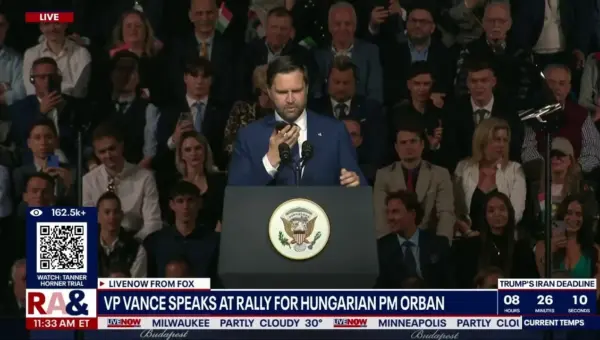
VP Vance Praises Hungary, Criticizes EU Bureaucrats
U.S. Vice President Vance spoke to thousands in Budapest, strongly endorsing Hungarian Prime Minister Viktor Orbán and his policies. Vance criticized European Union bureaucrats, championing national sovereignty and traditional values while contrasting them with what he called a "far-left ideology." The speech highlighted a shared political vision between the two nations.


VP Vance Praises Hungary’s Orban, Boosts US-Hungary Ties
U.S. Vice President Vance met with Hungarian Prime Minister Viktor Orban, highlighting strong economic ties and shared values. The leaders discussed Europe's energy crisis, peace efforts in Ukraine, and concerns over foreign election interference. The visit underscores a deepening strategic partnership between the two nations.