Disturbing ‘Love Letter’: Trump Campaign Accused of Targeting Sexual Assault Survivor E. Jean Carroll with Valentine’s Day Email
E. Jean Carroll, a sexual assault survivor who won a civil lawsuit against Donald Trump, received a disturbing Valentine's Day email from his campaign that read, "I love you and I was pretty sure you loved me back." The unsolicited message, believed to be targeted and sourced from court documents, sparked outrage and raised serious ethical questions about political campaign tactics and the treatment of survivors.

A Valentine’s Day Message Ignites Outrage and Alarm
Valentine’s Day, traditionally a time for expressions of affection and warmth, took a profoundly disturbing turn for E. Jean Carroll this year. While political campaigns routinely leverage holidays for fundraising appeals, an email she received from the Donald Trump campaign on Saturday, February 17, 2024, transcended typical political messaging, sparking widespread outrage and alarm. The email, part of a mass dispatch, contained a message that read: "It’s Valentine’s Day. I love you and I was pretty sure you loved me back." The sender, however, was not an admirer, but the campaign of a man a jury found civilly liable for sexually assaulting her.
The incident immediately drew condemnation, highlighting a perceived egregious breach of ethical conduct and a calculated act of psychological distress against a survivor of sexual violence. Coming on the heels of a landmark legal battle where a jury concluded that Donald Trump had sexually abused Carroll and subsequently defamed her, the email was not merely inappropriate; it was viewed by many as a cruel and targeted provocation, pouring "salt on that wound," as the transcript suggests.
The Shadow of a Landmark Verdict: Understanding the Carroll-Trump Legal Battle
The Allegations and the Trial’s Genesis
To fully grasp the gravity of the Valentine’s Day email, one must understand the tumultuous legal saga between E. Jean Carroll, a respected advice columnist, and Donald J. Trump, the former President of the United States. Carroll first publicly accused Trump of sexually assaulting her in the mid-1990s in a dressing room at the Bergdorf Goodman department store in New York City. She detailed the alleged assault in her 2019 memoir, "What Do We Need Men For? A Modest Proposal."
Trump vehemently denied the allegations, famously stating that Carroll was "not my type" and accusing her of fabricating the story to promote her book. These denials, which Carroll considered defamatory, formed the basis of her initial lawsuit. She sought damages for defamation and later, under New York’s Adult Survivors Act, filed a second lawsuit that included a battery claim for the sexual assault itself.
Civil Liability vs. Criminal Conviction: A Crucial Distinction
The legal proceedings culminated in a significant verdict in May 2023. A New York jury found Donald Trump civilly liable for sexually abusing E. Jean Carroll and for defaming her. This distinction – "civilly liable" versus "criminally liable" – is paramount. In a civil case, the standard of proof is a "preponderance of the evidence," meaning the jury found it more likely than not that the sexual assault occurred. The outcome typically involves monetary damages, as was the case here, with Carroll being awarded $5 million.
A criminal conviction, by contrast, requires proof "beyond a reasonable doubt," a much higher legal standard, and can lead to penalties such as imprisonment. The fact that Trump was found civilly liable means a jury of his peers concluded he committed the act, even if no criminal charges were brought or pursued. This verdict was subsequently reinforced in a second defamation trial in January 2024, where a jury awarded Carroll an additional $83.3 million in damages for Trump’s continued defamatory statements after the initial verdict. The legal system, through its civil mechanisms, had affirmed Carroll’s account, yet the former President’s campaign chose to address her with a message laden with chilling irony.
The Disturbing Email: A Deep Dive into Its Content and Context
A ‘Love Letter’ or a Calculated Provocation?
The Trump campaign’s Valentine’s Day email to E. Jean Carroll was far from a standard fundraising appeal. Its content – "It’s Valentine’s Day. I love you and I was pretty sure you loved me back" – in the context of the recent civil verdict, transforms what might otherwise be a saccharine, if generic, political message into a chilling and deeply offensive communication. For a survivor of sexual assault, particularly one who has endured a highly publicized legal battle against her alleged abuser, receiving such a message from his campaign is not merely insensitive; it can be perceived as an act of psychological intimidation and a deliberate attempt to re-traumatize.
The timing of the email, coinciding with a holiday dedicated to love and affection, only amplified its disturbing nature. It twisted a symbol of positive human connection into a vehicle for what many interpreted as mockery and further abuse. The stark contrast between the message’s superficial sentiment and the profound trauma inflicted upon Carroll underscored the campaign’s apparent disregard for the legal findings and the emotional well-being of a woman who had bravely sought justice.
Unraveling the ‘Creepy’ Layers: Data Acquisition and Intent
Beyond the message itself, several layers of the incident escalated its "creepy" factor, as described in initial reactions. The most immediate question concerned how E. Jean Carroll’s email address ended up on the Trump campaign’s mailing list. Carroll is not, and has never been, a supporter or donor to Donald Trump or his campaign. It is highly improbable that she would have voluntarily subscribed to receive communications from him.
The prevailing assumption, widely discussed, is that her email address was likely obtained through "all the court stuff" – meaning legal discovery documents, court filings, or other materials related to the multi-year lawsuits. If this is indeed the case, it raises serious ethical questions about the misuse of personal information obtained through legal processes for unrelated political campaigning. Legal documents are meant for judicial proceedings, not for populating political databases for targeted messaging, especially not against an adversary who has just won a significant judgment.
Furthermore, the transcript highlights an even more disturbing possibility: that this was the *first* campaign email Carroll had ever received from the Trump campaign. This suggests a targeted act, implying that her email address was not merely swept up in a broad data acquisition but rather specifically added to the mailing list with the express purpose of sending her this particular "creepy ass message." The intention, as articulated in the transcript, was seemingly to "pour a little salt on that wound," an act of deliberate emotional harm.
Such an action moves beyond mere poor taste or oversight and enters the realm of calculated harassment. It suggests a campaign willing to exploit personal vulnerability and legal processes to inflict further distress, challenging established norms of political conduct and respect for individuals, particularly survivors of violence.
E. Jean Carroll’s Reaction and the Broader Outcry
Carroll’s Voice: "Yes, we are living in a crazy world."
E. Jean Carroll, known for her resilience throughout the protracted legal battles, took to social media to address the disturbing email. She shared an image of the message, confirming its authenticity and unequivocally stating that she had not signed up for the mailing list. Her concise yet powerful commentary – "Yes, this is a real email. No, I did not sign up on this mailing list. Yes, we are living in a crazy world" – encapsulated the surreal and alarming nature of the incident. Her choice of the word "crazy" was echoed by many who described the situation with stronger terms like "disturbing," "disgusting," and "horrific."
Carroll’s immediate public response was crucial. It not only validated the incident but also prevented any attempts by the campaign to dismiss it as a fabrication or a misunderstanding. Her clear articulation of not having subscribed underscored the intrusive and potentially targeted nature of the communication.
Public and Media Response
The news of the email quickly spread, igniting a fresh wave of public and media outrage. Victim advocates and women’s rights organizations were particularly vocal, condemning the act as a blatant disregard for a survivor’s well-being and a cynical attempt at intimidation. Social media platforms became arenas for widespread discussion, with many expressing solidarity with Carroll and denouncing the campaign’s tactics as unethical and cruel.
Journalists and commentators across the political spectrum weighed in, with many agreeing that regardless of political affiliation, such an act crossed a line of basic human decency. The incident served as a stark reminder of the challenges faced by survivors seeking justice, especially when their alleged perpetrators wield significant power and influence.
Ethical Lapses and Campaign Strategy: A Troubling Precedent
Navigating the Murky Waters of Political Ethics
The Trump campaign’s email to E. Jean Carroll represents a significant ethical breach in political campaigning. While aggressive tactics are not uncommon in the political arena, there are generally understood, if unwritten, rules of engagement. These rules typically preclude direct, unsolicited, and psychologically distressing communications to individuals who have successfully sued a candidate for personal misconduct, particularly sexual assault.
Professional journalistic standards and public expectations demand a certain level of decorum and respect, even in highly contentious political environments. The act of sending a "love letter" to a sexual assault survivor, who has been legally affirmed as a victim of the sender, demonstrates a profound lack of ethical judgment and empathy. It suggests a campaign willing to prioritize provocation and perceived dominance over fundamental human respect and the integrity of the political process.
Weaponizing Communication: A Tactic of Intimidation?
The intentionality behind the email, especially if Carroll was specifically added to the mailing list, points towards a deliberate strategy of psychological warfare. Such tactics can be employed to intimidate critics, silence accusers, and send a message that challenging powerful figures comes with personal costs beyond the courtroom. For survivors of sexual violence, who often face immense societal pressure and skepticism when coming forward, such acts of apparent harassment can be deeply re-traumatizing and discouraging.
This incident risks setting a dangerous precedent, suggesting that political campaigns might leverage legal proceedings not just for defense, but as a source of information to target and harass adversaries. The psychological impact on a survivor, to receive such a message from the man a jury found responsible for their assault, can be immense, potentially undermining their sense of safety and justice. It risks creating a chilling effect, deterring other survivors from coming forward, fearing that their pursuit of justice could expose them to further, politically motivated attacks.
Data Privacy Concerns in Political Campaigns
The alleged acquisition of Carroll’s email address from "court stuff" also raises significant concerns about data privacy and the ethical use of personal information in political campaigning. While political campaigns often engage in sophisticated data mining and list acquisition, there are generally accepted ethical boundaries, and in some jurisdictions, legal restrictions, on how personal data can be collected and used.
Information obtained through legal discovery or public court records, while technically accessible, is intended for the specific purpose of litigation. Its repurposing for targeted political messaging, particularly in a manner designed to cause distress, is a severe breach of ethical conduct. It highlights the need for greater scrutiny and potential regulation regarding how political campaigns source and utilize personal data, especially when it involves individuals who are not voluntary participants in the political process or who are involved in sensitive legal disputes with the candidate.
Broader Implications: The Political Landscape and Treatment of Survivors
The Culture of Confrontation in Modern Politics
This incident is not isolated but rather fits into a broader pattern of highly confrontational and often aggressive political discourse that has become increasingly prevalent in modern politics. Certain political figures and campaigns have embraced a strategy that thrives on provocation, pushing boundaries, and directly challenging opponents in ways that previous generations might have considered beyond the pale. This approach, while galvanizing a loyal base, often alienates others and contributes to a more polarized and hostile political environment.
The E. Jean Carroll email serves as a stark example of how this culture of confrontation can manifest in personal and deeply offensive ways, extending beyond policy debates to target individuals directly, even those who have successfully sought legal redress.
Setting a Dangerous Precedent for Victim Engagement
The implications for survivors of sexual violence are particularly troubling. The courageous act of coming forward, enduring a public trial, and achieving a civil victory against a powerful figure like Donald Trump is an arduous journey. To then be subjected to what appears to be a targeted act of harassment from that figure’s political campaign sends a profoundly negative message.
It risks creating an environment where survivors might feel that even after achieving legal vindication, they remain vulnerable to further attacks and intimidation. This stands in stark contrast to the growing movement to believe and support survivors, and to foster environments where victims feel safe and empowered to seek justice without fear of retribution or psychological torment.
The Role of Social Media in Amplifying and Documenting Such Events
E. Jean Carroll’s ability to immediately share and validate the disturbing email through social media played a critical role in bringing the incident to public attention. In an era where information spreads rapidly, social media platforms serve as powerful tools for individuals to document their experiences, challenge narratives, and mobilize public opinion. Carroll’s swift action ensured that the email could not be dismissed or hidden, forcing a public reckoning with the campaign’s actions.
This highlights the dual nature of social media: while it can be a source of vitriol and misinformation, it also provides a crucial avenue for accountability, allowing individuals to expose wrongdoing and rally support in real-time, effectively bypassing traditional media gatekeepers.
Looking Ahead: Accountability and the Path Forward
While the immediate legal repercussions for the Trump campaign regarding this specific email are uncertain, the incident has undoubtedly generated significant public outcry and further solidified perceptions of the campaign’s ethical boundaries. It will likely continue to fuel the ongoing public discourse about the standards of conduct expected from political figures and their organizations.
The E. Jean Carroll saga, including the Valentine’s Day email, underscores the enduring challenges of ensuring accountability for powerful individuals, particularly in the realm of sexual assault and harassment. As Donald Trump continues his presidential campaign, his past and present actions, including those directed at his accusers, will undoubtedly remain under intense scrutiny. The incident serves as a powerful reminder of the need for unwavering vigilance in upholding ethical standards, protecting survivors, and demanding respect and decency in all aspects of public life.
The disturbing "love letter" is more than a fleeting controversy; it is a profound illustration of the weaponization of communication and a stark reminder of the battles survivors continue to face, even after achieving legal victories. It challenges society to reflect on the values it cherishes and the kind of conduct it is willing to tolerate from those who seek the highest offices.
Source: Trump Assault Survivor Receives Disturbing ‘Love Letter’ from His Campaign (YouTube)

Related Articles


Trump Open to Iran Talks After Attacks, Shifts on Regime Change
President Trump has agreed to negotiate with Iran's new leadership following recent U.S. and Israeli attacks, signaling a potential shift from his regime change objective. The move has drawn scrutiny from former officials who question the strategic coherence of U.S. policy.

Trump: Iran Strikes Ahead of Schedule, Expects ‘Great Deal for World’
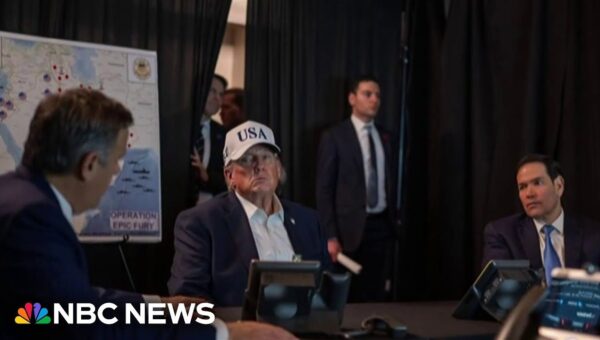
Three U.S. service members have been killed amid escalating conflict with Iran, President Trump confirmed. He stated that strikes are ahead of schedule, with senior Iranian leaders killed, and expressed optimism for a "great deal for the world" despite ongoing talks with Iranian officials.
Trump Agrees to Talks with Iran After Major Strikes
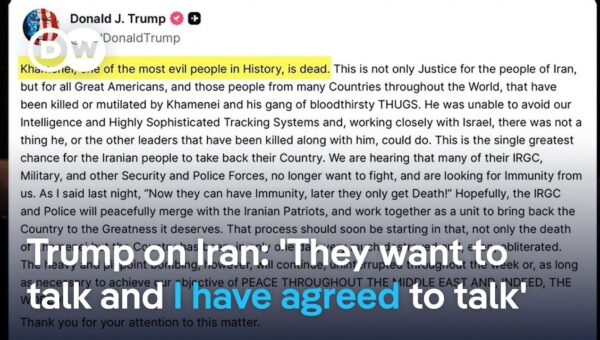
President Donald Trump has agreed to talks with Iran's leadership following coordinated strikes that reportedly killed key figures, including the Supreme Leader. While Trump claims significant military successes, U.S. strategy remains unclear, and public opinion shows limited support for the actions amid rising American casualties.