Disc Golf Flight: Unlocking the Secrets of Aerodynamic Curves
Discover the aerodynamic principles behind the curving flight of a disc golf disc. From spin and stability to throwing angles and disc design, explore the science that makes every throw a fascinating display of physics in motion.


The Unexpected Aerodynamics of a Flying Disc
Every time a disc golf disc is thrown, it embarks on a journey defined by curves. Whether it’s a powerful drive aimed at a distant basket or a gentle toss, the disc’s trajectory is rarely a straight line. This phenomenon, a source of fascination for players and physicists alike, is rooted in complex aerodynamic principles that govern the flight of these specially designed objects. Smarter Every Day, in a deep dive into the sport, explored the intricate dance between spin, angle, and air that causes these predictable yet captivating flight paths.
Expert Insights from the Fairway
To unravel the mysteries of disc flight, the investigation began in Finland, the host of the Professional Disc Golf Association World Championships. Here, host Destin met with elite players Simon Lizotte and Eagle McMahon. These athletes, whose careers depend on a nuanced understanding of disc dynamics, provided firsthand accounts of how they manipulate disc flight.
Understanding Disc Rotation and Stability
A key concept introduced is the direction of spin. For a right-handed backhand throw, the disc rotates clockwise when viewed from above. Conversely, a left-handed backhand or a right-handed forehand results in counterclockwise rotation. This spin is fundamental to the disc’s stability. The terms ‘overstable,’ ‘stable,’ and ‘understable’ describe a disc’s natural tendency to curve. An overstable disc, when thrown with a right-handed backhand, will naturally fight to curve left. A stable disc flies relatively straight, while an understable disc tends to curve to the right. These tendencies are crucial for players to predict and control the disc’s path.
The Angles of Flight: Hyzer and Anhyzer
Beyond the disc’s inherent stability, the angle at which it is thrown significantly influences its flight. A ‘hyzer’ angle involves tilting the disc so the outside edge is lower than the inside edge, causing it to roll towards the ground. A ‘flat’ throw is self-explanatory, with the disc held level. An ‘anhyzer’ angle is the opposite of a hyzer, with the inside edge tilted down, causing the disc to roll upwards initially before gravity takes over. By combining the disc’s stability with these throwing angles, players can create a vast array of flight paths, including the coveted ‘S-curve’ – a shot that initially turns one way before curving back in the opposite direction.
The Science Behind the Curve
To provide a deeper scientific context, the journey led to Dr. Johnny Potts, whose doctoral research focused on disc aerodynamics. While the full depth of his expertise couldn’t be captured in the video, the core principles were illuminated. The curved flight of a disc is primarily a result of the Magnus effect, similar to how a spinning baseball curves. The airflow over the spinning disc creates a pressure difference. On one side of the disc, the air moves faster relative to the disc’s surface due to the spin, resulting in lower pressure. On the other side, the air moves slower, creating higher pressure. This pressure differential generates a force perpendicular to both the direction of motion and the axis of spin, causing the disc to curve.
The Role of Spin and Speed
The amount of spin imparted on the disc is critical. Higher spin rates generally lead to greater stability and a straighter flight path, counteracting the destabilizing effects of airflow. This is often referred to as ‘snap’ by players – the rapid acceleration of the disc at the point of release, which generates significant rotational velocity. When a disc is thrown with insufficient spin, it can ‘turn and burn,’ meaning it flips over prematurely and crashes to the ground. The speed of the throw also plays a role, interacting with the disc’s design and the air resistance to determine its overall flight distance and trajectory.
Disc Design and Aerodynamics
Disc golf discs are not uniform. Manufacturers like MVP Disc Sports meticulously design discs with varying shapes, weights, and plastic compositions. The ‘dome’ of the disc, the curvature of its top surface, and the profile of its rim all contribute to its aerodynamic properties. A higher dome often indicates a disc that will have more lift and glide, while flatter discs might be more overstable. The ‘shoulder’ of the disc – the transition from the top surface to the rim – is also a critical factor that players can feel, providing clues about the disc’s stability and flight characteristics. This tactile feedback allows experienced players to identify a disc’s potential flight path simply by holding it.
The Physics of the Throw: More Than Just Arm Strength
The physical act of throwing a disc golf disc involves a complex sequence of movements designed to maximize power and control. While arm strength is a factor, the most effective throws engage the entire body. The ‘X-step,’ a common technique in disc golf, involves a specific footwork pattern that allows the thrower to transfer energy from their legs and core through their body to the disc. This rotational movement, akin to coiling and uncoiling a spring, generates significant velocity and spin. The forehand throw, while often perceived as less powerful than the backhand, utilizes a different kinetic chain, emphasizing wrist and elbow action to impart spin and control.
The Savant-like Skill of Professional Players
The ability of professional disc golfers to predict and control a disc’s flight is remarkable. Players like Eagle McMahon demonstrate an almost intuitive understanding of how different discs will fly, often identifying a disc’s model and characteristics merely by feel. This deep connection between the athlete and the equipment is honed through years of practice and competition, allowing them to make split-second decisions on the course based on wind, elevation, and the specific demands of each shot. Their expertise highlights that disc golf is as much a game of physics and aerodynamics as it is of athletic prowess.
What’s Next in Disc Aerodynamics?
The exploration of disc golf aerodynamics is far from over. Continued research into the interplay of spin, speed, angle, and disc design promises to further refine our understanding of flight. As technology advances, we may see even more sophisticated disc designs and training tools that leverage aerodynamic principles. For the everyday player, a deeper appreciation for the physics involved can transform their game, leading to more accurate throws and a greater enjoyment of the sport. The science behind the curve is not just about understanding why a disc flies the way it does, but about harnessing that knowledge to achieve greater mastery on the course.
Source: The Definitive Video on Disc Aerodynamics – Smarter Every Day 313 (YouTube)

Related Articles


Heisenberg’s 1925 Quantum Leap Still Puzzles
In 1925, Werner Heisenberg's groundbreaking work laid the foundation for quantum mechanics, a theory that revolutionized physics but whose fundamental implications remain a profound mystery 100 years later. This exploration delves into the birth of this strange new physics.

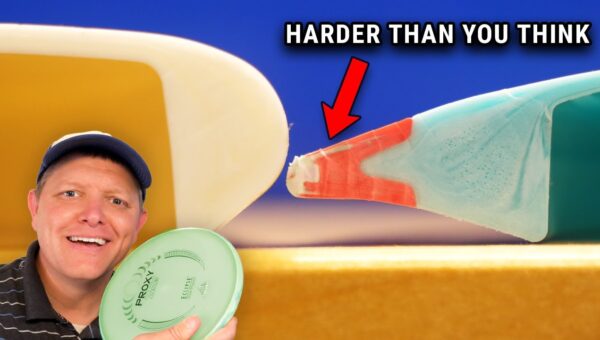
Disc Golf Discs: A Journey from Plastic to Flight
Explore the intricate manufacturing process behind disc golf discs at MVP Disc Sports. From raw plastic granules and advanced injection molding to robotic automation and artistic finishing, discover how these aerodynamic wonders are brought to life.


Spinning Wonders: Unraveling Gyroscopic Precision’s Mysteries
An experimental approach using analogies to linear momentum helps demystify the counterintuitive behavior of spinning objects known as gyroscopic precision. This phenomenon, where a spinning object reacts to force at a 90-degree angle, is crucial for understanding everything from frisbees to spacecraft.