Diplomatic Discord and Discomfort: Inside the Controversial ‘Board of Peace’ Meeting
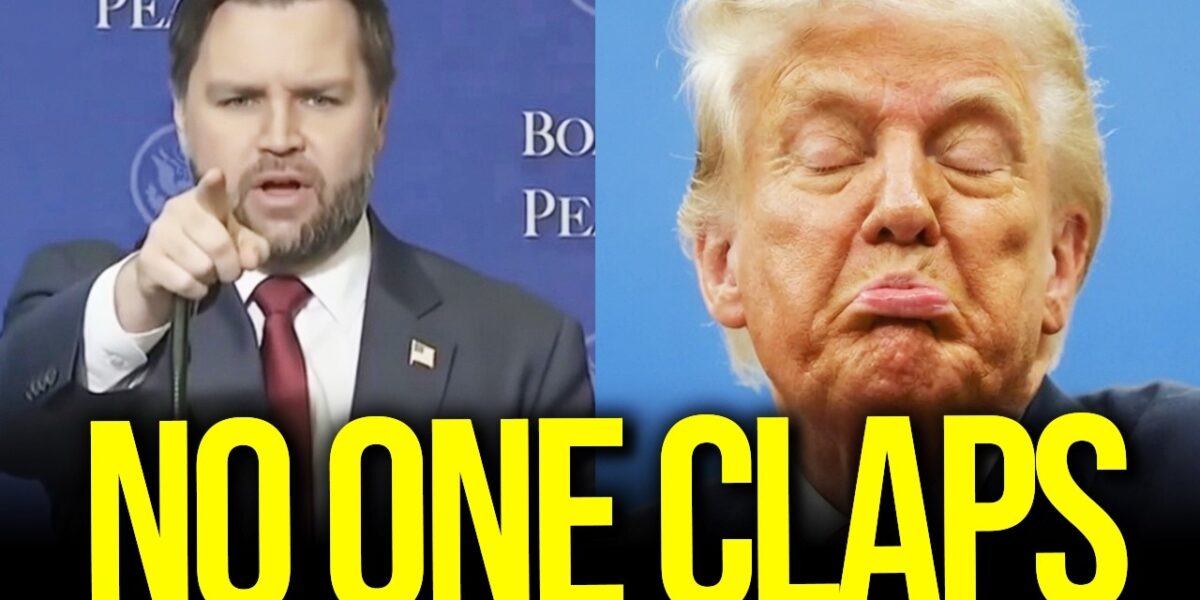
A recent gathering, informally dubbed the "Board of Peace meeting," featuring Donald Trump and J.D. Vance, descended into controversy marked by awkward gaffes, inappropriate remarks about women, and factual inaccuracies. The event, intended to discuss striking Iran, instead became a spectacle highlighting diplomatic discord and the erosion of conventional political discourse. This gathering exposed a blend of questionable rhetoric and stark political ironies, raising significant questions about the nature and legitimacy of such an assembly.

Diplomatic Discord and Discomfort: Inside the Controversial ‘Board of Peace’ Meeting
A recent gathering, informally dubbed the "Board of Peace meeting," has ignited a firestorm of controversy, exposing a blend of diplomatic gaffes, questionable rhetoric, and stark political ironies. Featuring former President Donald Trump, Senator J.D. Vance, and Hungary’s Prime Minister Viktor Orbán, the event, purportedly focused on discussions around striking Iran, quickly devolved into a spectacle of awkward moments and eyebrow-raising statements that have left observers questioning the very premise of the assembly.
The Ill-Fated "Board of Peace": A Misnomer in Motion
The moniker "Board of Peace" itself immediately struck many as incongruous, given the stated topic of discussion: the potential for military action against Iran. Compounding this irony was the composition of the attendees, which included figures widely characterized as "anti-democratic leaders." The presence of Viktor Orbán, a leader frequently criticized for undermining democratic institutions in Hungary, alongside Donald Trump, whose presidency was marked by challenges to democratic norms, set a contentious tone from the outset. The very idea of such a group deliberating on matters of international peace and war, particularly with the inclusion of non-state actors or individuals not holding current governmental authority in the US, raised significant questions about the nature and legitimacy of the gathering. Critics were quick to point out the dissonance between the group’s self-appointed title and the actual political philosophies and actions of its members.
The context surrounding this informal "Board of Peace" is crucial. In a geopolitical landscape fraught with tension, particularly concerning Iran’s nuclear program and regional influence, any discussion of military intervention carries immense weight. For a group outside formal governmental channels to engage in such deliberations, even hypothetically, sends a complex signal. It suggests an alternative foreign policy apparatus, one that operates parallel to or even in defiance of established diplomatic frameworks. This approach, characteristic of a populist political style, often prioritizes strongman leadership and direct, often provocative, rhetoric over conventional diplomatic processes. The inclusion of figures like Orbán further solidifies this impression, aligning the group with a global trend of right-wing nationalism that frequently challenges multilateral institutions and established international norms.
The potential implications of such a gathering, even if informal, are far-reaching. It could be seen as an attempt to project influence on international policy outside traditional governmental structures, or as a platform to rally support for specific geopolitical stances among a like-minded international conservative base. Regardless of its direct impact, the optics alone fueled concerns about the erosion of institutional diplomacy and the rise of personalistic foreign policy initiatives.
J.D. Vance’s Awkward Debut: A Joke That Fell Flat
One of the most widely reported moments of the event involved Senator J.D. Vance, whose attempt at humor on stage spectacularly misfired. After being introduced by Donald Trump with effusive praise, Vance took the microphone and, in his opening remarks, tried to land a joke aimed at Congresswoman Alexandria Ocasio-Cortez. The joke, which alluded to Ocasio-Cortez briefly losing her train of thought during an event in Munich, was intended to highlight Vance’s own intellectual prowess in contrast. However, the delivery was drawn out and lacked a clear punchline, resulting in an uncomfortable silence from the audience – not a single laugh. This moment of public awkwardness quickly became a talking point, underscoring the challenges of political communication and the unforgiving nature of live audiences, especially when attempting humor that relies on tearing down an opponent rather than genuine wit.
The incident was particularly salient given Trump’s preceding remarks. The former President had just finished a lengthy introduction of Vance, emphasizing his academic achievements and contrasting them with unnamed "young attractive women" who "didn’t graduate quickly from college" and were "unable to answer questions." This thinly veiled attack on Ocasio-Cortez, coupled with Trump’s characteristic fixation on physical appearance, created an immediate context for Vance’s subsequent attempt at humor. Vance’s decision to immediately echo Trump’s disparagement rather than pivot to a more substantive message further solidified the perception of a coordinated attack, yet one that lacked the comedic timing or substance to land effectively.
This episode also provides a window into the dynamics of political performance and loyalty within the orbit of figures like Donald Trump. Vance, often seen as a rising star within the conservative movement and a staunch Trump ally, appeared to be attempting to align himself with Trump’s style of political attack. However, the failure of the joke highlighted a potential disconnect between intention and execution, suggesting that the charisma and stage presence required to effectively deliver such rhetoric are not easily replicated. The public nature of the misstep, captured on video and widely shared, serves as a cautionary tale in political communication, where an ill-conceived attempt at humor can quickly overshadow any intended message and instead become a source of embarrassment.
From a broader perspective, this incident speaks to the current state of political discourse, where personal attacks and attempts to belittle opponents often take precedence over substantive policy debates. The focus on a minor verbal stumble by a political opponent, framed as a disqualifying flaw, while simultaneously overlooking more significant rhetorical inconsistencies or policy gaps, reflects a trend towards superficiality in political criticism. It also raises questions about the expectations placed on public figures and the standards by which their communication is judged, often through a highly partisan lens.
Trump’s Disconcerting Rhetoric: A Pattern of "Creepy" Comments
Perhaps even more unsettling than Vance’s failed joke were the various comments made by Donald Trump throughout the event, particularly his recurring fixation on women’s appearances and age. Just moments before Vance took the stage, Trump embarked on a tangent about "young attractive women," explicitly stating, "It doesn’t mean we have to like young and handsome men. Mainly women I like." This remark, delivered in a formal setting, immediately drew criticism for its objectifying tone and inappropriateness from a former head of state. It was not an isolated incident but rather a continuation of a pattern of behavior and rhetoric that has long shadowed Trump’s public persona.
The transcript highlights several instances where Trump’s comments about women have veered into what many describe as "creepy." His past remarks, such as those from a 2006 video where he likened "beautiful" young women to his "form of alcoholism" when discussing hiring a flight attendant, resurfaced in public discourse. This anecdote, where he describes hiring a "beautiful girl who was 17 or 18" with "no experience" to work on his plane, has been cited repeatedly as evidence of a problematic perspective on women in professional settings. Furthermore, his known association with Jeffrey Epstein, whom he once described as "a good guy" who "likes them young," adds another layer of disturbing context to his public statements.
More recently, his comments about political figures like Caroline Leavitt, describing her "beautiful face and those lips that don’t stop like like a little machine gun," further exemplify this pattern. Such descriptions, often focusing on physical attributes rather than professional accomplishments or policy positions, are frequently criticized for reducing women to their appearance and creating an uncomfortable, objectifying environment. For many, these comments are not merely gaffes but indicative of a deeper-seated issue regarding respect for women and appropriate public discourse.
The implications of such rhetoric, particularly from a former President and potential future presidential candidate, are significant. It normalizes a certain type of public discourse that objectifies women and dismisses their professional capabilities in favor of their physical attractiveness. This can have a chilling effect on women in politics and public life, creating an environment where their appearance is scrutinized more than their ideas. Moreover, it raises questions about the standards of leadership and the messages conveyed to younger generations about gender roles and respect.
Political analysts and commentators often highlight how these remarks contribute to a broader culture of misogyny and disrespect. While supporters might dismiss them as "locker room talk" or "just Trump being Trump," critics argue that such statements from a figure of immense power carry weight and contribute to a political climate where inappropriate behavior is excused. The continued recurrence of such comments, despite public outcry, suggests either an indifference to criticism or a deliberate strategy to appeal to a segment of the base that tolerates or even embraces such rhetoric.
Economic Exaggerations and Diplomatic Missteps
Beyond the personal remarks, Trump’s speech also included several factual inaccuracies and diplomatic blunders. He began by erroneously bragging about the Dow Jones Industrial Average hitting "50,000 in the first year" of his presidency, a figure that never materialized. The Dow’s highest point during his first year was just over 24,000, and it never reached 50,000 during his entire term. This misrepresentation of economic data, a common feature of his public addresses, highlights a consistent pattern of inflating achievements and downplaying challenges. In reality, the stock market’s performance is influenced by a myriad of factors, and attributing substantial gains solely to one administration, let alone fabricating figures, distorts public understanding of economic realities. For context, the Dow has indeed seen significant growth under other administrations, with the Biden administration, for instance, overseeing a rise from approximately 31,000 to 44,000, demonstrating that market increases are often part of a natural economic cycle rather than singular achievements.
Further diplomatic missteps included Trump’s public search for President Javier Milei of Argentina and Prime Minister Viktor Orbán of Hungary, seemingly unsure of their whereabouts on stage. His comments about endorsing foreign leaders, stating, "I endorse when I like people. You know, I’ve had a very good record of endorsing candidates within the United States. But now I endorse foreign leaders including Victor Orbond who’s here," raised significant concerns. While it is not uncommon for former heads of state to maintain international relationships, openly endorsing foreign leaders, particularly those with controversial human rights records or anti-democratic tendencies like Orbán, blurs the lines of traditional diplomatic protocol. This practice, especially when framed within an "America First" ideology that purports to avoid foreign entanglements, presents a profound contradiction. It suggests a selective application of non-interference, where the US criticizes certain foreign elections while a former president actively intervenes in others through public endorsement.
The presence of Viktor Orbán at such a gathering is particularly noteworthy. Orbán’s government has faced consistent criticism from international bodies and human rights organizations for its erosion of democratic institutions, restrictions on media freedom, and suppression of dissent. His inclusion in a "Board of Peace" discussing international security issues, alongside the suggestion that figures like Vladimir Putin and Benjamin Netanyahu were considered, paints a picture of a group that prioritizes ideological alignment over adherence to democratic principles or international law. This alignment with leaders often described as strongmen or autocrats sends a concerning message about the values that would guide foreign policy under a potential future Trump administration, signaling a departure from traditional alliances and a embrace of a more transactional and ideologically driven approach to international relations.
The Double Standard of Political Scrutiny: AOC vs. Trump
The incident involving J.D. Vance’s joke about Alexandria Ocasio-Cortez’s momentary "stutter" in Munich highlighted a stark double standard in how political figures are scrutinized, particularly concerning their verbal fluency and coherence. Republicans, including Trump and Vance, seized upon Ocasio-Cortez’s brief pause as a sign of intellectual inadequacy, attempting to portray it as disqualifying. This criticism, however, stands in sharp contrast to the often disjointed and rambling speaking style of Donald Trump himself, which frequently features incomplete sentences, sudden topic shifts, and a perceived lack of coherent thought. As the transcript notes, "Donald Trump hasn’t made sense in a decade."
This discrepancy in criticism reveals a highly partisan lens through which political communication is often judged. A minor, fleeting verbal hesitation from a progressive politician like Ocasio-Cortez is amplified and weaponized as evidence of incompetence, while a consistent pattern of rhetorical incoherence from a conservative figure like Trump is often overlooked, dismissed as part of his "charm," or even celebrated as an authentic, unscripted communication style. This selective criticism undermines genuine public discourse and focuses instead on superficial flaws to score political points.
The broader implications of this double standard are significant for the health of democratic debate. It creates an uneven playing field where communication styles are not judged on their clarity or substance, but rather on the political affiliation of the speaker. This can lead to a devaluation of articulate and well-reasoned arguments, favoring instead those who can deliver emotionally charged or populist messages, regardless of their factual accuracy or logical consistency. Moreover, it can discourage younger or less experienced politicians from entering the public sphere, knowing that even minor imperfections will be mercilessly exploited.
In a media landscape dominated by soundbites and viral clips, the ability to maintain a flawless public persona can sometimes seem more important than the substance of one’s policies. The Ocasio-Cortez incident, contrasted with the consistent defense or dismissal of Trump’s rhetorical eccentricities, illustrates how political opponents exploit any perceived weakness, no matter how minor, while simultaneously insulating their allies from similar scrutiny. This dynamic contributes to a polarized environment where objective assessment of communication is often sacrificed for partisan advantage, further eroding trust in political institutions and the media.
Conclusion: A Microcosm of Modern Political Discourse
The "Board of Peace" meeting, despite its informal nature, served as a potent microcosm of contemporary political discourse, replete with its contradictions, controversies, and characteristic personalities. From J.D. Vance’s awkwardly delivered joke to Donald Trump’s pattern of objectifying comments and factual inaccuracies, the gathering underscored a range of issues currently challenging democratic norms and public civility.
The irony of a "Board of Peace" comprising figures with anti-democratic leanings discussing military intervention against Iran, while simultaneously engaging in personal attacks and diplomatic missteps, highlights a profound disconnect between rhetoric and reality. Trump’s continued reliance on controversial comments about women, his economic exaggerations, and his unorthodox approach to international relations signal a consistent, unyielding political brand that, while appealing to a segment of the electorate, deeply concerns others.
Ultimately, the event served as a stark reminder of the volatile and often uncomfortable nature of modern politics. It illuminated the challenges of maintaining respectful discourse, the pervasive influence of personality over policy, and the ongoing struggle to uphold democratic values in an increasingly polarized world. The public fallout from this meeting will undoubtedly contribute to ongoing debates about leadership, accountability, and the future direction of both domestic and international relations.
Source: JD Vance HUMILIATES Trump in front of ENTIRE WORLD (YouTube)

Related Articles

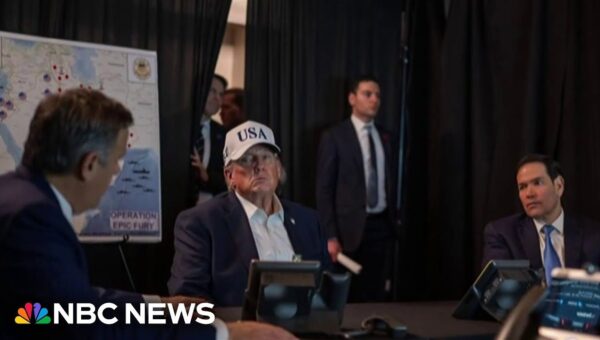
Trump: Iran Strikes Ahead of Schedule, Expects ‘Great Deal for World’
Three U.S. service members have been killed amid escalating conflict with Iran, President Trump confirmed. He stated that strikes are ahead of schedule, with senior Iranian leaders killed, and expressed optimism for a "great deal for the world" despite ongoing talks with Iranian officials.
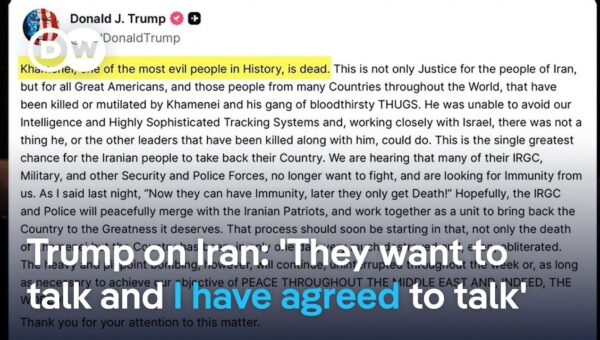
Trump Agrees to Talks with Iran After Major Strikes
President Donald Trump has agreed to talks with Iran's leadership following coordinated strikes that reportedly killed key figures, including the Supreme Leader. While Trump claims significant military successes, U.S. strategy remains unclear, and public opinion shows limited support for the actions amid rising American casualties.

Trump’s Putin Stance: US Strategy and Global Implications
Analysis suggests Donald Trump's approach to the Ukraine war involves pressuring Kyiv, but US involvement is crucial for resolution. China's influence and the 'MAGA' agenda's geopolitical implications are key factors.