Da Vinci’s Tree Rule: A Lesson in Perception
Leonardo da Vinci's overlooked observation about tree structure reveals a profound truth about human perception. The analysis explores how our minds, trapped in 'pretend fighting,' miss the natural order, and offers a path to peace by recognizing these illusions.

Da Vinci’s Tree Rule: A Lesson in Perception
Leonardo da Vinci, a name synonymous with genius, is widely celebrated for his artistic masterpieces and pioneering inventions. We often recall his designs for tanks and helicopters, or his exquisite work in costume and stage design. However, a seemingly simple observation about the natural world, often overlooked, offers a profound insight not just into botany, but into the human mind itself.
The Uniformity of Nature
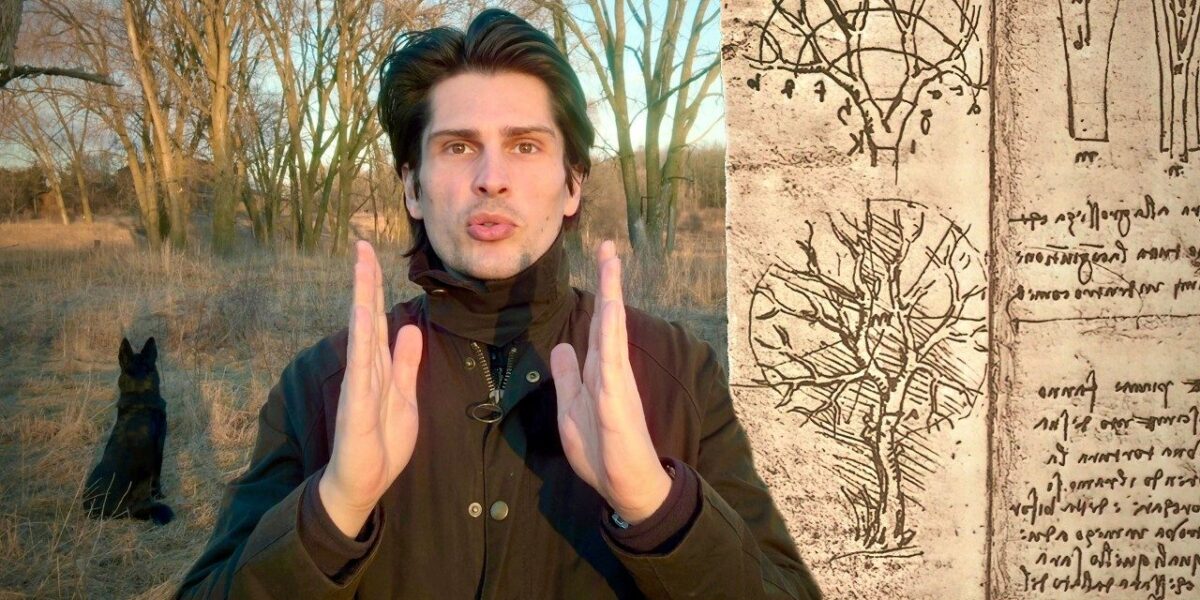
Da Vinci’s most striking, yet understated, discovery, as highlighted by a recent analysis, concerns the structure of trees. He observed a consistent principle: the thickness of the upper half of a tree, when its branches are conceptually merged, is always equal to the thickness of the trunk just below where the branches emerge. This phenomenon, which he noted applies universally to trees, can be verified with a simple walk through any neighborhood. The principle extends to branches as well; as a smaller branch splits off from a larger one, the thickness of the larger branch is reduced by the exact thickness of the new branch. This elegant mathematical proportionality, dubbed ‘Da Vinci’s rule,’ also extends to natural formations like river systems, where the combined thickness of branching rivers equals the thickness of the main river before the split.
The Mind’s Blindness to the Obvious
What makes this observation truly remarkable is not the discovery itself, but the fact that Da Vinci’s mind was free enough to make it. Billions of people encounter trees daily, yet this simple, elegant law of nature remains largely unnoticed. The analysis posits that our minds are often too preoccupied with internal narratives – rehashing past events or worrying about the future – to perceive the present reality around us. We are, in essence, trapped in our own heads, missing the beauty and inherent order of the universe.
“We’re all seeing trees. They’re all around us all the time. And by the way, this phenomenon can be observed on river bodies as well. When the river goes and then it splits apart, those are equal to the thickness right before the river splits apart when you look at it from up top. It’s called Dainci’s rule. Now, how was he free enough in his mind to be so open to to be out in nature and to walk as we all do, I hope, to sometimes just take a walk. But we’re so in our heads. We’re so in our heads that all these things pass us by.”
The Illusion of Conflict
The analysis draws a powerful analogy between our mental state and childhood play-fighting. As children, we engage in pretend battles with swords and pistols, feigning injury and death. The core argument is that as adults, we often forget this is a game. We continue to react to ‘pretend stabs’ – the criticisms, perceived slights, and failures in career or reputation – as if they were real wounds. These are framed as illusions, images that others construct and project, which we then internalize and defend as if they were our true selves.
The argument is that while external actions can affect our physical bodies, reputation, or career, they cannot fundamentally harm our true selves. We are not our jobs, our reputations, or even our physical bodies. Yet, we dedicate our lives to fighting for these illusions, delaying peace and happiness until some external battle is won or some achievement is secured. This perpetual state of ‘pretend fighting,’ where we mistake the illusion for reality, prevents us from experiencing true peace.
Breaking Free from the Illusion
The piece suggests that if we were to recognize that these ‘stabs’ and ‘bullet wounds’ are not real, we would cease to fight. The actions of others – lying, cheating, deceiving – are presented as self-inflicted wounds. A liar becomes a liar, a cheater becomes a cheater, instantly and irrevocably. Such individuals, the analysis contends, can never be at peace because they are engaged in a perpetual internal conflict.
The core message is that peace is incompatible with fighting. If life is perceived as a struggle, it is because we are still engaged in this ‘pretend fighting.’ The analysis challenges the reader to consider what would happen if we laid down our weapons. It suggests that by fully expecting the ‘stabs’ and ‘attacks’ without resistance, we would find that they never truly materialize. The external threat, the ‘person with the sword,’ would cease to exist because the internal fight, the belief in the reality of the illusion, has ended.
A Return to Wonder
By letting go of the fight, we can reclaim the childlike wonder that allows us to notice the world again. The analysis concludes with a delightful correction to a common misconception: squirrels do not hibernate. The nests seen in trees are their homes throughout the winter, a fact often obscured by cultural narratives, like a Spongebob episode. This highlights how our perceptions can be shaped by illusions, and how freeing our minds allows us to see the world as a playground, not a battlefield.
Pain, the analysis acknowledges, is an inevitable part of existence and change. However, suffering, the internal reaction and attachment to pain and illusion, is presented as optional. By recognizing the illusory nature of conflict and releasing the need to fight, one can achieve a state of peace and re-engage with the wonder of the natural world, much like Leonardo da Vinci did.
Why This Matters
This analysis offers a compelling framework for understanding human behavior and the pursuit of happiness. It suggests that much of our distress stems not from external circumstances, but from our internal interpretation and reaction to them. By drawing parallels between Da Vinci’s observational prowess and our own mental blockages, it provides a tangible path toward greater peace and awareness. The concept of ‘pretend fighting’ resonates deeply, offering an explanation for why so many people feel perpetually dissatisfied or at war with themselves and others. Recognizing these illusions is the first step towards liberation, allowing us to engage with life authentically, appreciate the present moment, and find peace amidst the inevitable changes and challenges.
Implications, Trends, and Future Outlook
The ideas presented touch upon several contemporary trends: the growing interest in mindfulness and mental well-being, the philosophical discourse around perception versus reality, and the search for meaning in a complex world. If widely adopted, this perspective could lead to a societal shift away from adversarial approaches and towards greater empathy and understanding. The future outlook suggests a world where individuals are less driven by ego and external validation, and more by inner peace and authentic connection. This could foster more collaborative and compassionate societies, where the focus shifts from ‘winning’ to ‘being.’ The challenge lies in the ingrained nature of conflict and the difficulty of relinquishing the perceived ‘fight’ that has become so familiar.
Historical Context and Background
Leonardo da Vinci lived during the Renaissance, a period of intense intellectual curiosity and a renewed focus on observation and humanism. His relentless pursuit of knowledge across diverse fields – art, science, engineering – exemplifies the era’s spirit. Da Vinci’s approach was characterized by meticulous observation of the natural world, a practice that informed both his art and his inventions. His notebooks are filled with detailed studies of anatomy, botany, geology, and mechanics, showcasing a mind that sought to understand the underlying principles of existence. The ‘Da Vinci’s rule’ regarding tree thickness is a testament to this empirical, observational method, revealing a fundamental geometric principle embedded in nature that had gone unnoticed for centuries. This discovery, though subtle, aligns with the Renaissance belief in an ordered, rational universe discoverable through human intellect and keen observation.
Source: Leonardo Da Vinci's most overlooked discovery (YouTube)

Related Articles

Aligning with Reality: The Antidote to Disappointment
This analysis explores the human tendency to reject reality and its consequences, drawing on philosophical insights to argue for aligning personal will with objective truth as a path to overcoming disappointment and fostering a more meaningful life.

The Paradox of Virtue: Why Pursuing Morals Can Make Us Worse
The pursuit of virtues like honesty and kindness, while noble, can paradoxically lead to judgment and resentment. This analysis explores how adhering to moral codes for external validation or self-improvement can be self-defeating, offering a path towards genuine non-judgment through intrinsic motivation and self-interest.


Beyond the Person: The Enduring Power of Shared Values
This analysis explores the idea that true love is not for the person themselves, but for the enduring virtues and ideas they embody. It suggests that our deepest connections are with universal principles like kindness and honesty, which transcend mortality and offer a path to lasting remembrance.