Cosmic Ocean of Water Found Near Galactic Center
Astronomers have discovered a massive reservoir of water vapor near the Milky Way's supermassive black hole, Sagittarius A*. This unprecedented finding, made with ALMA, challenges our understanding of galactic centers and star formation.


Vast Water Reservoir Discovered Lurking Near Milky Way’s Core
Astronomers have detected an immense reservoir of water vapor swirling in the vast expanse of space just outside the Milky Way’s supermassive black hole, Sagittarius A*. This discovery, made using the Atacama Large Millimeter/submillimeter Array (ALMA) in Chile, reveals a cosmic ocean of water vapor far larger than previously imagined, offering tantalizing clues about the conditions surrounding our galaxy’s heart and the potential for future star formation.
A Universe of Water
The colossal cloud of water vapor is located approximately 3,000 light-years from the galactic center, a region known for its extreme conditions, including intense radiation and gravitational forces. While water is commonly found throughout the universe, this particular discovery is significant due to its sheer scale and proximity to such a dynamic environment. The detected water vapor is estimated to be at least 12 times the mass of Earth’s oceans, a staggering amount that challenges existing models of gas dynamics in galactic centers.
Understanding Wetness: A Human and Insect Perspective
Our perception of ‘wetness’ is a fascinating neurological trick. When we touch water, our skin doesn’t directly sense the liquid; instead, it registers a rapid drop in temperature. Water conducts heat approximately 23 times more efficiently than air. This significant heat loss is interpreted by our brain as the sensation of wetness. This proxy works effectively for humans in everyday situations, ensuring we stay dry enough to avoid hypothermia. However, this sensory mechanism is not universal. For many insects, their survival depends on a more direct detection of moisture. These tiny creatures have evolved specialized microscopic hairs that deform when they come into contact with water. This physical deformation allows them to sense moisture directly, a capability humans lack. This subtle difference highlights how different life forms interact with and perceive their environment on vastly different scales.
ALMA’s Gaze into the Galactic Core
The ALMA observatory, with its unparalleled sensitivity and resolution, was crucial in identifying this distant water vapor. Situated on the Chajnantor Plateau in the Atacama Desert of Chile, ALMA comprises 66 high-precision antennas that work together as a single telescope. Its ability to observe millimeter and submillimeter wavelengths allows it to peer through the dust and gas that obscure the galactic center at other wavelengths. The observations captured specific spectral lines emitted by water molecules, enabling scientists to map the distribution and quantity of this vapor. The data revealed that the water vapor is concentrated in a large, turbulent cloud, likely influenced by the powerful gravitational pull and energetic outflows emanating from Sagittarius A*.
Historical Context: Water Beyond Earth
The discovery of water in space is not new. Since the mid-20th century, astronomers have found water in various forms across the cosmos – in comets, asteroids, planetary atmospheres, and even in interstellar clouds. The first detection of water in interstellar space dates back to the 1940s. More recently, missions like the Herschel Space Observatory (2009-2013) mapped water in star-forming regions, and observations of exoplanets have revealed the presence of water vapor in their atmospheres. However, finding such a massive reservoir of water vapor so close to a supermassive black hole is unprecedented. It suggests that even in the most extreme environments, the building blocks for life, or at least for complex chemistry, can persist and even thrive.
Implications for Star Formation and Beyond
The presence of abundant water vapor in the galactic center has significant implications for our understanding of star formation. Water molecules are crucial in cooling gas clouds, a necessary step for gravitational collapse and the birth of stars. While the intense environment around Sagittarius A* was thought to be hostile to star formation, this discovery suggests that pockets of suitable conditions might exist. The water vapor could play a role in regulating the temperature and density of gas, potentially triggering the formation of new stars within this turbulent region. Furthermore, understanding the distribution and behavior of water in galactic centers can provide insights into the evolution of galaxies themselves and the chemical enrichment of the interstellar medium over cosmic time.
What Comes Next?
Future observations with ALMA and other advanced telescopes will aim to further characterize this water vapor cloud. Scientists hope to determine its precise temperature, density, and chemical composition. They will also investigate its relationship with Sagittarius A* and the surrounding gas and dust. Understanding how this water reservoir formed and how it interacts with the supermassive black hole will be key to unlocking its secrets. This discovery opens a new chapter in the study of galactic centers and underscores the pervasive nature of water throughout the universe, potentially shaping the destiny of galaxies and the possibility of life beyond Earth.
Source: You Can't Feel Wet (YouTube)

Related Articles


Vera C. Rubin Observatory Begins Sky Survey
The Vera C. Rubin Observatory has officially begun its 10-year sky survey, promising to generate millions of astronomical alerts nightly. Meanwhile, new Webb images reveal Uranus in unprecedented detail, and the Artemis program faces timeline adjustments.


JWST Unveils Distant Galaxy’s Surprising Maturity
The James Webb Space Telescope has detected an ancient galaxy, JADES-GS-z13-0, existing just 320 million years after the Big Bang. Its surprising maturity challenges current theories about the rapid formation of early galaxies.

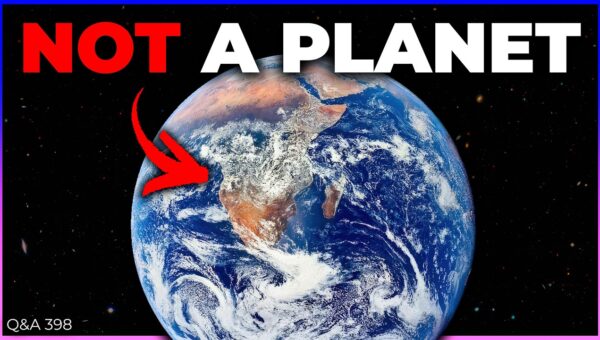
Earth’s Planetary Status Questioned, Figure-8 Orbits Debunked
Exploring Earth's planetary status, the impossibility of figure-8 orbits, the ongoing debate about dark matter's composition, and the future of human spaceflight.