Cosmic Cradle: Unraveling the Universe’s First Moments
Scientists have precisely mapped the first three minutes of the universe's existence, revealing how nuclear reactions forged the lightest elements. This Big Bang Nucleosynthesis provides crucial evidence for the Big Bang theory and the origin of the universe's fundamental building blocks.

Cosmic Cradle: Unraveling the Universe’s First Moments
In the infinitesimal moments after the Big Bang, a cosmic crucible forged the very building blocks of everything we see today. For decades, scientists have meticulously pieced together the story of the universe’s first three minutes, a period of intense heat, rapid expansion, and fundamental particle interactions that dictated the primordial abundances of the lightest elements. This era, known as Big Bang Nucleosynthesis (BBN), is a cornerstone of modern cosmology, providing crucial evidence for the Big Bang theory itself.
The Fiery Genesis
The universe, born in an unimaginably hot and dense state, began to expand and cool. In these initial fleeting moments, the universe was a soup of elementary particles governed by the fundamental forces of nature, primarily the strong and weak nuclear forces. The weak force played a pivotal role in the early universe, mediating interactions between neutrons, protons, neutrinos, and electrons. Initially, these reactions were incredibly rapid, converting neutrons into protons and vice versa. For instance, neutrons could combine with neutrinos to form protons and positrons, while protons could merge with neutrinos to create neutrons and positrons.
A Cosmic Freeze-Out
As the universe expanded, its temperature dropped. At a critical point, the universe cooled sufficiently for these weak force interactions to effectively cease. This moment is often referred to as a ‘freeze-out.’ The ratio of neutrons to protons became fixed, with predictions suggesting a ratio of approximately six protons for every one neutron. This fixed ratio was a crucial precursor for the formation of atomic nuclei.
Forging the First Atoms
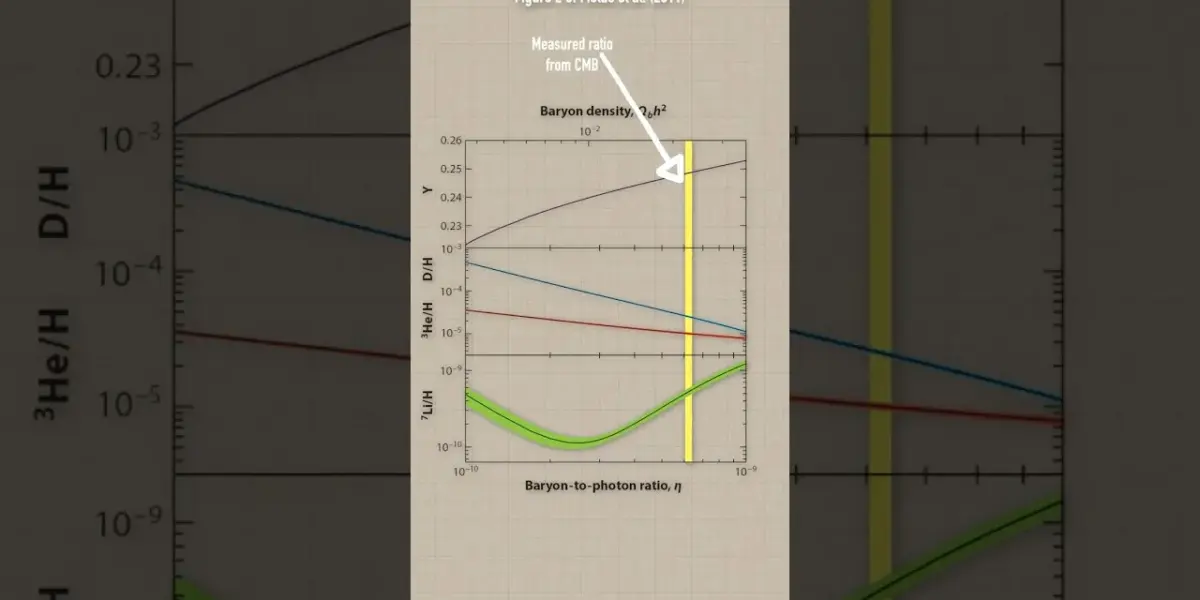
With the universe continuing to expand and cool, the strong nuclear force, which binds protons and neutrons together, began to dominate. This allowed for the fusion of protons and neutrons to form the nuclei of the lightest elements. The process was a delicate dance of nuclear reactions, a cycle of binding particles to form nuclei and then, in some cases, those nuclei decaying. The precise amounts of each element created were critically dependent on the ratio of normal matter to photons (particles of light) in the early universe. The abundance of photons, representing the universe’s radiation energy, influenced the energy available for different nuclear reactions to occur.
The Crucial Ratio: Matter to Light
Determining this matter-to-photon ratio was a significant challenge for cosmologists. It wasn’t until the 2000s that precise measurements became possible, thanks to the study of the Cosmic Microwave Background (CMB). The CMB, a faint afterglow of light from the Big Bang that permeates the entire universe, carries invaluable information about the conditions of the early cosmos. By analyzing the subtle temperature fluctuations in the CMB, scientists could accurately constrain the density of normal matter and the intensity of radiation during the BBN era.
Predicting Primordial Abundances
With the matter-to-photon ratio precisely measured, theoretical models of BBN could yield highly accurate predictions for the primordial abundances of hydrogen, deuterium (a heavy isotope of hydrogen), helium, and lithium. These elements represent the first atomic matter to exist in the universe. The reactions involved in their formation have been extensively studied and recreated in laboratories on Earth, allowing scientists to understand the energy requirements and probabilities of each nuclear pathway.
Historical Context and Observational Evidence
The theoretical framework for Big Bang Nucleosynthesis was developed in the mid-20th century by scientists like George Gamow, Ralph Alpher, and Robert Herman. Their work laid the foundation for understanding how the elements could have been synthesized in the early universe. For decades, the predictions of BBN held true, with observations of the oldest stars and gas clouds in the universe showing abundances of hydrogen, helium, and lithium that closely matched theoretical calculations. These observations have provided some of the most compelling evidence supporting the Big Bang model over alternative cosmological theories.
Looking Ahead: The First Stars and Beyond
The primordial elements forged in the first few minutes of the universe’s existence were the raw materials for the very first stars and galaxies, which began to form a few hundred million years after the Big Bang. The precise composition of these early celestial objects, dictated by BBN, influenced their evolution, the types of supernovae they produced, and the subsequent enrichment of the universe with heavier elements. Understanding BBN is therefore fundamental to understanding the evolution of cosmic structure, the formation of planets, and ultimately, the conditions necessary for life.
Future research continues to refine our understanding of BBN. Missions like the Planck satellite have provided increasingly precise measurements of the CMB, further tightening the constraints on cosmological parameters. Ongoing observational efforts aim to detect even fainter and more distant primordial gas clouds, offering direct glimpses into the composition of the early universe. The story of the first three minutes is far from over; it remains a vibrant frontier in our quest to comprehend our cosmic origins.
Source: The first 3 minutes of the Universe's life (YouTube)

Related Articles


Webb Telescope Unveils Hidden Water Worlds in Distant Galaxy
The James Webb Space Telescope has detected significant amounts of water vapor in a galaxy located 12.5 billion light-years away. This discovery provides crucial insights into the conditions of the early universe and the prevalence of water, a key ingredient for life.


Black Holes: 10 Years of Cosmic Mysteries Unraveled
For ten years, questions about black holes have dominated public curiosity. A new 10-hour compilation reveals fascinating insights into their formation, behavior, and cosmic role, from stellar remnants to galactic centers.


Cosmic Lithium Mystery Puzzles Big Bang Theory
The Big Bang theory, our leading model for the universe's origin, faces a persistent challenge: a significant deficit of lithium. Observations consistently show less lithium than predicted, prompting scientists to explore new physics or stellar destruction mechanisms.