Cosmic Census: How Scientists Count Two Trillion Galaxies
Scientists estimate there are at least two trillion galaxies in the observable universe. This staggering number is derived not by direct counting, but by sampling small regions of the sky, extrapolating based on the universe's age and expansion, and accounting for observational limitations.

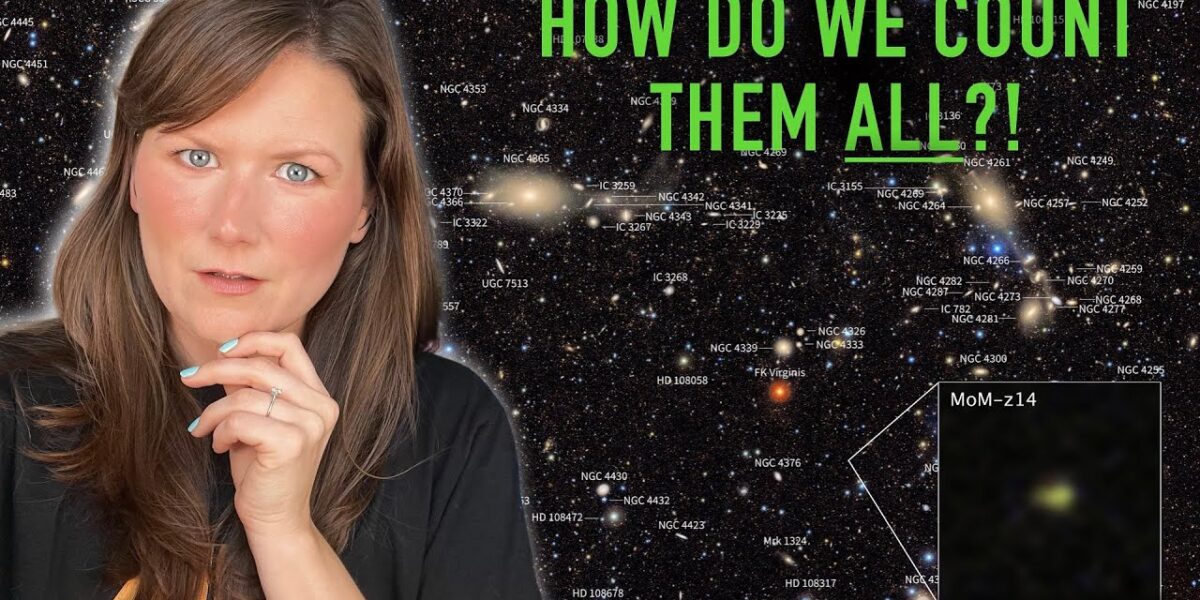
Peering into the Abyss: Unraveling the Universe’s Galactic Count
The cosmos is an unimaginably vast expanse, and within it reside countless galaxies – vast islands of stars, gas, and dust, each a universe unto itself. For decades, astronomers have strived to quantify the sheer scale of this cosmic tapestry. As of early 2026, our most robust estimate suggests there are at least two trillion galaxies within the observable universe. But how can we possibly arrive at such a staggering number when direct counting is an insurmountable task? The answer lies in a combination of ingenious observation, sophisticated extrapolation, and a deep understanding of the universe’s fundamental properties.
The Art of the Cosmic Sample
The fundamental challenge in counting galaxies is the sheer immensity of the universe. It’s simply impossible to visit and tally every single galaxy. Instead, astrophysicists employ a method akin to a census taker sampling a small, representative area of a large city to estimate the total population. In the cosmic context, this means focusing on a tiny, seemingly insignificant patch of the night sky and meticulously counting every galaxy visible within it. This detailed count is then scaled up, assuming that this small sample accurately reflects the distribution of galaxies across the entire sky.
Defining Our Cosmic Horizon
Before we can extrapolate, we must define the boundaries of what we can observe. The ‘observable universe’ is not a physical edge, but rather a limit imposed by the speed of light and the age of the universe. Light from the most distant objects has been traveling towards us for nearly the entire lifespan of the universe. Knowing the universe’s age, which is precisely determined by measuring its expansion rate to be approximately 13.8 billion years, allows us to define a sphere with a radius of 13.8 billion light-years. This sphere encompasses all that we can, in principle, see. However, it’s crucial to remember that this is only the portion of the universe we can currently observe; the universe itself may extend far beyond this boundary.
Navigating the Cosmic Web
A critical assumption in this sampling method is that our chosen patch of sky is truly representative of the universe as a whole. The universe isn’t uniformly sprinkled with galaxies; it’s structured into a vast, intricate network known as the ‘cosmic web.’ This web consists of dense clusters of galaxies, long filaments connecting these clusters, and immense, nearly empty voids. While local variations exist—some areas are packed with galaxies, others are sparse—on the grandest scales, the universe exhibits remarkable homogeneity (roughly the same everywhere) and isotropy (roughly the same in all directions). This means that, on average, any given patch of sky, irrespective of its apparent density, provides a statistically valid cross-section of the universe’s structure. Each observed slice effectively captures a 3D segment, containing both dense regions and voids, which, when averaged over large areas, balance out.
However, practical considerations arise. Our own Milky Way, with its dense disk of stars and interstellar dust, can obscure our view of distant galaxies. Therefore, astronomers often select ‘boring,’ seemingly empty patches of sky that are less affected by foreground contamination from our own galaxy, ensuring a clearer view of the distant universe.
The Challenge of Faintness and Definition
Even with a clear view, accurately counting every galaxy presents further hurdles. The number of galaxies we detect is intrinsically linked to the sensitivity of our telescopes. Brighter galaxies, either because they are closer or intrinsically larger, are easier to spot. Fainter galaxies, which could be small or extremely distant, are much harder to detect. This means any count is a lower limit; there are almost certainly more galaxies out there than we can currently see.
To overcome this, astronomers utilize ‘deep field’ observations. These involve staring at the same patch of sky for extended periods, accumulating light over multiple exposures. This technique allows even the faintest signals to emerge from the background noise, revealing previously unseen galaxies. The advancement in telescope technology directly impacts these counts. Early estimates using instruments like the Hubble Space Telescope yielded numbers around 200 billion galaxies. More recent observations with the James Webb Space Telescope (JWST), with its superior sensitivity and infrared capabilities, have pushed this estimate dramatically higher, leading to the current figure of two trillion.
Adding to the complexity is the very definition of a ‘galaxy.’ There isn’t a universally agreed-upon threshold separating a dense star cluster from a dwarf galaxy. Objects with little visible matter but significant dark matter content also pose a definitional challenge. Furthermore, the dynamic nature of the universe, with galaxies constantly merging under gravity, raises the question of whether a merging system should be counted as one or two entities. Advanced telescopes with higher resolution help astronomers distinguish between truly merging galaxies and those that merely appear to overlap in a 2D projection.
Extrapolation and the Vastness of Two Trillion
Once a count is established from a deep field image, astronomers calculate the fraction of the total sky that the image represents and multiply their galaxy count by this factor. Repeating this process with multiple deep field images refines the estimate and reduces the error margin. The result of these painstaking efforts is the current estimate of at least two trillion galaxies in the observable universe.
To truly grasp this number, consider this: if you could count one galaxy per second, counting two trillion galaxies would take approximately 62,000 years. This mind-boggling figure underscores the sheer scale of our cosmic neighborhood. And even this monumental number is likely an underestimate, as there will always be galaxies beyond our current technological reach or beyond the very edge of our observable universe.
The Road Ahead
The ongoing quest to refine our galactic census continues with every new generation of telescopes and observational techniques. Future missions will undoubtedly probe even deeper into the universe’s past, potentially revealing more faint galaxies and pushing our understanding of cosmic evolution. Each improvement in our ability to observe the universe not only refines our count but also deepens our appreciation for the intricate processes that shaped the cosmos and our place within it. The two-trillion-galaxy estimate is not an endpoint but a milestone, a testament to human curiosity and our relentless drive to comprehend the universe’s grand design.
Source: How do we know there are 2 TRILLION galaxies in the Universe? (YouTube)

Related Articles


Vera C. Rubin Observatory Begins Sky Survey
The Vera C. Rubin Observatory has officially begun its 10-year sky survey, promising to generate millions of astronomical alerts nightly. Meanwhile, new Webb images reveal Uranus in unprecedented detail, and the Artemis program faces timeline adjustments.


JWST Unveils Distant Galaxy’s Surprising Maturity
The James Webb Space Telescope has detected an ancient galaxy, JADES-GS-z13-0, existing just 320 million years after the Big Bang. Its surprising maturity challenges current theories about the rapid formation of early galaxies.


Earth’s Planetary Status Questioned, Figure-8 Orbits Debunked
Exploring Earth's planetary status, the impossibility of figure-8 orbits, the ongoing debate about dark matter's composition, and the future of human spaceflight.