China’s Unrest Grows: Protests Ignite Over Deception and Grievances
Recent weeks have seen a surge in protests across China, fueled by local grievances ranging from land deception to unfair fees. The escalating demonstrations, some featuring direct political challenges to leadership, signal growing public discontent and a potential shift in how citizens voice their anger.

China’s Unrest Grows: Protests Ignite Over Deception and Grievances
Life for ordinary people in China is becoming increasingly difficult. Reports have surfaced of mothers being forced into prostitution to afford baby formula, a heartbreaking situation that highlights deep economic struggles. Meanwhile, state media promotes narratives that seem out of touch with reality, like claiming citizens are happy about rising oil prices due to international conflicts. This disconnect between the government’s portrayal and the people’s lived experiences suggests a growing tension beneath the surface of Chinese society.
This underlying frustration recently erupted into widespread protests across several regions. These demonstrations, triggered by various local grievances, reveal a pattern of official deception and a lack of transparency, leading to public anger and demands for change.
The Crematorium Controversy in Shingi
One of the most dramatic protests occurred in Shingi, Guangdong province. On March 16th, villagers received an official notice about a development project. They believed the land they agreed to give up was for essential infrastructure like roads and bridges. However, they soon discovered the truth: the land was designated for a massive crematorium complex, a $20 million project. The location was alarmingly close to their homes, just 700 meters away, and even closer to local schools—less than 600 meters from a middle school and about 200 meters from a primary school. It was also situated right next to the village’s main water source.
What made this situation particularly egregious was that this project had been rejected in other locations. It was then pushed onto the Shingi villagers without their full knowledge or consent. This deception fueled their anger.
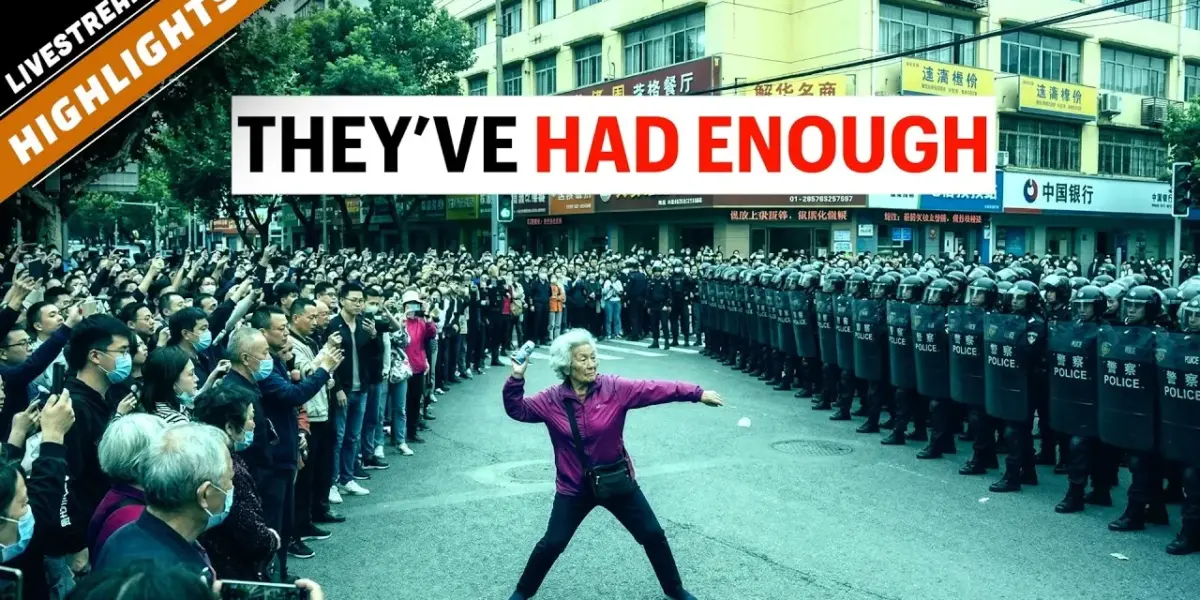
The next day, villagers sought answers from the local committee. By March 19th, hundreds gathered at the Shingi city government building. Riot police were present, and physical confrontations broke out as officers blocked the entrance. During the clash, an elderly woman in a pink shirt, with white hair, became a powerful symbol of resistance. She bravely picked up a stone and threw it at the riot police, an act captured in an image that quickly became iconic, representing the villagers’ defiance.
While a period of quiet followed, the anger simmered. On March 25th, the situation reached a breaking point. According to local reports, dozens, possibly up to a hundred people, were killed or injured. The initial gathering was peaceful, with residents expressing their opposition silently in a park. However, the response from authorities was severe. Buses carrying fully armed special police arrived, and clashes erupted. It was at this point that the crowd realized the seriousness of the situation, and chants of “Down with dictator Xi Jinping” and “Down with the CCP” began.
Following the crackdown, authorities immediately sealed off the area, a common tactic in China to control information and prevent further dissent. Roads were blocked, checkpoints were established, and residents were restricted from leaving or entering the village. Power was cut to nearby villages for extended periods. An intense information crackdown followed, with police visiting homes to force people to delete online posts and comments. Villagers were threatened, and their cooperation was coerced, with officials warning that refusal could impact their children’s futures.
The Shingi incident is significant not only for the heavy-handed response but also for the open political slogans shouted by protesters. They were no longer just demanding their rights; they were identifying the Communist Party and its leader as the source of their problems.
Wuhan Residents Fight Back Against Parking Fees
This Shingi protest was not an isolated event. During the same week, other large-scale demonstrations occurred. In Wuhan, Hubei province, residents of the Zoling Town New Town complex protested a sudden change in parking policy. Since 2014, parking had been free for residents, considered part of their compensation for relocation and included in their monthly property management fees. However, around the new year in 2026, the property management company, without any consultation or vote, announced a new policy charging residents for parking through a third-party operator.
Resentment built, and on March 19th, elderly residents began blocking the entrance to protest the new fees. The resistance spread quickly. By the night of March 24th, hundreds, possibly up to a thousand residents, mobilized. Several men took the lead, breaking down parking gate barriers. The residents then moved through multiple communities, systematically dismantling all the newly erected parking enforcement infrastructure. Within a single night, parking systems in six communities were destroyed, effectively collapsing the enforced fee policy. This was a rare grassroots victory in a large city like Wuhan, showing the power of collective action.
Wuhan saw another protest the following night, March 25th. Residents opposed the construction of a battery manufacturing facility on land designated for a school and civilian use. Concerns about toxic materials and the misuse of land sparked the demonstration.
Other Protests and a Pattern of Suppression
On March 25th in Sichuan province, residents of another complex protested forced parking fees, leading to a confrontation with police. While the outcome remained unclear, the trigger and the pattern were similar to the Wuhan events.
In Inner Mongolia, on the same day, dozens of villagers in Chong City protested unpaid land lease fees owed by a factory. When they demanded their money, they were met with over 200 police officers. One villager’s desperate question, “Are you not ordinary people’s children? Is this the Communist Party?” highlighted the perceived disconnect between the authorities and the people they are meant to serve.
A particularly striking incident occurred on March 26th in Shaanxi province. An 80-year-old woman climbed onto an excavator alone, using her body to protect her family’s land, for which they had not received compensation for land seizure or crop loss. Police quickly handcuffed the elderly woman and removed her by force, an image that spoke volumes without words.
These events—the broken parking barriers in Wuhan, the defiant stone throw in Shingi, the desperate questions in Inner Mongolia, the elderly woman’s arrest in Shaanxi, and the political chants in Shingi—all occurred within a single week. They represent signs of a deep struggle against what many perceive as systemic problems in China.
Why This Matters
The recent wave of protests across China signifies a potential shift in public sentiment and the nature of dissent. Historically, protests in China have often focused on specific local grievances, such as environmental concerns or labor disputes. While these issues remain, the emergence of overt political slogans like “Down with dictator Xi Jinping” in Shingi is a significant development. It indicates that some citizens are moving beyond localized complaints to directly challenge the legitimacy of the ruling party and its leadership.
This escalation suggests that the government’s long-standing strategy of controlling information and suppressing dissent through swift, often brutal, crackdowns may face increasing challenges. The sheer number of simultaneous protests, even if driven by different immediate causes, points to a widespread discontent that the authorities cannot easily dismiss as isolated incidents.
Implications and Future Outlook
The government’s response to these protests, characterized by information blackouts, heavy police presence, and coercive tactics, aims to prevent any form of organized opposition. However, the persistence of protests, even after crackdowns, suggests that the underlying causes—economic hardship, perceived injustice, and official deception—remain unaddressed. The use of social media, despite censorship, also allows grievances to spread and mobilize people, making complete control more difficult.
The future outlook for public dissent in China is complex. While the government possesses immense power to suppress protests, the growing willingness of citizens to voice their discontent, even with political slogans, indicates a potentially more assertive populace. The authorities will likely continue to prioritize stability and control, potentially leading to more stringent surveillance and enforcement measures. However, the underlying economic and social pressures that fuel these protests are unlikely to disappear without significant policy changes that address citizen grievances more directly and transparently.
Historical Context
China has a long history of social unrest, from peasant rebellions to student-led movements. The Tiananmen Square protests of 1989, though brutally suppressed, remain a stark reminder of the potential for large-scale public mobilization. In recent years, localized protests have continued, often related to land seizures, environmental damage, or labor rights. The current wave of protests, however, stands out due to the breadth of issues and, in some cases, the direct political challenges being issued to the highest levels of leadership. The government’s response often involves rapid deployment of security forces, media censorship, and efforts to isolate affected communities, tactics that have been refined over decades to maintain party control.
Source: Protests Are Breaking Out Across China—Here’s What Triggered Them (YouTube)

Related Articles


Taiwan Opposition Leader Seeks China Talks Amid US Tensions
Taiwan's opposition leader, Joong Lee Nguyen, is heading to Beijing for talks with President Xi Jinping, aiming to ease tensions ahead of President Trump's visit. Her approach of engaging directly with China aims to prevent conflict, though it faces skepticism both in Taiwan and regarding U.S. support.


US Faces Growing Pressure Over Arms Sales
The United States is facing mounting international pressure over its global arms sales. The debate pits national security and economic interests against human rights concerns, influencing alliances and regional power balances worldwide.

China’s Shadow Looms: Threats Silence Art in Canada
Bomb threats have led to the cancellation of Shen Yun performances in Toronto, with presenters blaming the Chinese Communist Party. The incidents highlight concerns about foreign interference and the safety of artistic expression in Canada.