China’s Role in Iran Deal Sparks Tariff Threat
China's reported role in brokering an Iran cease-fire has triggered a U.S. threat of 50% tariffs on military suppliers. This move highlights the complex financial ties between the U.S. and China, with millions of American investors potentially exposed. Geopolitical tensions and economic factors are creating significant market uncertainty.

China’s Shifting Stance on Iran Creates Market Uncertainty
Recent reports suggest China played a key role in brokering a cease-fire involving Iran. This development has drawn attention to China’s complex relationship with Iran and its broader impact on global markets. While China appears to be positioning itself as a peacemaker, experts warn that its past support for Iran’s military programs could lead to significant trade repercussions.
U.S. Threatens Tariffs Over Military Support
The United States has issued a stern warning, threatening to impose immediate 50% tariffs on all goods from any country supplying military weapons or components to Iran. This strong stance comes after Iran reportedly used Chinese-supplied weapons, including supersonic anti-ship cruise missiles, against a U.S. aircraft carrier. These weapons contained microchips manufactured in or channeled through China, highlighting Beijing’s indirect involvement.
The White House Press Secretary confirmed that high-level discussions between the U.S. and Chinese governments took place regarding China’s increased involvement in Iran. The New York Times reported that Iranian officials indicated China pressured Iran to accept the cease-fire, aiming to reopen the Strait of Hormuz and reduce regional tensions.
China’s Motivations: Economy and Oil Security
Gordon Chang, a Senior Fellow at the Gatestone Institute, suggests China’s current actions are an attempt to mitigate problems it helped create. He points out that China has supplied Iran with the equipment, materials, and technology for its nuclear weapons program. However, China’s immediate need for peace stems from its reliance on the Strait of Hormuz for at least 45% of its sea-borne imported oil.
Furthermore, China’s deeply trade-dependent economy requires a stable global environment to sell its products. Chang believes China’s foreign policy has shifted from being a troublemaker to a peacemaker due to its fragile economic state. This shift is seen as a strategic move to protect its economic interests during a critical period.
Broader Geopolitical Chessboard
The situation is further complicated by President Trump’s upcoming meeting with Chinese President Xi Jinping. Following actions taken in Venezuela and Iran, the U.S. is seen as having strengthened its negotiating position. China’s historical involvement in Cuba, with listening posts directed at the U.S. and aspirations for a military base, is also a point of concern. Experts suggest President Trump’s strategy involves dismantling China’s proxies, which could weaken Beijing’s influence.
If President Trump is successful in these diplomatic efforts, he may hold a superior position during the talks with Xi Jinping in May. This could lead to a scenario where Xi Jinping appears subordinate in his own capital, a significant geopolitical outcome.
Investor Exposure and Financial System Concerns
A significant concern for investors is the deep entanglement of Chinese companies within the U.S. financial system. Approximately 40 Chinese companies, including major players like China National Petroleum and Sinopec, are reportedly responsible for supporting Iran’s economy. These companies are ironically present in the investment portfolios of major U.S. asset managers, meaning millions of American retail investors are unknowingly helping China underwrite Iran.
Roger Robinson, former Senior Director at the Reagan National Security Council, highlights that Iran has effectively operated as a subsidiary of China. He stresses that the U.S. is in a belligerent situation with China, which is acting indirectly as an enemy combatant. This indirect conflict underscores the need to scrutinize the financial ties between the two nations.
China’s IPO Market and Decoupling Efforts
In the first quarter, China’s IPO market saw a significant increase of 56%, driven by Beijing easing restrictions on equity financing to boost domestic technology innovation. The question remains whether these companies will seek listings in Hong Kong or attempt to go public in the U.S.
Meanwhile, China’s own actions are pushing for financial decoupling. The Chinese Security Regulatory Commission is reportedly not approving offshore offerings, forcing companies to list in Hong Kong or mainland Chinese markets like Shanghai and Beijing. This move by Beijing aims to separate the Chinese and U.S. financial systems.
Market Impact and Investor Considerations
The intricate web of financial ties between the U.S. and China, coupled with geopolitical tensions, presents a complex environment for investors. China’s reliance on secure oil routes and its fragile economy make it sensitive to trade disruptions. The threat of significant U.S. tariffs could directly impact companies with exposure to both the U.S. and Iran, as well as those supplying military components.
Investors should be aware of the potential for increased volatility in markets sensitive to U.S.-China relations and the Middle East. The ongoing debate about removing Chinese companies from U.S. indices and markets adds another layer of complexity. While China’s economy is currently showing signs of growth in its IPO market, its geopolitical actions and the U.S. response create considerable uncertainty. The potential for sudden escalations, as highlighted by the risk of flare-ups in the South and East China Seas, means investors must remain vigilant.
What Investors Should Know
- Geopolitical Risk: Tensions between the U.S. and China, particularly concerning Iran’s military activities, pose a significant geopolitical risk.
- Tariff Threat: The U.S. threat of 50% tariffs on goods from countries supporting Iran’s military could disrupt global supply chains and impact specific sectors.
- Financial Entanglement: Millions of U.S. investors may be indirectly exposed to Iran’s support through Chinese companies listed in their portfolios.
- Market Volatility: Expect potential market swings as these geopolitical and trade issues unfold.
- China’s Economic Fragility: China’s current economic challenges may influence its foreign policy decisions, creating unpredictable market reactions.
Source: ‘FLARE UP OVERNIGHT': Chang warns China tensions could escalate quickly (YouTube)

Related Articles
US Tightens Grip: Iran Strait Blockade Sparks Global Oil Fears
The U.S. is threatening to block Iranian ports, a move that could severely disrupt global oil supplies. This action tests international law and puts major economies like China and India at risk of inflation. The standoff signals a potential shift in global power dynamics.

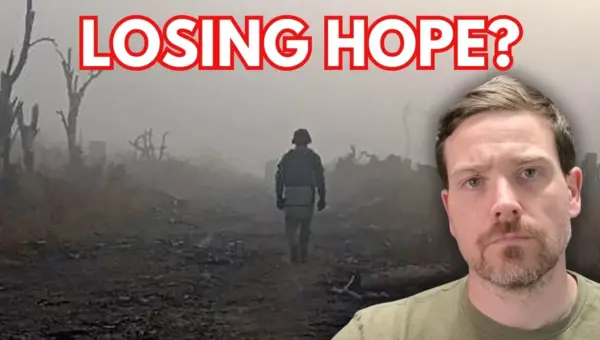
Ukraine’s Drones Expand ‘Kill Zone,’ Rattling Russia
A Russian military blogger's questions about winning the war highlight Ukraine's expanding drone 'kill zone.' This zone, now 40-50 km deep, makes Russian troop movements and supply lines vulnerable. Ukraine's increasing quantity and quality of drones are inflicting heavy losses and shifting battlefield momentum.
US Navy Blockades Strait of Hormuz, Targets Iranian Tolls
The U.S. Navy has initiated a blockade of the Strait of Hormuz, targeting vessels paying Iranian transit tolls. This move aims to cut off Iranian revenue and follows failed diplomatic talks. The action carries significant geopolitical risks, particularly concerning potential Chinese involvement.