Canada’s Gold Medal Power Play: A Slow Burn
Canada's prolonged five-on-three power play in the gold medal game was described as an "excruciatingly slow" and frustrating experience. The team's inability to generate offense during the extended advantage drew comparisons to agonizingly slow waits, ultimately highlighting a missed opportunity in the championship match.


Canada’s Lethargic Power Play Stalls Gold Medal Hopes
In the high-stakes drama of a gold medal game, every second counts. Yet, for the Canadian contingent watching their team navigate a crucial five-on-three power play, time seemed to stretch into an eternity. The agonizingly slow pace of their offensive zone pressure became the unexpected subplot of the championship clash, drawing comparisons to the most mundane of waiting experiences.
The transcript paints a vivid picture of frustration. “Talk about the slowest increments of time,” one observer lamented, drawing parallels to the agonizing wait for a microwave burrito, especially when one is perhaps a bit too relaxed. The analogy quickly escalated: “You’d push the time and it’s like, is it done? It’s probably done.” This sentiment of impatience and the feeling of time standing still was amplified when discussing the on-ice product.
The Microwave Analogy and the Power Play Reality
The idea of staring into the glowing light of a microwave, willing the food to heat up, was invoked to describe the visual of the Canadian team’s power play. “If your microwave is big enough, you got both hands pressed against the wall and you’re just staring into that yellow light of the microwave,” the speaker elaborated, capturing the intensity of the wait. The follow-up, often a disappointing discovery of still-frozen food, mirrored the perceived lack of offensive urgency from the Canadian squad.
However, the comparison to a drunk person waiting for a Hot Pocket was quickly dismissed as the ultimate slow-motion scenario. The true arbiter of glacial time, according to the transcript, was Canada’s extended five-on-three advantage in the gold medal game. “Slowest increment of time is Canada has a 513 in the gold medal game. And you’re like, HOW IS THERE STILL A MINUTE AND 30 left in this god run clock run on reverse?” The sheer duration of the opportunity, coupled with the perceived lack of tangible progress, made it a uniquely torturous viewing experience.
The Four-Minute Penalty: A Fleeting Moment
The context provided highlights a stark contrast. The “4-minute penalty” that led to this extended power play opportunity was, ironically, described as “the fastest thing ever.” This juxtaposition underscores the missed chance. A significant advantage, meant to be capitalized upon swiftly and decisively, instead devolved into a test of endurance for both the players and the spectators.
Implications and Looking Ahead
While the transcript doesn’t provide the final score or the ultimate outcome of the game, it clearly identifies a critical juncture where Canada failed to seize momentum. The inability to convert on such a dominant man-advantage in a gold medal match is a significant talking point and likely a source of deep regret. The “excruciatingly slow” nature of their execution meant that a golden opportunity to change the game’s trajectory slipped through their fingers, a stark reminder that in elite sports, efficiency and urgency are paramount, especially when the stakes are highest.
The experience serves as a painful lesson for the Canadian team. The memory of that prolonged, yet unproductive, five-on-three will undoubtedly linger, fueling a desire to ensure such moments are never again characterized by such a frustrating lack of pace and purpose. The gold medal game is won and lost on such critical possessions, and Canada’s inability to make theirs count will be a bitter pill to swallow.
Source: Canada's 5 on 3 was EXCRUCIATINGLY SLOW 😂 (YouTube)

Related Articles

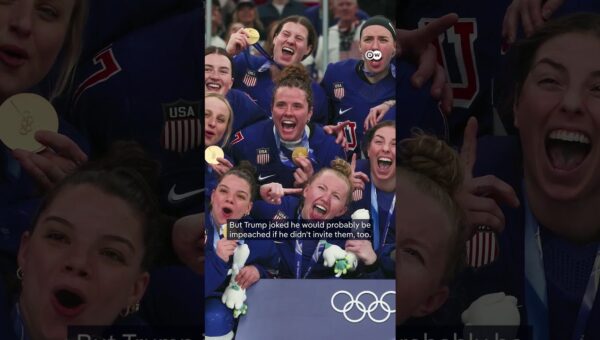
US Men’s Hockey Team Faces Backlash Over Sexist Joke
The U.S. men's ice hockey team is facing widespread criticism after being filmed laughing at a sexist joke made by Donald Trump following their Olympic gold medal win. The team's reaction has drawn accusations of misogyny and sparked debate about gender respect in sports.


Team USA Women’s Hockey Claims Gold!
The U.S. Women's National Hockey Team has claimed a thrilling gold medal, defeating rivals in a spectacular overtime victory. With their third championship, the team solidifies its status as a dominant force in international hockey.


Numbers Don’t Lie: Chiney & Shae’s Bold Claim
Basketball analysts Chiney Ogwumike and Chiney Ogwumike engage in a humorous debate about the reliability of numbers versus human statements. They playfully assert their own accuracy, grounded in statistical truth.