Boost Your AI Visibility: Become a Recognized Brand Entity
Learn how to make your brand visible to AI search engines by becoming a recognized "entity." This guide explains the shift from keyword SEO to defining your brand's unique identity for AI understanding. Discover how to use schema markup and focus on complex topics to ensure your brand is cited and trusted in the AI-driven search landscape.

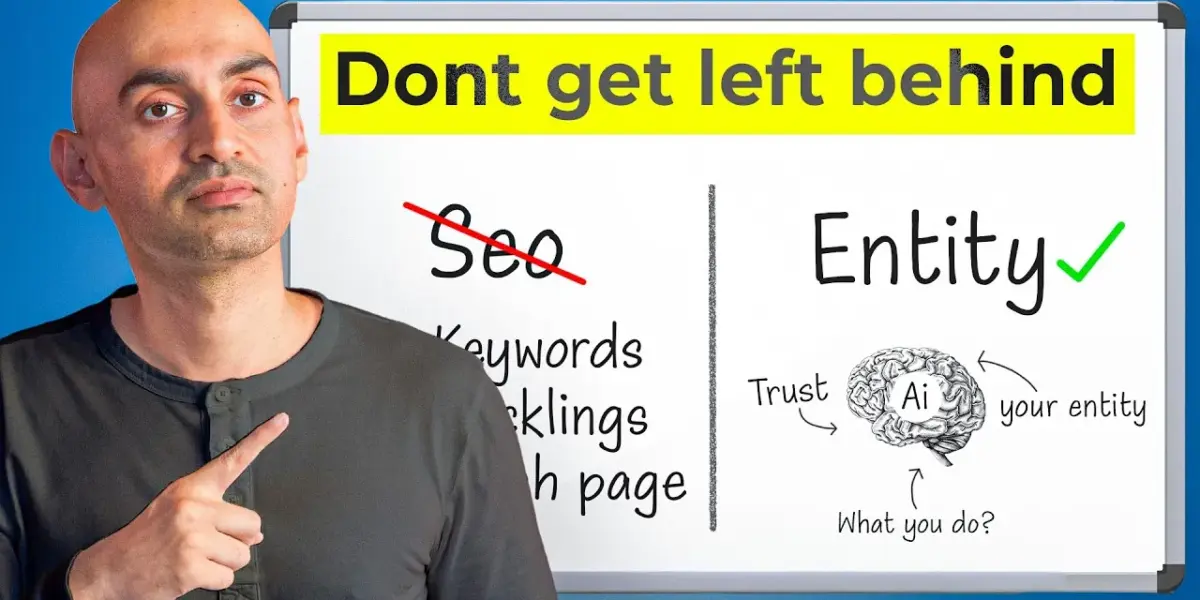
What You’ll Learn
This article will show you how to make your brand stand out to AI search engines. You’ll learn why traditional SEO tactics aren’t enough anymore. We’ll cover how to define your brand as a unique ‘entity’ so AI systems understand and trust you. By the end, you’ll know how to adapt your content and technical setup for the future of search.
The Shift from Keywords to Entities
For years, getting found online meant focusing on keywords, building links, and aiming for high search rankings. This approach worked well when Google acted like a librarian, organizing web pages. However, Google and other AI tools have changed significantly. They are no longer just organizing information; they are building a vast database of real-world things, people, businesses, and concepts. These are called ‘entities’.
Today, when you ask an AI a question, it doesn’t just search for matching keywords. It looks at its knowledge base of entities and facts to find the most relevant answer. Being recognized as a well-defined entity greatly increases the chance that AI systems will mention or cite your brand. If your brand isn’t clearly defined as an entity, it becomes much harder for AI to find you, and this gap is widening quickly.
Understanding the “String-to-Thing” Revolution
In 2012, Google introduced the Knowledge Graph, a database of real-world entities. For a long time, most marketers ignored it because keyword optimization still delivered results. But with the rise of tools like ChatGPT and AI-powered search modes in Google, this entity database has become crucial.
When you search for something like “best CRM,” AI systems don’t just scan web pages. They query Google’s massive entity database, which contains billions of entities and trillions of facts. If your business is listed and clearly defined within this database, you are more likely to be cited. If not, you effectively don’t exist to these AI systems.
What Makes an Entity?
Google defines an entity as something or a concept that is:
- Singular
- Unique
- Well-defined
- Distinguishable
Your content is now judged not just on how many times you use a keyword, but on how clearly it defines the entity it’s about. If Google’s AI cannot identify the specific entity your page represents, AI search tools won’t be able to find you.
Example: The “Services” Page Problem
Consider a page titled “Our Services.” Google might read this and find no clear information about what the business does. It’s just generic marketing language. On the other hand, a competitor might use ‘schema markup,’ which is special code that tells Google exactly what they are. This code might specify: “This is a SaaS company. Product category: project management. Target market: remote teams.” Even with similar content quality, the second business clearly exists as an entity in Google’s eyes, while the first does not.
Action Step: Define Your Entities
Stop thinking about your content as pages that rank for keywords. Start thinking about your content as pages that define specific entities. Every important page on your website should clearly answer:
- What specific ‘thing’ or concept is this page about?
- What category does this entity belong to?
- How does this entity relate to other entities?
If you can’t answer these questions for your content, neither can Google or other AI systems.
Solving the “Disambiguation” Problem
The challenge arises when a single word can refer to multiple different things, or entities. For example, if you search for “Jaguar,” are you looking for the animal, the car brand, or the NFL team? Google has to guess which one you mean.
AI systems use ‘entity context’ to figure this out, not just keyword matching. If you search for “Jaguar animal,” you’ll see results about wildlife. If you search for “Jaguar car,” you’ll see results about vehicles. The context changes everything.
Why Clear Entity Definition Matters
If someone searches for a term in your industry, and Google can’t tell which specific entity your brand represents, it will likely choose a competitor who has made their entity signals clearer. This means even if you have great content and strong backlinks, you can lose out if Google misinterprets what you do.
Example: HVAC Specialist vs. General Contractor
An agency client spent months optimizing for “HVAC services.” They had good content and links, but Google kept classifying them as a general contractor because their website’s underlying code (schema) was incorrect. Once the schema was fixed to explicitly define them as an “HVAC specialist,” their website traffic doubled within 90 days. The content remained the same, but the entity classification changed dramatically.
Action Step: Audit Your Brand’s Entity Perception
Search for your company name online. Do you see a ‘knowledge panel’ (the info box that appears on the side of search results)? Does it accurately describe what your business does? If not, you have an entity problem. Google doesn’t know what you are, which means it can’t show your site for relevant searches.
Creating Your Digital ID Card with Schema Markup
When AI systems scan your website, they look for structured information. A phrase like “We are a leading provider of innovative solutions” gives AI almost no useful data. It doesn’t know if you’re a SaaS company, if you serve businesses or consumers, or what specific products you offer.
Schema markup is structured code that directly tells AI systems what entity you are, using a language machines can understand. Instead of just saying you offer “plumbing services in Chicago,” schema markup can specify:
- Organization type: Local Business
- Service area: Chicago, Illinois
- Services offered: Emergency repair, drain cleaning, water heater installation
- Operating hours: 24/7
Without schema, AI guesses. With schema, AI knows precisely what you offer.
Example: Software Company Entity Shift
In one test, an enterprise client’s website was incorrectly categorized by Google as a generic software company. After implementing product schema with specific details—like “enterprise resource planning software for manufacturing”—Google’s understanding of the entity completely changed. This resulted in a 40% increase in rankings for relevant manufacturing ERP terms within 60 days.
Action Step: Implement Baseline Schema
You should implement at least three basic types of schema markup:
- Organization schema: Defines your company as an entity.
- Product or Service schema: Details what you offer.
- Local Business schema: Use this if you serve a specific geographic area.
Use tools like Google’s Rich Results Test to check how AI interprets your website’s data. If it detects no structured data, your site is effectively invisible to machines.
Building a “Complexity Moat” for AI
If AI can answer a user’s question without needing to cite any sources, you might be competing in the wrong category. Research shows that simple, short search queries (1-3 words) trigger AI overviews less often than longer, more complex queries (6+ words).
Complex queries require more nuance, context, and expertise, which AI often cannot provide on its own. This complexity acts as a “moat,” protecting your visibility. When someone searches for “best CRM,” AI might directly name Salesforce or HubSpot. But if someone searches for “best CRM for enterprise SaaS companies managing distributed sales teams across EMEA with Salesforce integration requirements,” the AI is forced to consult and cite expert sources.
Focus on Niche Expertise
The real value isn’t in answering broad questions; it’s in owning specific, multi-layered topics that AI can’t easily summarize. Brands that chase simple, high-volume keywords get many views but few AI citations. Brands that focus on complex, specific topics get fewer views but significantly more citations and conversions.
Why? Because complex questions signal higher intent. Someone asking a simple question might just be browsing, but someone asking a detailed, complex question is likely in the deep research phase, has a budget, and needs expert information.
Example: Specialized Email Marketing
One client stopped targeting the broad term “email marketing software.” Instead, they focused on a niche: “email deliverability optimized for e-commerce brands sending 1 million plus monthly emails.” While overall traffic decreased by 30%, their revenue increased by 200%. They became the cited expert for a complex, high-intent topic.
Action Step: Audit Your Content for Complexity
Review your content strategy. Stop trying to rank for generic, simple terms that AI can answer directly. Instead, identify the complex, nuanced questions within your industry. Look for topics that require deep expertise, real-world experience, and unique insights. Build comprehensive, authoritative content around these specific subjects.
The “Zero-Click” Endgame and AI Agents
The era of competing solely for clicks is ending. The new competition is about becoming the answer that AI synthesizes and acts upon. AI agents are evolving beyond just searching; they are starting to make decisions and execute tasks.
Soon, users won’t search for “Find me a CRM.” They’ll tell their AI agent, “Research CRM options for my 20-person remote team, compare the top three, and book demos with the best fits.” The AI agent won’t just provide a list of links. It will gather information from its entity database, make a decision, and schedule the meeting. Only one vendor will get that meeting; everyone else will remain invisible.
Data Shows Declining Clicks
Reports indicate that “zero-click” searches (where users get their answer directly on the search results page) are already very common and continue to rise. The percentage of searches that lead to a website click is dropping each year, and this trend is accelerating. Google is willing to reduce website traffic to stay competitive with AI tools like ChatGPT.
New Metrics for Success
Traditional success metrics like traffic and rankings are no longer sufficient. The new benchmarks are:
- Does AI recognize your brand as an entity?
- Does AI understand what you do?
- Does AI trust your brand enough to surface it?
Measure your success by your entity presence: Are you appearing in knowledge panels? Are you being cited in AI overviews? If not, your brand is at risk of becoming irrelevant in the AI-first search era.
Action Step: Measure Entity Presence
When someone asks an AI tool about your industry or category, does your brand appear in the response? If the answer is no, you are not just losing traditional SEO; you are becoming invisible to the future of search. You need to actively architect your brand as a verified identity to exist in the AI-powered future.
Source: You Don't Have an SEO Problem. You Have a "Brand Entity" Problem. (YouTube)

Related Articles


Tell Google Exactly What Your Business Does
Learn how to use schema markup to explicitly tell search engines like Google what your business offers. This guide explains how structured data can improve your website's visibility and search rankings.


How to Make Your Content Visible to AI Search Engines
Learn how to make your content visible to AI search engines by understanding and defining 'entities'. This guide explains why keywords aren't enough and how to structure your content so AI can find and cite it.


Clarify Your Business Entity to Boost Google Rankings
Learn how Google uses 'entity context' to rank websites and how to clarify your business's identity. This guide explains how fixing your website's schema markup can help Google understand your specialty, leading to better search rankings and increased traffic.