Blackwell Fights Back Against Corporate Takeover
In Blackwell, Arkansas, a former warehouse manager turned farmer is leading a community's fight against the encroaching corporate giant Amax. With critical crops to plant and local independence at stake, the town is betting its future on a grassroots agricultural revival.


Blackwell Fights Back Against Corporate Takeover
In a landscape increasingly dominated by monolithic corporations, the small town of Blackwell, Arkansas, is mounting a defiant stand against the encroaching influence of Amax. What began as a personal journey of resilience for a former warehouse manager, now a fledgling farmer, has evolved into a community-wide battle for independence and the soul of rural America.
From Warehouse Floor to Farming Frontier
The narrative of Blackwell’s struggle is deeply personal for its de facto leader, Herd. Years ago, Herd found himself unexpectedly unemployed when his company, a major employer in his hometown, shut down. Faced with financial uncertainty, he sought refuge and a new path on his grandfather’s farm in the Upper Mississippi River Valley. It was there he learned the ropes of agriculture and met key allies, including Justin, but also witnessed firsthand the destructive power of corporate expansion as Amax systematically dismantled local farming operations.
The story took a somber turn when Herd’s grandfather fell ill after moving to Arkansas. Herd followed, taking a soul-crushing job at a local paper mill under a difficult boss. It was this experience that fueled his determination to fulfill his grandfather’s unfulfilled dream: establishing a cooperative. However, his initial attempt in Riverbend Springs, Arkansas, met with resistance from farmers who, fearing Amax’s power, opted to align with the conglomerate. The result was predictable: struggle and hardship for the local farmers, while Amax and complicit politicians reaped the benefits.
A New Hope in Blackwell
Facing a bleak future in Riverbend Springs, Herd saw an opportunity in the neighboring town of Blackwell. Mayor Roy offered Herd and his team a chance to establish their operation the ‘right way,’ with the explicit goal of preventing Amax from engulfing Blackwell as well. This marked the beginning of a crucial fight for the town’s survival.
Cultivating a Future, One Field at a Time
The episode picks up on a damp March morning, as Herd and his team prepare for a pivotal day. The immediate focus is cultivating the town’s central field, a critical step for the upcoming wheat program. ‘If we don’t get that right, nothing else this year is really going to matter,’ Herd emphasizes, underscoring the high stakes involved. This wheat is not just for grain; it’s essential for Blackwell’s poultry farmers, who stand to save thousands of dollars annually if they can re-establish their own wheat supply, a necessity disrupted by Amax’s control over seed distribution.
Beyond the wheat, the team is also preparing fields for oats, destined for Blackwell’s well-established equestrian trade. The operation is a complex ecosystem designed to support the town’s diverse agricultural base and foster local commerce. ‘We’re trying to provide as much as we can so that they are at least set up for next year,’ Herd explains, outlining the long-term vision of creating a self-sufficient local economy.
The Shadow of Amax Looms Large
The specter of Amax is ever-present. The company’s aggressive expansion tactics are a constant concern, mirroring the devastating impact they had on Riverbend Springs. Cal, a local farmer and ally, voices a common sentiment: ‘Every town, they think they have time till they suddenly don’t. Let’s not let it be our town.’ He warns that Amax’s strategy involves a slow, insidious infiltration, starting with friendly overtures and corporate events like the ‘Afest’ in Riverbend Springs, which has replaced traditional farmer gatherings.
‘The Afest as they call it now in Riverbend Springs. What a what a crazy story there,’ Herd reflects. ‘It went from farmers gathering, sharing a meal and sharing ideas… Everybody got smarter and all of that has been replaced by well by Amex and Afest and corporate marketing.’ This stark contrast highlights the loss of genuine community and knowledge sharing under corporate influence.
Herd acknowledges the immense pressure. ‘I know that right now we are running on borrowed time. Right now, we’re trying to get as big a head start as possible so that we’re able to bite them a little bit more. But right now, even I don’t know if we’ll be able to save Blackwell.’ The fight is not just about farming; it’s about preserving the independence and livelihood of the town’s residents.
Claire’s Move: A Symbol of Unity
Adding a layer of inter-community support, Claire’s strawberry business is relocating to Blackwell. Her operation was instrumental in helping Herd’s team survive the previous year. ‘Claire’s strawberry business has done really well, and honestly, if we’re being frank, it really kept us around. It really helped us survive last year,’ Herd states. The move signifies a strengthening of alliances and a collective effort to rebuild and resist external pressures.
The Fight for Independence
The core of the conflict lies in the battle for farmer autonomy. Herd passionately articulates the dangers of Amax’s model: ‘If you don’t give the farmers the ability to look for the best deal, if you don’t give the farmers the ability to go out and make decisions on their own, I mean, you really don’t have a farmer, you have an employee.’ He criticizes Amax’s control over every aspect of a farmer’s operation, from equipment repair and seed purchasing to even adding new animals, effectively turning farmers into indentured servants.
The current season is framed as a make-or-break moment for Blackwell. The success of the wheat and oat crops, the establishment of a local farm store, and the ability to support local farmers are all crucial steps in building a bulwark against Amax. As Herd hooks up the plow to prepare the fields for seeding, the sentiment is clear: this is more than just agriculture; it’s a fight for survival, independence, and the future of their town.
‘It’s not so much the money, although the money is important. It’s more the trust. It’s more the showing somebody that I can do this,’ Herd concludes, reflecting on his own journey from warehouse manager to a leader fighting for his community’s future. The success of Blackwell this year will be a testament to the resilience of farmers and the power of community standing united against overwhelming corporate might.
Source: FIGHT FOR BLACKWELL | THE FARM EP 39 (YouTube)

Related Articles


Nvidia Unveils Vera Rubin: A 10x Leap in AI Compute Power
Nvidia's new Vera Rubin AI compute platform promises a tenfold increase in performance per watt, driven by an "extreme co-design" of six integrated chips. This innovation tackles the growing demands of complex AI models and aims to enhance efficiency and reduce costs for data centers.
Harvest Day: The Farm Finally Delivers!
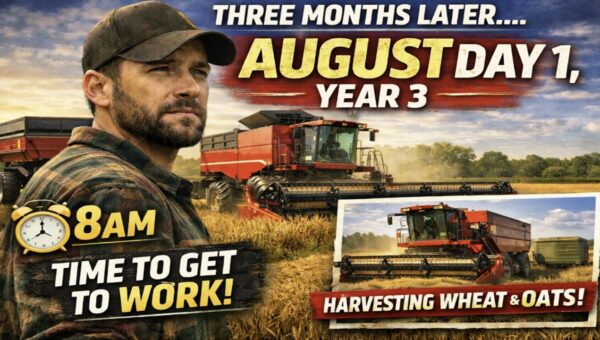
After months of hard work and community support, "The Farm" finally reaps its rewards on Harvest Day. The wheat and oat harvests bring a mix of relief and anticipation, as the venture aims to finally achieve financial stability and support the local community.


Farm Store Opens Amidst Crop Concerns and Wiener Mobile Mania
The grand opening of a new farm store in Blackwell is met with both excitement and significant apprehension. While the store aims to revitalize the local agricultural economy, concerns linger over a troubled wheat crop and the farm's reliance on borrowed equipment. The day took an unexpected turn with the arrival of the Oscar Mayer Wienermobile, drawing crowds and adding a touch of surreal celebration.