BlackRock Ignites ETH ETF Race with Staking Rewards
BlackRock has launched its iShares Ethereum Trust ETF (ETHB), offering investors staking rewards, a move poised to accelerate Ethereum's adoption as a global financial ledger. Meanwhile, the US Senate passed a bill temporarily banning Federal Reserve CBDC issuance, offering a reprieve for private stablecoin issuers.


BlackRock Launches Staked Ethereum ETF, Shaking Up Crypto Landscape
In a significant move for the cryptocurrency market, BlackRock, the world’s largest asset manager, has launched its iShares Ethereum Trust ETF (ETHB), offering investors staking rewards. This development, announced amidst discussions at Davos, positions Ethereum as a central piece in the future of finance and tokenization, according to industry leaders.
Ethereum as the “Global Financial Ledger”
Larry Fink, CEO of BlackRock, has previously highlighted the importance of tokenization, with a notable presentation by his former boss, Larry Frink, likening Ethereum to the “total road to tokenization.” This sentiment is echoed on BlackRock’s own website, where Ethereum is prominently featured, signifying institutional recognition of its potential as a global financial ledger. BlackRock’s iShares division, responsible for nearly 500 US-listed ETFs, is now leading with Ethereum, a strategic decision that has not gone unnoticed in the market.
Staking Rewards: A Game Changer for ETH ETFs
While BlackRock already offers the highly successful iShares Bitcoin Trust (IBIT), its previous Ethereum Trust ETF (ETHA) lacked a key feature: staking rewards. The new ETHB ETF addresses this by passing on 82% of staking rewards to investors, paid out through monthly distributions. The remaining 18% will cover custodial and staking service provider fees. This inclusion of staking rewards is expected to significantly boost the appeal of ETHB.
Jay Jacobs, BlackRock’s US Head of Equity, anticipates a flow of funds from the original ETHA to the new ETHB. While ETHA has accumulated $6.5 billion in assets and boasts a robust options market, Jacobs stated that client outreach indicates a strong investor interest in staking. “We believe that there will be some shift to ETHB,” he noted, underscoring the perceived advantage of the new product.
The Rise of Staked ETH and its Market Impact
Currently, approximately 31% of the total Ethereum supply is staked, meaning this portion is locked and unavailable for immediate sale. Historically, Ethereum’s staking percentage has been lower compared to other major Proof-of-Stake networks like Cardano and Solana. Three years ago, only 16% of Ethereum was staked, whereas Cardano and Solana saw over 70% staked. Analysts suggest that as Ethereum’s staking percentage continues to climb, it could exert upward pressure on ETH’s price, as a larger portion of the supply becomes less liquid.
The trend towards increased staking aligns with the broader institutional adoption of Ethereum. Major banks and financial institutions are reportedly developing Ethereum strategies, recognizing its potential for generating new revenue streams and cutting costs, much like the adoption of Artificial Intelligence (AI). The convergence of AI and Ethereum, described as the “money layer,” is expected to fundamentally reshape how businesses operate, driving innovation, creating jobs, and introducing new products.
Blockchain’s Role in Modernizing Operations
Ethereum’s underlying technology offers tangible benefits such as lower settlement times, reduced reliance on trust assumptions, and the replacement of manual processes with mathematical certainty. These upgrades are crucial for optimizing operational efficiencies within traditional financial institutions, including banks and asset managers.
US Senate Passes CBDC Ban Bill, Offering Regulatory Clarity
In parallel with these market developments, the US Senate has passed a bill that includes a ban on the Federal Reserve issuing a Central Bank Digital Currency (CBDC) until 2030. This means the Fed cannot launch a national stablecoin for at least the next four years. The bill, passed as part of a housing bill, faces an uncertain future in the House of Representatives and potential challenges regarding presidential assent.
The move has been welcomed by proponents of private market innovation in the stablecoin space, such as Circle and Tether. The argument is that allowing the free market to determine the best stablecoin solutions before government intervention is preferable.
Market Snapshot: Bitcoin Holds Strong Amidst Broader Economic Trends
Despite these significant crypto-specific events, Bitcoin has maintained its position around the $70,000 level. Meanwhile, oil prices have seen a resurgence. The article also briefly touches upon investment opportunities in traditional assets like gold and silver, noting promotional offers for zero-fee trading on certain derivatives exchanges.
Emerging Altcoins and Future Predictions
The discussion also briefly touched upon promising altcoins, with a viral clip from the ‘All-In’ podcast highlighting Bit Tensor as a potential “open-source substrate for the AI story.” Predictions suggest Bit Tensor could become a trillion-dollar ecosystem by 2030.
Source: BlackRock CEO is Warning You… (Most Won’t Listen) (YouTube)

Related Articles


Crypto Czar Resigns Amid CLARITY Bill Uncertainty
David Sacks, the U.S. "Crypto Czar," has resigned just before the CLARITY Bill's vote, creating uncertainty in the crypto market. The move raises questions about the future of digital asset regulation and investor confidence. Market volatility is expected as the industry awaits clarity on new rules.


Fannie Mae Embraces Crypto Mortgages, ETH Preps for Quantum Future
Fannie Mae is now accepting crypto-backed mortgages, allowing homeowners to use digital assets like Bitcoin for down payments. Meanwhile, Ethereum is enhancing its security against quantum computing threats, with significant on-chain data showing reduced exchange holdings. X (Twitter) is also expanding into financial services, signaling broader crypto adoption.

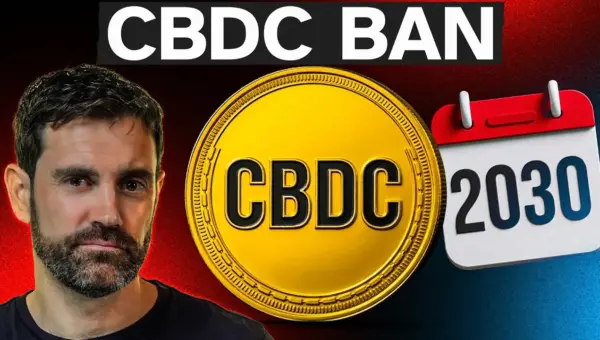
US Senate’s CBDC Ban: A 2030 Time Bomb?
The US Senate's recent vote to ban retail CBDCs appears to be a win for privacy, but a closer look reveals a sunset clause set to expire in 2030. Critics argue this temporary ban is a strategic move to allow private stablecoin infrastructure to develop, potentially paving the way for government-controlled digital dollars by the end of the decade.