Billionaire Crisis Fuels Political Divide, Experts Warn
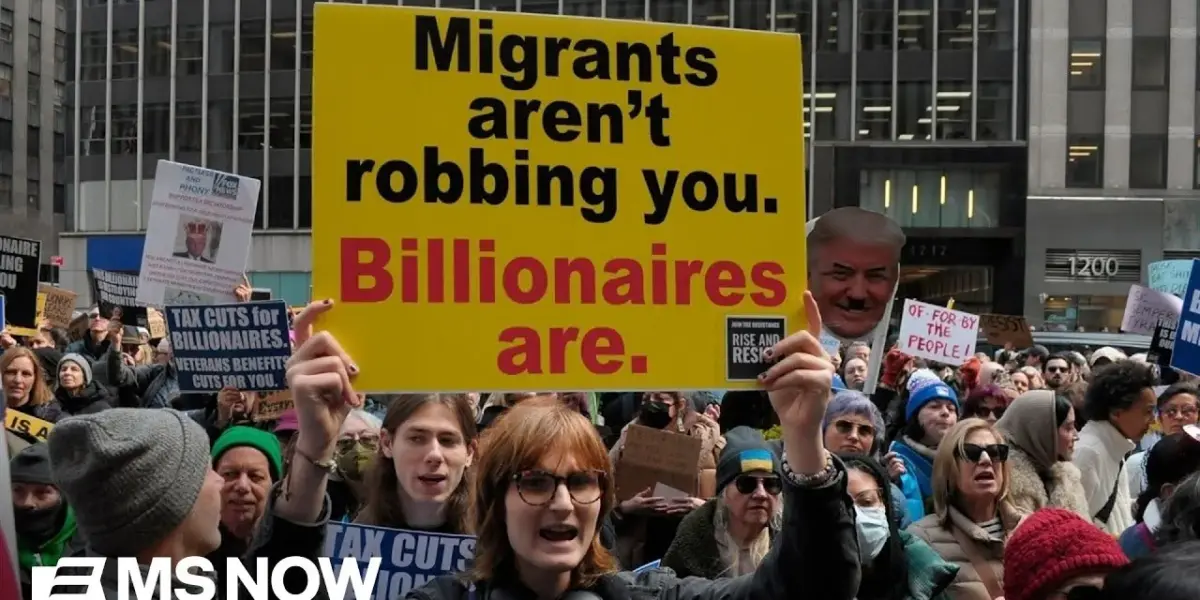
Experts warn of a growing "billionaire crisis" impacting democracy and the economy. Matt Stoller highlights how policies have fueled billionaire wealth while ordinary Americans face hardship, arguing that monopoly power erodes liberty and fuels political authoritarianism.

Billionaire Crisis Fuels Political Divide, Experts Warn
In an era where economic anxieties resonate across the political spectrum, a growing consensus suggests that the concentration of wealth in the hands of a few billionaires is not merely an economic issue, but a profound democratic crisis. Matt Stoller, Director of Research at the American Economic Liberties Project and author of “Goliath: The Hundred-Year War Between Monopoly Power and Democracy,” articulated this growing concern, suggesting that the nation is grappling with a “billionaire crisis” that is increasingly evident to ordinary Americans.
Speaking on a recent broadcast, Stoller highlighted that this sentiment appears to be transcending traditional party lines. “A whole lot of people who validly supported Donald Trump because he said he would make things fairer for them understand what everybody else understands, that nothing has become fairer for the working person in America,” Stoller observed. This observation points to a shared frustration among citizens, regardless of their political affiliation, who perceive a system that increasingly favors the ultra-wealthy at the expense of the working and middle classes.
The Rise of the ‘Billionaire Class’
The sheer proliferation of billionaires in recent decades is a stark indicator of this shift. Stoller noted that in 1980, there were fewer than a handful of billionaires. Today, that number has swelled into the thousands. He clarified that this surge is not a simple consequence of inflation, but rather a result of economic structures and policies intentionally designed to facilitate wealth accumulation at the very top.
“We have structured our economy around creating billionaires, and something like the Trump tax cuts, both versions of it, but also a whole set of policies, regulatory policies, enforcement priorities, facilitates the increase of wealth at the very top.”
Stoller pointed to recent business transactions and policy decisions as evidence. The attempted settlement and de facto pardon of Ticketmaster by the Trump administration, for instance, saw the company’s stock surge and its largest shareholder’s net worth increase significantly. Similarly, the proposed merger between Paramount and Warner Brothers, while expected to result in substantial layoffs and political scandals, is projected to make Warner Brothers CEO David Zaslav a billionaire, with an estimated earning of $500 to $600 million from the transaction.
These examples illustrate a system where the personal financial gains of top executives and major shareholders are amplified, often at the cost of job security and the economic well-being of ordinary workers. “It’s not just that, oh, sad people are becoming wealthy and these policies help increase their wealth. It’s also that our jobs and our welfare is worsening precisely because our wealth is being stolen and appropriated by these extremely wealthy guys and the political leaders who are abetting them,” Stoller stated.
Monopoly as a Democratic Problem
A central theme in Stoller’s work is the redefinition of monopoly, moving beyond a purely economic concept to one with profound democratic implications. He describes a monopoly as essentially a “dictatorship of an industry” – a form of political control exerted within the economic sphere.
The fear and silence that pervade industries dominated by a few powerful players are not merely a matter of financial standing but a fundamental erosion of liberty. Stoller explained:
“If you talk to people in that industry, they are scared of that dominant player. They won’t talk about it because they are frightened. And that’s not just a question of, oh, their bank account shows a certain number of zeros or not. That is a function of their liberty.”
This atmosphere of fear extends beyond the workforce, impacting even those with substantial wealth who are not part of the billionaire elite. The pervasive control exerted by dominant companies in sectors ranging from meatpacking and entertainment to agriculture creates an environment where dissent is stifled, mirroring the rise of authoritarianism in the political arena.
“When you start to see more authoritarianism coming into politics, it’s because people have gotten used to that authoritarianism in their daily life, in their way they work and who they sell to and who they buy from and so on and so forth,” Stoller argued.
The Path Forward: Policy and Affordability
The conversation around economic fairness, Stoller emphasized, cannot be solely framed around affordability. While affordability is a critical concern for many, it is a symptom of deeper systemic issues rooted in policy and the concentration of power. Addressing the “billionaire crisis” requires a fundamental re-evaluation of economic policies, regulatory frameworks, and enforcement priorities.
The path toward greater wealth and stability for working and middle-class Americans lies in confronting the monopolistic structures that stifle competition and concentrate power. This requires a deliberate policy shift aimed at dismantling these concentrations and fostering a more equitable distribution of economic gains.
As the awareness of the “billionaire crisis” grows, the challenge ahead lies in translating this public sentiment into concrete policy changes. The coming years will likely see increased scrutiny of corporate power, regulatory bodies, and the legislative decisions that shape the nation’s economic landscape. The question remains whether political leaders will heed the growing calls for reform and implement policies that prioritize broad-based prosperity over the unchecked accumulation of wealth at the top.
Source: Matt Stoller: ‘We have a billionaire crisis’ (YouTube)

Related Articles

Americans Rally for Democracy Amidst War and Economic Woes
Thousands of Americans are participating in "No Kings" rallies nationwide, demanding accountability from leaders and drawing parallels to historical movements that spurred significant change. The protests occur amidst a controversial war with Iran, economic uncertainty, and a partial government shutdown. Organizers emphasize solidarity, joy, and the power of collective action in defending democracy.


Jane Fonda Warns of ‘Existential Crisis’ Amid Protests
Jane Fonda has issued a stern warning about widespread attacks on the First Amendment, urging Americans to defend their freedoms. The veteran activist highlighted the growing number of large-scale protests as a sign of public concern and a crucial opportunity to address both democratic erosion and the climate crisis.

Mass Protests Erupt as Trump Approval Plummets
Thousands of 'No Kings' rallies are scheduled nationwide, protesting perceived autocratic actions by Donald Trump. As Trump's approval ratings fall, concerns grow over his challenges to democratic norms and the rule of law.