Beyond Bricks: The Cash Flow Secret to Real Estate Riches
Seasoned real estate investors emphasize that true wealth creation stems from consistent cash flow, not just property appreciation. Mastering financial metrics, operational efficiency, and tax strategies are key to success, while avoiding FOMO and building financial reserves is crucial in today's market.

The Unseen Driver of Real Estate Wealth: It’s Not About the Property, It’s About Cash Flow
For decades, the allure of real estate has been its tangible nature: bricks, mortar, and the promise of appreciation. However, seasoned investors understand that the true engine of wealth creation in property isn’t found in the aesthetics of a kitchen or the size of a backyard. Instead, the most critical, yet often overlooked, factor is consistent, predictable cash flow. This fundamental principle, honed over 30 years of managing tens of thousands of units and personal investments ranging from single condos to multi-million dollar syndications, forms the bedrock of sustainable real estate success.
The Pitfalls of Passive Ownership
Many aspiring investors fall into the trap of treating real estate as a passive investment, akin to buying a commodity. The speaker recounts a personal early mistake: purchasing a $105,000 condo in 1995. Despite a 25% down payment and an 8% loan, the investment yielded a meager $50 per month in cash flow, easily wiped out by a single vacancy, HOA fee increase, or repair. This experience underscored a vital lesson: owning a unit within a saturated market, where you compete with numerous other landlords, offers little control and minimal returns. “Scarcity wins and control wins. And most importantly, cash flow wins,” the speaker emphasizes. The takeaway is clear: owning one duplex in a desirable neighborhood, offering greater control and stable income, is far more valuable than a dozen identical condos in a crowded complex.
Rethinking the Investment Strategy: From Buyer to Investor
The core shift required for real estate success is moving from a buyer’s mindset to an investor’s perspective. Buyers are often swayed by aesthetics and immediate appeal. Investors, however, prioritize underlying financial health and operational efficiency. This means scrutinizing factors like property management, market dynamics, and the potential for forced equity – enhancements that increase value beyond market appreciation. The emphasis is on identifying opportunities to improve net operating income (NOI) through strategic rent increases, expense reductions, or adding new revenue streams.
The Power of Forced Equity and Operational Improvements
Real wealth in real estate is often generated not by simply buying low and hoping for appreciation, but by actively improving a property’s performance. The speaker shares an anecdote about acquiring a 158-unit property on a golf course. The previous owner, living out of state, had mismanaged the property, leading to low occupancy. By stepping in, optimizing operations, and renovating units, rents were significantly increased, and the property’s value soared. Another example involved a portfolio of 1,200 units where implementing a Rubs (Ratio Utility Billing System) to bill tenants for utilities recovered an additional $500,000 annually. These are not passive gains; they are the result of strategic intervention and operational expertise, creating “forced equity” and demonstrating how true investors add value.
Understanding Key Investment Metrics
For aspiring investors, grasping fundamental financial concepts is crucial. Key metrics include:
- Net Operating Income (NOI): The total income generated by a property after deducting all operating expenses, but before accounting for debt service and income taxes.
- Capitalization Rate (Cap Rate): A measure of a property’s profitability, calculated by dividing the NOI by the property’s market value. It indicates the potential rate of return on an all-cash purchase.
- Cash-on-Cash Return: This metric measures the annual pre-tax cash flow generated by an investment relative to the total amount of cash invested. It’s particularly useful for leveraged properties.
- Leverage: The use of borrowed money (debt) to finance an investment. While leverage can amplify returns, it also increases risk. Loan-to-Value (LTV) ratio is a key indicator of how much leverage is being used.
Deals that do not perform well based on current numbers, without relying on future rent increases or market appreciation, are often best avoided. “Future potential doesn’t pay the bills,” the speaker stresses.
The Underrated Advantage: Tax Strategies
Beyond cash flow and operational improvements, the wealthy leverage real estate for significant tax advantages. Strategies such as depreciation, bonus depreciation, cost segregation, and 1031 exchanges allow property owners to reduce their taxable income substantially. These are not loopholes for the unscrupulous; they are incentives built into the tax code to encourage real estate investment. Failing to understand and utilize these tax benefits means leaving considerable wealth on the table, making tax planning a critical component of any real estate investment strategy.
Navigating Market Conditions and Avoiding FOMO
In the current market, characterized by higher interest rates and potentially tighter margins, the temptation to make hasty decisions can be strong. Fear of Missing Out (FOMO) is a primary driver of failure, leading investors to skip due diligence, fudge numbers, or fall in love with a property without a solid financial foundation. The advice is to resist this urge. “The right deal is worth waiting for. And let the bad ones go.” Building personal financial reserves – three to six months of living expenses – is paramount before even considering real estate investment. This financial cushion ensures that an investor is not forced into decisions out of desperation and can weather unexpected expenses or income disruptions.
The Indispensable Role of Property Management
Perhaps the most critical operational aspect is property management. It’s far more than just collecting rent. Effective management involves robust systems for maintenance, tenant relations, legal compliance, vendor management, and marketing. A property is only as strong as the team managing it. Poor management can sink even the most promising asset, while exceptional operations can transform underperforming properties into profitable ventures.
Taking Action: The Path Forward
The journey to real estate wealth is not a shortcut but a vehicle that requires skillful operation. The biggest mistake, ironically, is waiting too long – waiting for the perfect market, the perfect partner, or the perfect amount of cash. Procrastination allows others to learn, grow, and win. The call to action is to move beyond passive consumption of information and take concrete steps. This could involve networking with experienced investors, refining deal analysis skills, and making calculated decisions based on sound financial principles, rather than succumbing to fear or the allure of a quick fix.
Source: 30 Years of Real Estate Knowledge in 10 Minutes (YouTube)

Related Articles


Four Rental Properties: Your Path to $3.3M Net Worth
Discover a strategic four-step plan to acquire four rental properties by age 40, potentially building a net worth of $3.3 million and securing a comfortable retirement. Learn how owner-occupied strategies, value-add renovations, and cash flow prioritization can accelerate your wealth-building journey.


Unlock Wealth: The Land Hacking Strategy
The "land hacking" real estate strategy involves acquiring properties with existing homes and significant acreage in desirable areas. This approach aims to maximize income by developing additional rentable units like tiny houses, while leveraging owner-occupied financing for lower down payments.

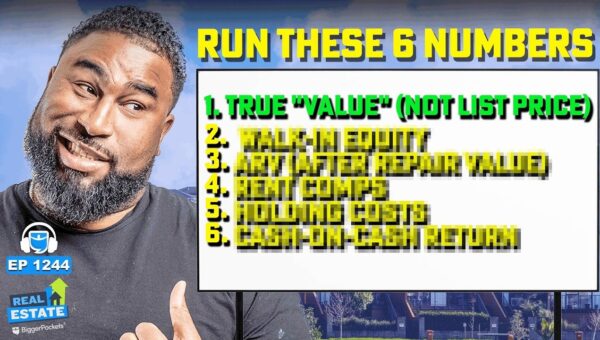
Mastering Investment Property Math: 6 Key Metrics
Savvy real estate investors prioritize data over "vibes." This article breaks down the six essential financial metrics—Current Value, Equity, ARV, Rent Comps, Holding Costs, and Cash Flow/Cash-on-Cash Return—that are crucial for evaluating investment properties and building sustainable wealth.