Astronauts Capture Historic First Views of Moon’s Far Side
NASA astronauts have captured the first human images of the Moon's far side during a record-breaking mission. The Orion spacecraft journeyed farther than Apollo 13, offering breathtaking views and leading to emotional tributes, including naming new craters.


Historic Mission: Humans See Moon’s Far Side for First Time
NASA astronauts aboard the Orion spacecraft have achieved a monumental feat, capturing the first-ever human views of the far side of the Moon. The mission, which has already broken records, sent the crew farther into space than the Apollo 13 mission did in 1970. This historic journey allows humanity to see a part of our celestial neighbor that has remained hidden from direct human observation for billions of years.
Breathtaking Images and New Discoveries
As the Orion spacecraft approached the Moon, the astronauts described the experience as breathtaking. They watched the Moon grow noticeably larger in their windows, taking turns to capture images of preselected targets on the far side. Commander Reid Wiseman noted the taxing nature of looking at the bright Moon, mentioning the many bright, new craters, some quite small. Researchers on the ground eagerly analyzed these images in real-time, identifying features like the Theiss Crater near the Moon’s south pole.
Record-Breaking Journey and a Message from the Past
The mission’s journey itself is a record-breaker. The Orion spacecraft has traveled farther into space than any previous human mission, surpassing the distance achieved by Apollo 13. In a touching moment, Mission Control played a prerecorded message from the late Apollo 13 commander, Jim Lovell. Lovell welcomed the crew to his “old neighborhood” and challenged the current and future generations to continue pushing the boundaries of space exploration, ensuring that this record would not stand for long.
Emotional Tributes and Crater Naming
The mission took on a deeply personal and emotional tone when the four crew members proposed naming two newly identified craters. One crater was named ‘Integrity,’ honoring the spacecraft itself. The other was named in memory of Commander Wiseman’s late wife, Carol, who passed away from cancer. Wiseman, visibly emotional, blew kisses to his daughters, Katie and Ellie, as the crew shared this poignant tribute. The shared experience of witnessing such a unique view of the Moon clearly resonated deeply with everyone involved.
Understanding the Moon’s Orbit
For roughly 4.5 billion years, Earth has only ever seen one face of the Moon. This phenomenon occurs because the Moon is tidally locked with Earth. Think of it like a dancer circling their partner, always keeping the same side facing them. This means that while we always see the same craters and features from Earth, there is a vast, unexplored terrain on the far side that is completely hidden from our view. The mission provided the first direct human look at this mysterious region.
Navigating the ‘Dark Side’ and Returning Home
During their journey, the astronauts experienced a planned loss of radio contact for about 40 minutes as they passed behind the Moon. This period of silence is a natural consequence of the Moon’s position blocking direct communication with Earth. Upon emerging from behind the Moon, communications were quickly restored, with video and radio checks confirming their return. The crew is now on their way back, preparing to leave the Moon’s gravitational pull and be drawn back towards Earth. The mission is expected to conclude with a splashdown, marking a successful return after their groundbreaking voyage.
Looking Ahead: The Future of Lunar Exploration
This mission marks a significant step forward in human space exploration, opening a new chapter in our understanding of the Moon. The images and data collected will undoubtedly fuel further scientific research. As the Orion spacecraft heads home, the success of this journey is sure to inspire future missions, potentially paving the way for longer-term lunar bases and even more ambitious journeys into deep space. The challenge issued by Jim Lovell echoes, urging humanity to continue reaching for the stars.
Source: Historic mission over far side of the moon (YouTube)

Related Articles


Moon Mission Sparks New Space Race Era
The Artemis II mission's return from the Moon marks a new era in space exploration, potentially sparking a modern space race. The mission provided new scientific data and breathtaking views, while also highlighting the inherent risks of deep space travel. This renewed focus on lunar exploration has significant geopolitical and economic implications for global powers.
Astronauts’ Silent Treatment Exposes Trump’s Space Rift
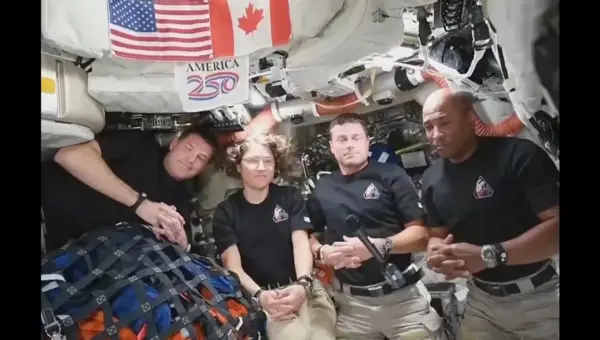
An awkward call between Donald Trump and the Artemis 2 astronauts, marked by prolonged silence from the crew, highlights a perceived disconnect in values and leadership. The incident contrasts with past presidential interactions and raises questions about Trump's stance on space exploration versus his proposed budget cuts.

Artemis II Crew Makes History, Sees Far Side of Moon
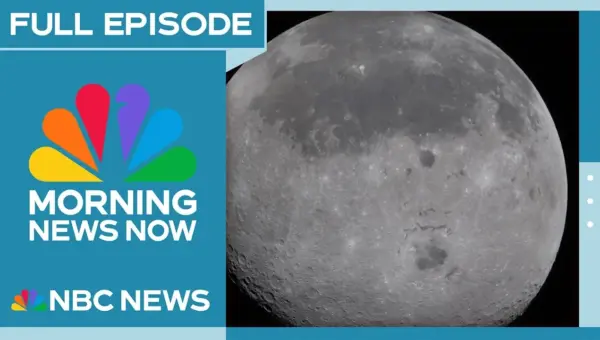
The Artemis II mission crew has made history by becoming the first humans to see the far side of the Moon with remarkable clarity. As they journey home, their mission has provided unprecedented views and scientific data. Meanwhile, escalating tensions in the Middle East and political developments in North Korea are also making headlines.