Astronaut Spots Cosmic Flip: The Tennis Racket Mystery
A Soviet cosmonaut's accidental discovery of a spinning wing nut revealed the bizarre Janabbeckov effect. This phenomenon, also known as the tennis racket theorem, explains why some spinning objects inexplicably flip, a quirk now understood through physics.

Astronaut Spots Cosmic Flip: The Tennis Racket Mystery
In the silent expanse of space, a cosmonaut witnessed a peculiar wobble that baffled scientists for years. This strange behavior, now known as the Janabbeckov effect, reveals a hidden quirk in how spinning objects move. It’s a phenomenon that sounds like a magic trick but is rooted in solid physics, and it all started with a simple wing nut aboard a Soviet space station.
A Space Station Rescue and a Spinning Surprise
The year was 1985. Cosmonaut Vladimir Janabbeckov was on a critical mission to save the Soviet space station Salyut 7, which had gone dark and unresponsive. After successfully bringing the station back to life, he began unpacking supplies. Among them was a common wing nut, used to secure bolts.
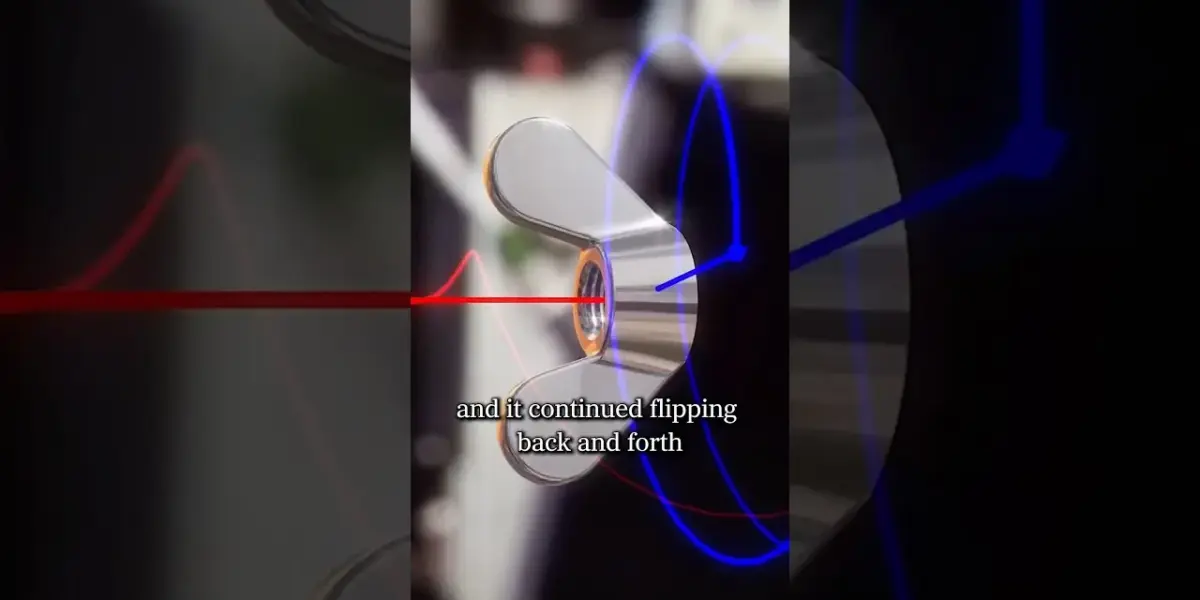
As Janabbeckov spun the wing nut off a bolt, something unexpected happened. Instead of spinning smoothly, the wing nut seemed to pause, flip 180 degrees, and then flip back again a few seconds later. This bizarre, repeating flip caught his eye. He watched it flip back and forth at regular intervals.
This counterintuitive motion was so strange that the Soviet Union kept it a secret for a decade. It defied simple expectations of how spinning objects should behave. Imagine trying to explain why a spinning top might suddenly wobble and flip itself over for no apparent reason.
The Tennis Racket Theorem Emerges
Six years later, in 1991, the scientific world began to catch up. A paper titled “The Twisting Tennis Racket” was published in the journal *Dynamics and Differential Equations*. This paper explored a similar behavior, though it didn’t mention Janabbeckov’s secret discovery.
The paper explained that if you hold a tennis racket and flip it through the air, it does more than just spin the way you expect. It also makes an unintended half-turn around an axis that runs through its handle. So, the side of the racket that was facing you when you threw it will be facing away when you catch it. This is the same kind of flip Janabbeckov observed.
Why Does This Happen? The Intermediate Axis Mystery
This peculiar behavior is formally known as the intermediate axis theorem, or sometimes the tennis racket theorem. It describes what happens when an object spins around three different axes, or imaginary lines passing through its center.
Think about spinning a book. You can spin it easily around an axis going through its pages, like a record player. You can also spin it around an axis going from the front cover to the back cover. Both of these spins are stable.
However, there’s a third way to spin the book: around an axis that goes through the middle of its covers, from top to bottom. This is called the intermediate axis. Trying to spin an object perfectly around this middle axis is incredibly difficult.
When an object is spinning around this intermediate axis, even the slightest disturbance or imperfection will cause it to wobble. This wobble makes it flip. Imagine trying to balance a pencil perfectly on its tip; even a tiny nudge will make it fall over. The intermediate axis spin is like that, but with a flip instead of a fall.
The math behind this involves complex equations describing how objects move through space. For objects with three different moments of inertia (which are like measures of how mass is spread out), spinning around the intermediate axis is unstable. The object will naturally try to shift to a more stable spin, often resulting in a 180-degree flip.
From Space to Sports Fields
The Janabbeckov effect has implications far beyond just wing nuts and tennis rackets. It affects how we understand the rotation of planets, stars, and even spacecraft. For instance, engineers designing satellites must account for this effect to ensure they maintain their correct orientation in orbit.
Understanding this phenomenon helps us predict and control the movement of objects in space. It’s crucial for launching rockets, maneuvering satellites, and exploring distant planets. Even the way a thrown ball or a spinning frisbee moves can be partly explained by these principles.
What’s Next?
The Janabbeckov effect, once a closely guarded secret, is now a fundamental concept in physics. Scientists continue to explore its nuances, using it to refine our understanding of celestial mechanics and advanced engineering.
This discovery reminds us that even in the familiar act of spinning something, there can be hidden complexities. It highlights how space exploration can lead to unexpected scientific insights, revealing the universe’s subtle and sometimes surprising rules.
Source: The Bizarre Behaviour Of Rotating Bodies (YouTube)

Related Articles


Artemis IV: Humans to Land on Moon First Time Since 1972
Humans are set to return to the Moon with the Artemis IV mission, marking the first lunar landing since 1972. Goonhilly Earth Station is a key player, supporting crucial test flights and future endeavors. The program emphasizes technological advancement and the growing role of private companies in space exploration.


Artemis II Blasts Off, Igniting New Space Race Era
NASA's Artemis II mission has successfully launched, sending a four-person crew on a historic journey around the Moon. The mission marks a significant step towards lunar exploration and potential Mars missions. Meanwhile, global markets react to escalating tensions with Iran, and a new, more convenient weight loss pill gains FDA approval.


Artemis II Launches: Humanity’s Next Lunar Leap Begins
The Artemis II mission has successfully launched, marking humanity's return to lunar exploration after over 50 years. Meanwhile, President Trump addressed the nation on the Iran conflict, vowing to continue strikes while claiming objectives are nearing completion. Elsewhere, a new weight loss pill was approved, and severe storms threaten the Midwest.