Artemis II Splashdown: A Triumph of Human Ingenuity
The Artemis II mission successfully returned to Earth, marking a major milestone in lunar exploration. The Orion capsule splashed down safely after a nearly 10-day journey. This achievement highlights advanced technology, historical parallels with Apollo, and the human element of spaceflight.


Artemis II Splashdown: A Triumph of Human Ingenuity
The successful return of the Artemis II mission marks a significant moment in humanity’s ongoing journey of space exploration. After a journey of nearly 10 days and covering over 694,000 miles, the Orion capsule, named Integrity, splashed down in the Pacific Ocean on April 10th. This event, watched globally, underscored the incredible precision, advanced technology, and dedicated teamwork required to send humans to the Moon and bring them back safely.
A Journey Back to Earth
The final moments of the Artemis II mission were a display of calculated risk and meticulous planning. As the capsule re-entered Earth’s atmosphere, it experienced a planned communications blackout. Mission control, a hub of intense focus, re-established contact with Commander Reid Wiseman and his crew. The trajectory was confirmed as nominal, and recovery teams had visual guidance, a crucial step in ensuring a safe landing.
The descent involved a series of precisely timed parachute deployments. First, drogue chutes slowed the capsule, followed by three main parachutes that further reduced its speed. This staged approach is vital to manage the immense forces involved. The capsule’s heat shield, designed to withstand extreme temperatures, performed as expected, protecting the astronauts inside. The entire process, from atmospheric entry to splashdown, was a testament to years of testing and validation.
Lessons from History, Innovations for the Future
The return of Artemis II echoes the historic Apollo missions, particularly Apollo 8 in 1968. In a nod to that past, the astronauts aboard Integrity read from the Book of Genesis, reflecting the profound, existential nature of space travel. While the mission’s shape and basic physics of re-entry remain similar to the Apollo capsules, the technology has advanced dramatically. Modern computers, improved communication systems, and enhanced tracking capabilities allow for greater precision and safety.
Former NASA astronauts Dr. Tom Mashburn, Dr. Linda Godwin, and Dr. Steve Holly provided expert commentary during the event. They highlighted the complexity of the mission, emphasizing that even what appears routine requires an immense amount of planning and flawless execution. Dr. Godwin noted the significance of the crew’s prior long-duration spaceflight experience, a difference from the Apollo era where astronauts often undertook these missions as their first major spaceflights.
The Human Element of Space Exploration
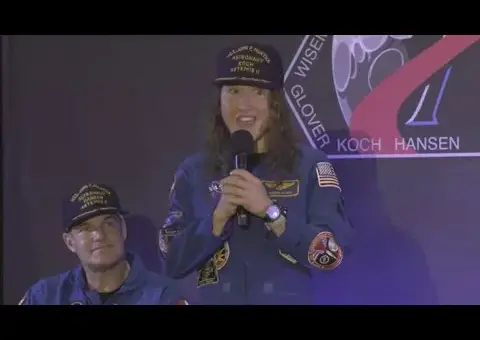
Beyond the technology, the human aspect of space exploration was a central theme. The astronauts aboard Integrity, including the first woman to orbit the Moon, Christina Koch, represent progress and inspiration. The dedication of the NASA team, some of whom, like Johnson Space Center Director Vanessa Wyche, have worked on the Orion project for over two decades, is equally remarkable.
The return to Earth is not just a technical achievement but also a profound human experience. The astronauts face physiological challenges upon re-entry. After spending days in zero gravity, their bodies must readjust to Earth’s pull. This can lead to feelings of heaviness, potential unsteadiness, and the need for careful movement. NASA has developed rehydration protocols and recovery procedures to help astronauts manage this transition safely.
Recovery and Reintegration
The recovery process itself is a complex operation involving Navy assets and specialized teams. Challenges such as establishing clear communication between the recovery crew and the capsule, and ensuring the environment around the capsule is safe for approach, are meticulously managed. These procedures, honed over years of training, are critical for the astronauts’ well-being.
Once safely recovered, the astronauts undergo immediate medical checks. They are then transported for more thorough evaluations. The process of readapting to Earth’s gravity can take time, ranging from a few days for basic motor functions to several months for full physical recovery, especially for those who have experienced long-duration missions. This return marks not just the end of a mission but the beginning of a new phase of reintegration and debriefing, crucial for future space endeavors.
Global Impact
The Artemis II mission’s success serves as a powerful reminder of human potential and the drive to explore. It inspires future generations to pursue careers in science, technology, engineering, and mathematics (STEM). Such endeavors foster international cooperation and demonstrate what can be achieved when nations work together towards a common, ambitious goal. The exploration of space continues to capture the global imagination, pushing the boundaries of what is possible and offering new perspectives on our place in the universe.
Source: Cuomo special edition: Artemis II returns to Earth| CUOMO Full Episode 4/10 (YouTube)

Related Articles

US Aims for Lunar Dominance with New Artemis Missions
NASA's Artemis program is charting a course for the Moon with upcoming missions III, IV, and V. These missions aim to test new lunar landers, return humans to the surface for the first time since 1972, and establish a foundation for sustained exploration.


NASA’s Artemis Program Takes Giant Leap Forward
NASA's Artemis II crew has successfully returned from a historic lunar mission, marking a significant step forward for the Artemis program. Future missions, including Artemis III, IV, and V, aim to establish a permanent Moon base and pave the way for Mars exploration.


US Shows Power in Space and Hostile Rescue
The United States recently demonstrated its dual capabilities through a daring military rescue of a downed airman in Iran and a significant space mission around the moon. These events highlight American technological prowess, military strength, and commitment to its personnel, while also reflecting on shared values and the unity of humanity.