Artemis II Nears Earth: NASA Prepares for Crew Splashdown
NASA's Artemis II mission is nearing its end as the crew prepares for splashdown. Officials detailed the return trajectory, parachute sequence, and recovery operations. The mission has yielded crucial scientific data and tested hardware for future lunar endeavors.


Artemis II Crew Returns to Earth After Lunar Journey
NASA’s Artemis II mission is nearing its conclusion as the four-person crew prepares to splash down safely on Earth after their historic journey around the Moon. Officials at NASA’s Johnson Space Center in Houston provided an update on the mission’s final days, focusing on the intricate preparations for the crew’s return and the valuable data being gathered.
Mission Progress and Scientific Returns
Flight Day 8 marked a significant transition for the Artemis II mission, shifting focus from lunar science to the critical task of bringing the crew home. “The mission continues to go well as the crew prepares to transition back to Earth and we get ready for entry day,” stated Lachea Hawkins, deputy for Artemis. While the primary goal of this development flight is to test systems for future missions, the crew has successfully conducted science activities, gathered stunning imagery, and provided crucial data.
Among the highlights shared were a group photo of the crew, showing them in high spirits, and a breathtaking image of the Milky Way taken from space, free from atmospheric interference. Beyond these visual mementos, the mission is yielding vital scientific insights. Experiments such as the immune avatar and immune biomarkers experiment are helping scientists understand how the deep space environment affects astronauts’ health. This data is essential for longer stays on the Moon and future missions to Mars, providing human health information not collected during the Apollo era or in low-Earth orbit.
Hardware Performance and Future Missions
The Artemis II mission is also serving as a critical testbed for hardware intended for future Artemis missions, including Artemis III. The Space Launch System (SLS) rocket performed exceptionally well, described as “flawless,” with engineers already analyzing its performance data for potential refinements. Similarly, the Orion spacecraft’s systems are operating nominally. Data from manual piloting demonstrations, including proximity operations, are vital for ensuring the ability to dock with human landers on upcoming missions.
Lessons learned are being addressed, such as adjustments to water valve operations and service module pressure control. Insights from suit demonstrations are also informing future emergency procedures. While some planned tests, like a radiation shielding demonstration, were adjusted to optimize cabin transition time for entry, the core objectives of learning and risk reduction for future missions are being met. “We’ve retired a significant number of risks over recent days,” Hawkins noted, emphasizing the team’s continued focus on mission success.
Entry, Descent, and Landing Preparations
Rick Henling, entry flight director, detailed the meticulous plan for the crew’s return. The process involves a series of critical maneuvers, beginning with the separation of the crew module from the service module approximately 20 minutes before entry interface. A final “crew module raise burn” is planned to fine-tune the flight path angle before the spacecraft enters Earth’s atmosphere. The spacecraft will then perform roll maneuvers to ensure separation between the crew module and the service module, which will undergo a destructive entry.
As the Orion capsule reaches an altitude of 400,000 feet, the crew will “go visors down,” entering a sealed environment within their launch and entry suits. The entry interface, occurring about 1,950 miles from the landing site, initiates a period of “blackout” lasting about six minutes due to plasma buildup around the spacecraft. Following blackout, at an altitude of 150,000 feet, the parachute sequence will begin. Two drogue parachutes will deploy at 22,000 feet, slowing the capsule to around 200 mph, followed by three main parachutes deployed at 6,000 feet, reducing the speed to a final splashdown velocity of approximately 20 mph in the Pacific Ocean.
Recovery Operations at Sea
The recovery effort is spearheaded by a joint NASA and U.S. military team aboard the USS John P. Murtha. Lily Via Real, the Artemis landing and recovery director, explained the post-splashdown procedures. Divers will approach the capsule once the area is deemed safe, then assist the crew in exiting Orion onto an inflatable raft known as the “front porch.” The capsule will then be towed away, and the astronauts will be airlifted by Navy helicopters to the recovery ship for immediate medical checks.
The entire recovery process, from splashdown to the crew reaching the medical bay, is expected to take less than two hours. The Orion capsule will then be recovered onto the ship. The crew is anticipated to fly off the ship back to shore within 12 to 24 hours after splashdown. “We feel confident that through our testing and training alongside the Navy and other collaborators, we will make Artemis 2 just as successful,” Via Real stated, referencing the successful recovery of the uncrewed Artemis I capsule.
Addressing Contingencies and Future Outlook
NASA officials addressed potential contingencies, including off-nominal landing trajectories that could result in higher G-forces, up to seven to seven and a half Gs, compared to the nominal 3.9 Gs. They also clarified that skipping parts of the radiation shielding demonstration does not mean a loss of critical data, as the most important aspect—airflow to a sheltered astronaut—can still be tested. The mission’s success, despite being a test flight, is paving the way for future lunar exploration and eventual human missions to Mars.
The Artemis II mission, while not setting a speed record for re-entry, is providing invaluable data and experience. As the crew heads home, NASA remains focused on ensuring a safe and successful splashdown, learning from every step to achieve its ultimate goals of establishing a sustainable presence on the Moon and sending humans to Mars.
Source: NASA gives update on Artemis II splashdown preps (YouTube)

Related Articles


NASA’s Artemis II Mission Blasts Off for Moon Flyby
NASA's Artemis II mission is launching, sending four astronauts on a historic journey around the Moon. This mission marks humanity's first crewed deep-space voyage in over 50 years and is a crucial step in NASA's plan to establish a lunar presence and eventually travel to Mars. The launch signifies a renewed era of lunar exploration amid a global space race.


Artemis II Astronauts Share Moon Journey; NYC Machete Attack; Iran Peace Talks
Astronauts from the Artemis II mission shared their experiences after returning from their historic journey around the moon. Meanwhile, New York City is investigating a shocking machete attack on a subway platform. High-stakes peace talks are also underway between U.S. and Iranian officials aimed at ending a major regional conflict.

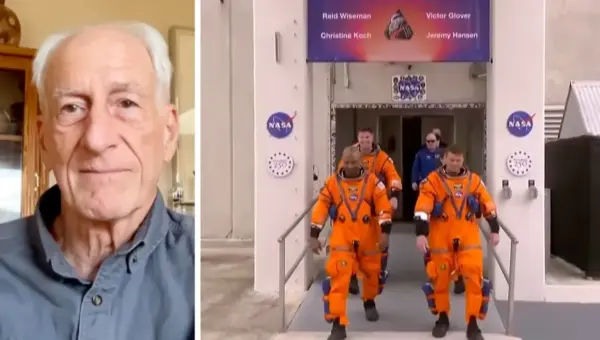
Astronaut Warns: Moon Return Dangers Threaten NASA’s Future
Former astronaut Jeffrey A. Hoffman highlights the extreme dangers of the Artemis II reentry. This critical phase is vital for NASA's future plans to return humans to the Moon and beyond.